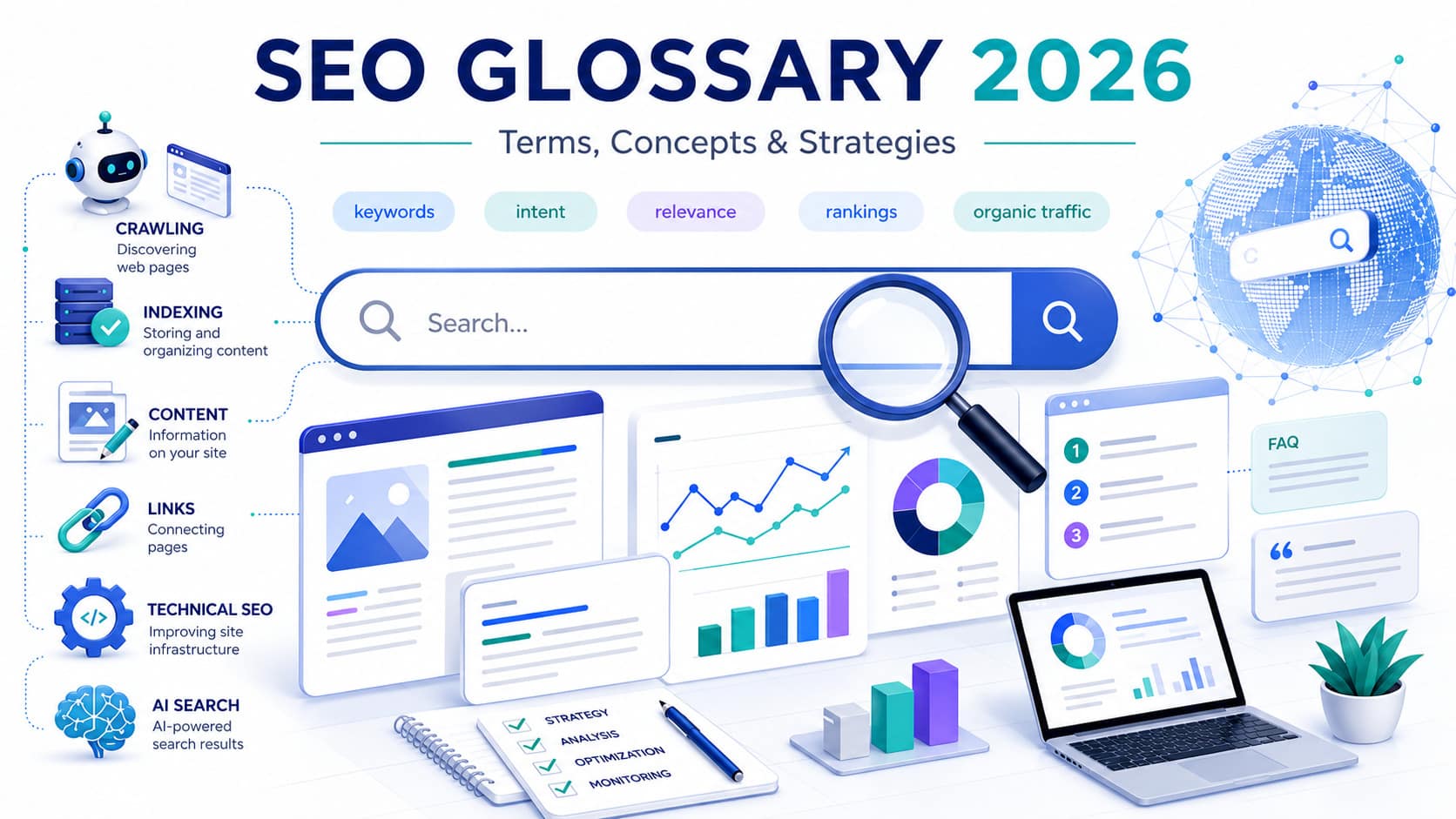
SEO has its own language, but you do not need to be a specialist to understand what is happening with your website. This SEO glossary gives you short definitions of the terms that appear most often in proposals, audits, reports, and conversations with agencies.
Use this page as a quick reference. When a topic needs a practical explanation, the definition points to a complete guide. If you need planning and implementation rather than definitions alone, see our SEO services.
Google describes Search as three broad stages: crawling, indexing, and serving results. That distinction matters because a page that does not appear can have a different problem at each stage. Source: Google Search Central on how Search works.
For the broader business explanation, start with our guide to what SEO is and how it works.
SEO stands for search engine optimization. It includes improvements to a website and its content that help search engines understand the pages and help people find and choose them in search results.
Organic results are the listings a search engine orders through its ranking systems rather than paid ads. A strong organic position cannot be purchased directly from Google.
A SERP is the page you see after a search. It may include standard listings, ads, maps, images, videos, direct answers, and AI-generated responses.
A search query is the wording a person actually types or speaks. One page can appear for many closely related queries even when every phrase is not written word for word in the copy.
A keyword is a phrase used to research and plan a page. It is a working reference, not wording that should be repeated mechanically throughout the content.
Search intent is the goal behind a query, such as learning, comparing options, finding a specific website, or making a purchase. Our search intent guide explains how to choose between an article, category, product page, and service page.
Ranking is the order in which results appear for a particular query, location, language, device, and moment. A website does not have one universal, permanent position.
Visibility describes how often and how prominently a website appears for searches that matter to the business. It is broader than the position of one keyword.
On-page SEO covers improvements made to the page itself, including its title, main copy, headings, images, links, and fit with the visitor's need. See the full on-page SEO guide.
Technical SEO addresses search access, indexing, redirects, speed, mobile delivery, and other technical conditions. The goal is to let important pages be found, understood, and used without avoidable barriers.
Off-page SEO covers signals beyond your own website, including links, mentions, and brand recognition. The role of links is explained in our link building guide.
If an important page is missing from Google, follow a crawling and indexing diagnosis instead of changing the copy at random.
Crawling is the process in which a search engine's automated program visits a URL and retrieves its content. A crawled page is not necessarily indexed.
Indexing is the processing and storage of information about a page in a search engine's index. Even a technically accessible page is not guaranteed to be included.
Googlebot is the general name for the programs Google uses to crawl pages and resources on the web. Server failures, security controls, robots.txt rules, and login requirements can affect its access.
Rendering is the stage in which a search engine processes HTML, CSS, and JavaScript to see the final page. If important copy appears only after an interaction or a JavaScript failure, use the JavaScript SEO guide to investigate.
An index is the large collection of processed page information used by a search engine. Search results are drawn from that index rather than from a new crawl of the entire web for every query.
An XML sitemap is a machine-readable list of URLs a website considers important. It can help discovery, but it does not guarantee crawling, indexing, or rankings.
Robots.txt is a file that gives automated crawlers access rules for parts of a website. It controls crawling, but it is not a reliable method for removing an already known page from search results.
Noindex is a directive that asks search engines not to include a page in results. The crawler must be able to access the page to see it. The differences among this directive, robots.txt, and canonical are covered in our dedicated guide.
A canonical signal identifies the preferred version of duplicate or very similar pages. Search engines consider other signals too and may select a different URL.
Crawl budget is the approximate number of pages a search engine can and wants to crawl during a period. It mainly matters for very large or rapidly changing websites, not as a universal explanation for every missing page.
An orphan page has no link from other normally accessible pages on the same website. It may appear in a sitemap, but it remains difficult for visitors and search engines to discover through the site.
Practical choices for moved, removed, and failing pages are covered in our HTTP status code guide.
A URL is the exact web address of a page or file. Changing it can break accumulated links and visits unless the old address is handled correctly.
A slug is the final descriptive part of a URL, such as seo-glossary in this page's address. Short, clear wording helps people recognize the topic.
An HTTP status code is the server's concise response to a request for a URL. It indicates whether the content was delivered, moved, removed, or affected by a temporary problem.
A 200 status normally means the request succeeded and content was returned. By itself, it does not prove that the page is useful, indexable, or indexed.
A 301 is a permanent redirect from an old URL to a new one. Use it when a page has moved permanently and there is a genuinely close replacement.
A 302 is a temporary redirect. It is appropriate when the original URL should remain the primary address and the change is genuinely temporary.
A 404 means the requested content was not found. It is normal for a permanently removed page with no suitable replacement, but it is a problem when the URL is supposed to work.
A 410 states more explicitly that content has been removed. For most websites, a correctly returned 404 is also sufficient.
5xx responses are server-side failures. When they recur, visitors and search engines cannot retrieve the content reliably.
A redirect chain sends a request through several redirects before reaching the final URL. It slows access and adds failure points, so links should generally point directly to the final destination.
The SEO title is the content of the HTML title element and often forms the clickable heading in Google. It should be clear, specific, and accurate, although Google may display different wording.
A meta description is a short summary stored in the page code. A search engine may use it below the result title, but it can select a more relevant excerpt from the page instead.
The H1 is the main visible heading of a page. It should clearly identify the topic without trying to contain every possible keyword.
H2 and H3 headings divide content into logical sections. They help readers find an answer and show how major topics and supporting points relate to each other.
Anchor text is the visible, clickable wording of a link. Useful anchor text tells a person what to expect after clicking instead of relying on vague wording such as "here."
An internal link connects two pages on the same website. It helps visitors continue to a related topic and helps search engines understand relationships among pages.
A breadcrumb shows the sequence of sections or pages that leads to the visitor's current location. Search engines may also use it to present a clearer path instead of the raw URL.
Image alt text describes an image when it cannot be seen. Its primary purpose is accessibility, so it should communicate meaning rather than hold a list of keywords.
Duplicate content is identical or very similar material available at different URLs. It is not automatically a violation, but it can complicate the choice of a primary version and divide signals across unnecessary pages.
Thin content does not provide a sufficiently useful, original answer for its purpose. Word count alone is not a reliable test of whether a page is thin.
Helpful content is created first for a real reader need, with a clear purpose, reliable information, and enough context. Google recommends a people-first approach in its guidance on helpful, reliable content.
E-E-A-T summarizes experience, expertise, authoritativeness, and trustworthiness. It is a quality-evaluation framework in Google's guidelines, not one technical setting or a single measurable score.
Topical authority is a website's ability to cover the important questions in a subject through clear, connected pages. Our topical authority guide explains why that does not require a separate page for every imaginable phrase.
A topic cluster is a group of pages that address different tasks within a larger subject and connect to one another meaningfully. Each page should still have a distinct role.
Keyword cannibalization occurs when several pages compete for the same task and make the preferred answer unclear. Two results from one site do not prove a problem by themselves. See the SEO cannibalization guide.
Content freshness means reviewing and updating information when the topic changes. Changing a date without making a meaningful revision does not make the page more useful.
A backlink is a link from another website to one of your pages. It can help people discover the content and may signal its importance, but its value depends on the source and context.
A referring domain is a separate website that provides one or more backlinks. Many links from one domain do not equal the same number of independent recommendations.
PageRank is part of Google's systems for evaluating links among pages. The old public toolbar score is no longer a reliable measure of modern SEO performance.
Nofollow is a link attribute publishers use when they do not want a link treated as a standard endorsement. Google treats it as a hint rather than an absolute crawling restriction.
Sponsored is the link attribute intended for paid, advertising, or sponsored relationships. It clearly distinguishes a commercial link from a normal editorial reference.
UGC is the link attribute for user-generated links, such as links in forums or comments. It helps a publisher identify content the publisher did not create directly.
Link spam includes practices intended to manipulate rankings through links, such as buying links or conducting large-scale exchanges for that purpose. Google lists official examples in its spam policies.
Disavow is a tool for asking Google not to count specified external links. Google says most websites do not need it, and incorrect use can harm performance.
Core Web Vitals are metrics for real-world loading performance, responsiveness, and visual stability. They are part of the broader page experience, not a replacement for useful content. See our Core Web Vitals guide and Google's official explanation.
Largest Contentful Paint measures how quickly the largest visible element appears in the initial viewport. It is often a hero image, a large heading, or a substantial text block.
Interaction to Next Paint measures how quickly a page provides visual feedback after user interactions across a visit. Long delays can make buttons, menus, and forms feel unresponsive.
Cumulative Layout Shift measures unexpected movement of page elements while the page loads. A typical problem is a button moving just before a visitor clicks it.
Time to First Byte measures how long it takes to receive the first data from the server. Hosting, application processing, network conditions, and caching can all affect it.
Caching stores prepared data so it does not need to be generated again for every visit. Correct settings can improve speed, while stale caches may temporarily show an earlier version.
A content delivery network distributes files through servers closer to visitors. It can reduce latency, especially for an international audience.
Lazy loading delays images or other resources until they are close to the visible area. Poor implementation can delay the main image or prevent important content from appearing when needed.
Mobile-first indexing means Google primarily uses the mobile version of content for indexing and evaluation. Important copy and links should not disappear on smaller screens.
Structured data is a standardized format for describing content to machines, such as a product, organization, article, or breadcrumb. It must match the visible information. Source: Google Search Central on structured data.
Schema.org is a shared vocabulary of types and properties for structured data. The presence of a type in that vocabulary does not automatically mean Google uses it for a special search feature.
JSON-LD is a format for adding structured data in a separate code block. Google recommends it in many cases because it can be easier to maintain when implemented correctly.
A rich result is a search result with an enhanced presentation that may be supported by structured data. Valid markup creates eligibility, but it does not guarantee display.
Local SEO improves visibility for searches connected to a place or service area. It combines the website, business profile, company details, reviews, and local relevance. See our Local SEO service.
Google Business Profile lets an organization manage details such as its name, category, address, hours, phone number, photos, and posts across Google. Practical steps are in our Google Business Profile and Maps guide.
The Local Pack is the group of map-based local results that appears for relevant searches. Its ordering is not the same as the order of standard organic results.
NAP stands for an organization's name, address, and phone number. Consistent details reduce confusion for customers and platforms.
A local citation is a mention of an organization's details in a directory, map service, publication, or other source. It may include a link, but a link is not required.
In an online store, a category page groups similar products and helps customers narrow their choices. It often serves a broader search need than an individual product page.
A product page presents one specific product with its price, availability, options, images, and terms. The information should be clear to the customer and consistent with submitted product data.
Faceted navigation consists of filters that create combinations by color, size, brand, price, or other attributes. It helps customers, but it can generate many unnecessary URLs if not managed carefully.
Product schema is structured data for a product's price, availability, and other properties. Our Product schema and Merchant Center guide explains how to keep it aligned with the visible page and product feed.
Google Merchant Center is a platform for submitting and managing product data for Google services. Mismatches among the feed, product page, and structured data can cause warnings or disapprovals.
Google Search Console is Google's free service for monitoring search visibility, indexing, technical signals, and selected enhancements. Our Google Search Console guide explains how to read its reports without jumping to conclusions.
Google Analytics 4 measures visits and actions on a website or app. It answers different questions from Search Console, so the two systems' numbers should not be expected to match exactly.
Search Console records an impression when a result from the website is shown under the report's rules. It does not necessarily mean the person noticed the result.
A click is an action that takes a person from a Google result to the website. Repeated clicks and different result types are counted according to the rules of the specific report.
Click-through rate is the share of impressions that produce clicks. Position, result type, intent, title, description, and other SERP features can all influence it.
Average position is the mean highest position of a website result across the reported impressions. It is not a permanent ranking and should be reviewed by query, page, country, and device.
A conversion is an action valuable to the business, such as an inquiry, purchase, registration, or phone call. Organic traffic alone does not demonstrate business value when those actions are not measured correctly.
An SEO audit is a structured analysis of technical health, content, pages, and off-site signals. Its output should be a verifiable list of issues, priorities, and specific corrections. See our technical SEO audit service.
A crawler is a program that visits website URLs like an automated visitor and collects technical data. Its findings depend on configuration, access, and server restrictions.
Log file analysis reviews records of real requests received by the server. It can show which URLs specific automated programs requested and which responses they received.
AI Overviews are summaries Google generates for some searches and supports with links to sources. They do not require a separate special markup beyond the normal requirements for appearing in Search. Source: Google on AI features and websites.
AI Mode is Google's experience for conversational and follow-up questions, which may gather information from multiple sources. Participation still depends on accessible, indexed, useful content.
Answer engine optimization is work intended to make information clear and usable for systems that provide direct answers. In practice, it calls for precise statements, sufficient context, sound structure, and verifiable sources.
Generative engine optimization is a term used for work on visibility in answers produced by generative systems. It does not replace technical access, quality, recognition, or clear content. See our GEO and AEO guide.
A large language model is trained to process and generate language. It can summarize information, but it is not a database of guaranteed accurate and current facts.
A citation in an AI answer is a link or label that identifies a source for part of the response. Whether it appears and which source is selected depend on the platform, query, and available material.
Keyword stuffing is the unnatural repetition of words intended to influence rankings. It makes content worse for readers and may fall under spam practices.
Hidden text is copy made invisible to visitors but left for a search engine with manipulative intent. Accessible content revealed through a normal interaction is a different case.
Cloaking shows materially different content to a search engine and to a visitor in order to deceive. The practice violates Google's spam policies.
A doorway page is created mainly to rank for a closely related query and send the visitor to another destination without providing independent value. Producing many such pages is risky.
Automatically generated content is produced through an automated process. The tool itself is not the issue; the risk is large-scale creation intended to manipulate rankings without accuracy, usefulness, or editorial accountability.
A definition can help you ask the right question, but it does not prove the cause of a specific traffic decline, missing page, or technical error. Reaching a decision requires website data, reporting evidence, and the server's real responses.
If you want these concepts turned into an ordered plan and implementation for your website, review our SEO services. If you only need an independent diagnosis of a specific issue, start with an SEO audit.