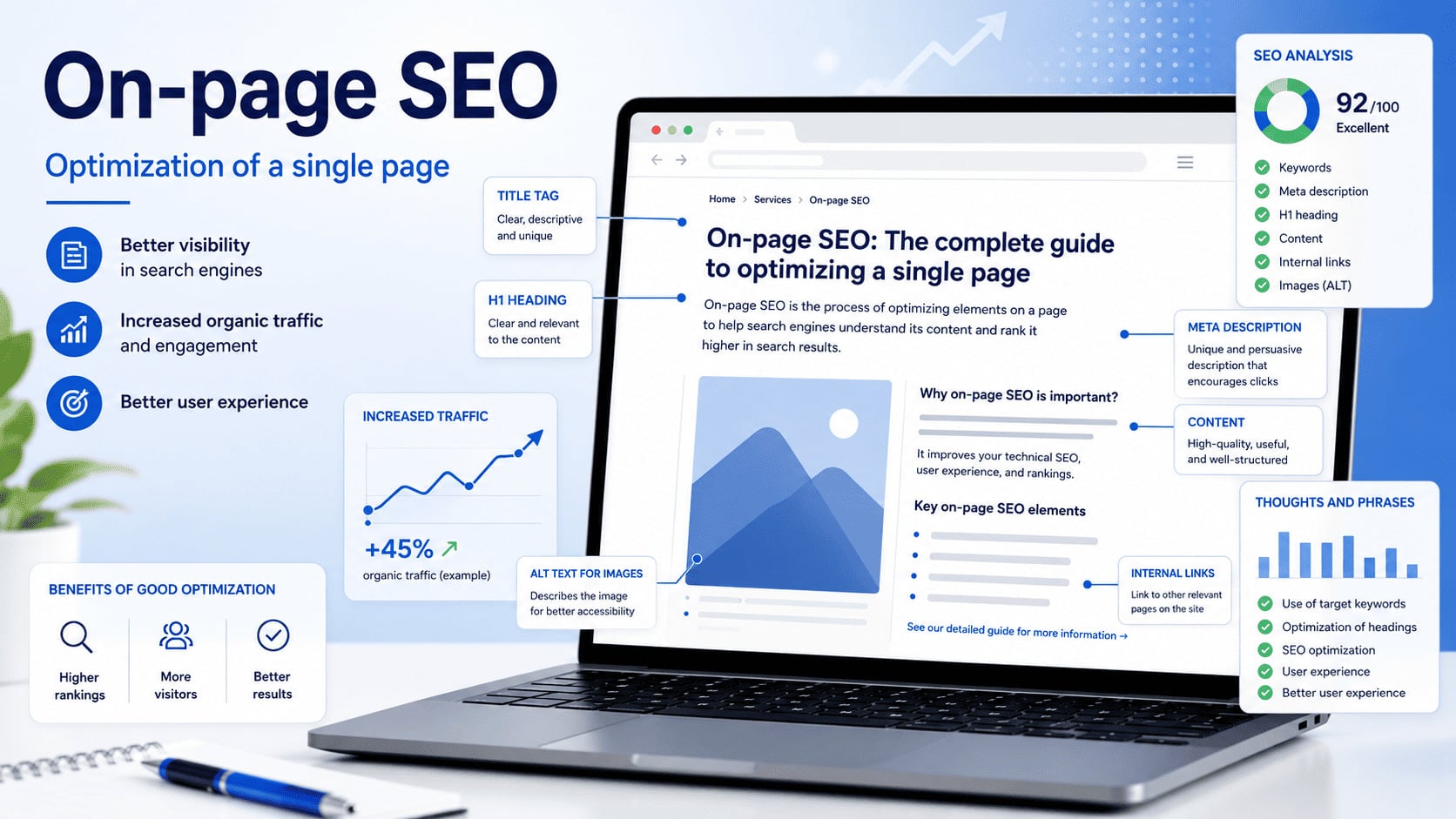
On-page SEO is the process of improving the content, organization, and HTML elements of a specific web page so it satisfies the user's search intent and communicates its purpose clearly to Google and other search systems.
It includes the page's primary purpose, main content, title tag, visible headings, meta description, internal links, images, structured data, and page-level usability.
This guide focuses on optimizing one page. It does not replace site-wide information architecture, technical crawling and indexing diagnostics, keyword-to-URL assignment, market research, or external authority work. Those disciplines belong within a complete SEO optimization program.
On-page SEO is the work performed within a specific page to make that page more useful, understandable, and relevant for a defined search need.
A well-optimized page should:
On-page SEO is not a formula for placing one keyword in a fixed number of locations. It begins with understanding what the page must accomplish and ends with measuring whether the page attracts and helps the right audience.
The three disciplines support one another, but they solve different problems.
| Discipline | Primary focus | Typical work |
|---|---|---|
| On-page SEO | A specific web page | Search intent, content, title tag, H1, page-level links, images, and relevant markup |
| Technical SEO | Technical access and processing across the website | Crawling, indexing, canonicalization, rendering, performance systems, and site-level technical controls |
| Off-page SEO | Authority and reputation beyond the website | Editorial links, media coverage, mentions, reviews, citations, digital PR, and partnerships |
A page-level edit cannot fix a site-wide crawling failure. A technically accessible page will not satisfy users if its content misses their intent. External authority cannot make an irrelevant page the best answer.
If a page is blocked, excluded from the index, or affected by a conflicting canonical, investigate the underlying problem through a proper technical SEO audit.
For editorial links, mentions, reputation, and other external signals, use the separate Off-Page SEO guide.

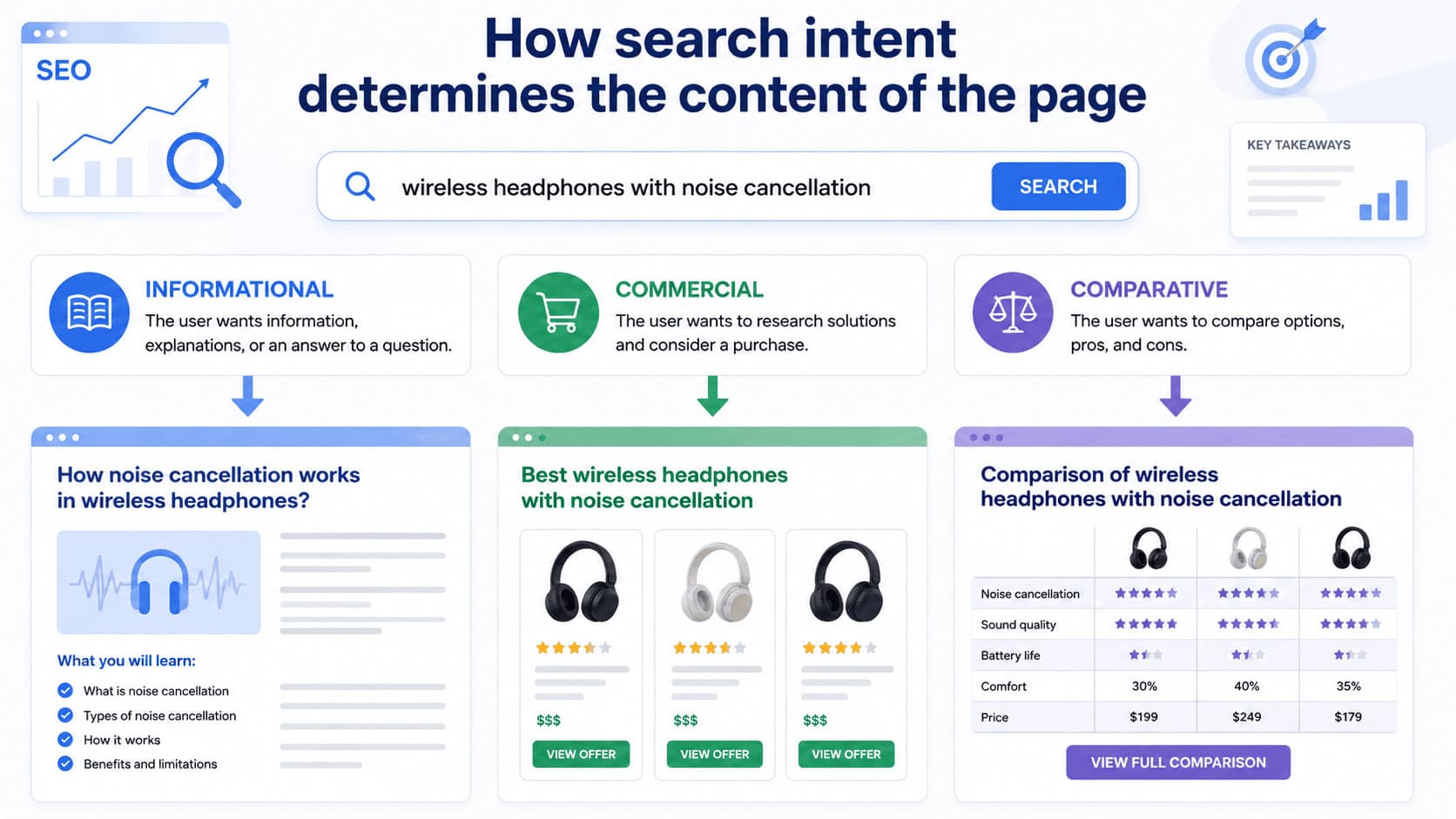
Search intent is the goal a person is trying to accomplish with a query.
The phrase "on-page SEO" usually calls for an informational guide. A query such as "SEO services pricing" suggests a commercial decision. The topics are related, but the person expects a different page type, level of detail, and next step.
Before writing or revising a page, answer these questions:
Search results can reveal the type of content Google currently considers relevant, but they are not a template that must be copied.
Review:
Then decide how your page can be more useful through original examples, direct experience, stronger evidence, clearer explanations, better organization, or current information.
Repeating the same headings used by competing pages does not create a distinctive resource. Search intent identifies the job to be done. Your content still needs its own reason to exist.
A page can answer several related questions, but it should have one recognizable primary purpose.
For an on-page SEO guide, relevant supporting concepts include:
These are supporting concepts, not a list of phrases that must be inserted at a particular density.
Terms such as "LSI keywords" are often used to imply that a writer must add a secret list of related words. That is not a useful model for modern content. Use the terminology needed to explain the subject accurately and answer the reader's real questions.
For definitions of specialized SEO concepts, use the SEO glossary.
A single URL should not attempt to be an informational tutorial, a complete technical audit manual, a service landing page, and a news feed at the same time.
When separate pages already own distinct tasks:
This protects clarity for the user without expanding one article into every adjacent SEO topic.
Helpful content enables a reader to understand a subject, make a decision, or complete a task.
Word count alone does not measure usefulness. A narrow question may need a short answer. A complex task may require definitions, examples, constraints, and a detailed process.
Strong main content usually includes:
Google's guidance on helpful, reliable, people-first content recommends creating content primarily to benefit people, not content designed mainly to attract search visits.
Generic claims such as "we are experts" do not prove expertise.
Useful evidence may include:
Evidence should match the claim. A small internal observation should not be presented as a universal industry conclusion.
Do not add paragraphs simply to reach a target number of words. Avoid:
Every section should earn its place by helping the page fulfill its purpose.
A page should work as a complete document, but important passages should also make sense on their own.
A strong section often follows this sequence:
Useful formats include:
This structure helps readers scan the page and helps search systems identify the part that answers a specific question.
Google does not require special AI markup or a separate AI optimization technique for a page to appear as a supporting link in AI Overviews or AI Mode.
Google's current AI features guidance says that the same foundational SEO practices remain relevant. A page must be indexed and eligible to appear in Google Search with a snippet. Meeting those requirements does not guarantee selection.
For a page-level review:
AI systems may combine information from multiple searches and sources. That makes clarity, evidence, and focused sections useful, but it does not justify writing disconnected blocks solely for extraction.
For a broader explanation of generative search terminology and strategy, see SEO, AEO, and GEO explained.

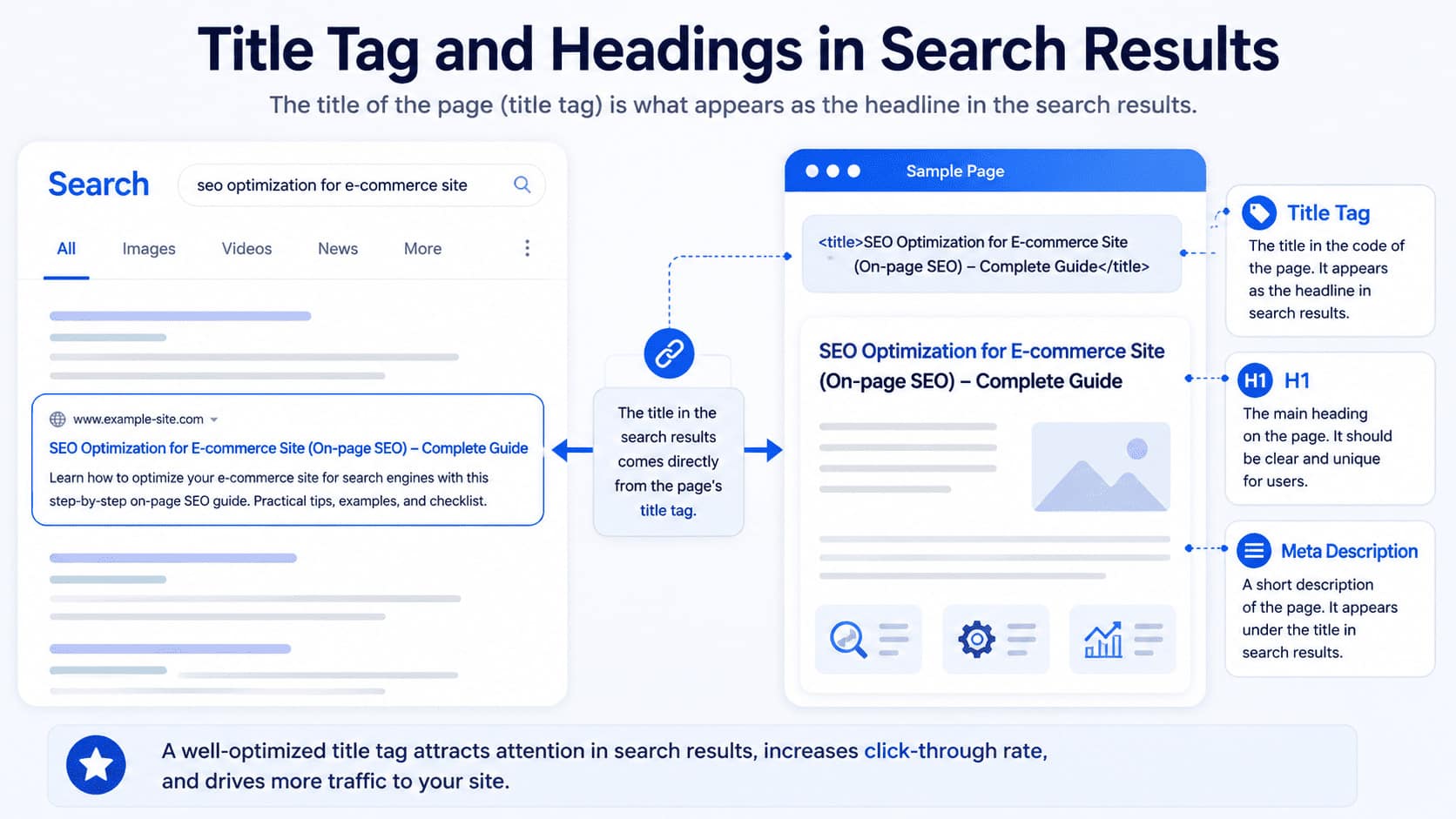
The title tag is the HTML element that provides a preferred title for the page:
<title>On-Page SEO: How to Optimize a Web Page for Search</title>
A useful title tag is:
There is no universal rule that every title must contain exactly 60 characters. Google can truncate a title link to fit the available display width.
Google also does not promise to use the title tag word for word. Its title link documentation lists several possible sources, including:
<title> element;og:title;Keep the title tag, H1, visible content, and primary purpose consistent. They do not have to be identical, but they should not make conflicting promises.
SEO, On-Page SEO, SEO Optimization, Website Optimization
This version repeats broad phrases without telling the reader what the page provides.
On-Page SEO: How to Optimize a Web Page for Search
This version identifies the topic and the practical outcome.
Avoid adding a year unless the content is genuinely reviewed and maintained for that year. A new date attached to unchanged advice creates a misleading freshness signal.
The H1 is the primary visible heading. It should tell a reader what the page is about as soon as the page loads.
The clearest practical pattern is one main H1 followed by logically nested H2 and H3 headings.
More than one H1 is not automatically a penalty. The problem is ambiguity. If several headings appear equally prominent, readers and search systems may have difficulty identifying the primary title.
Good headings:
Weak heading:
More Information
Stronger heading:
How Google Generates a Title Link
Do not add keywords to every heading. A heading is a navigation and comprehension tool, not a storage location for repeated phrases.
A meta description is a short page summary that Google may use when generating a search result snippet.
<meta name="description" content="Learn how to optimize the content, title tag, headings, links, images, and structured data on a specific web page.">
The description should:
Google's snippet documentation explains that snippets are primarily generated from page content. Google may use the meta description when it provides a more accurate summary for a particular query.
Different searches can therefore produce different snippets for the same page.
There is no fixed character count that guarantees a complete display. Google truncates snippets as needed for the device and result format. Put the essential idea first and keep the description focused.
A page-level review should confirm that the existing URL is understandable, stable, and aligned with the content.
The URL does not need to repeat every keyword. Its wording alone cannot make a weak page rank.
Do not change an established address simply to make it shorter or insert another phrase. An existing URL may already have:
Any URL change is a migration decision, not a routine copy edit. It requires a separate review of redirects, canonical signals, internal references, sitemaps, and translation relationships.
This article does not assign new URLs or redesign site hierarchy. It only checks whether the current page address creates a page-level clarity or consistency problem.

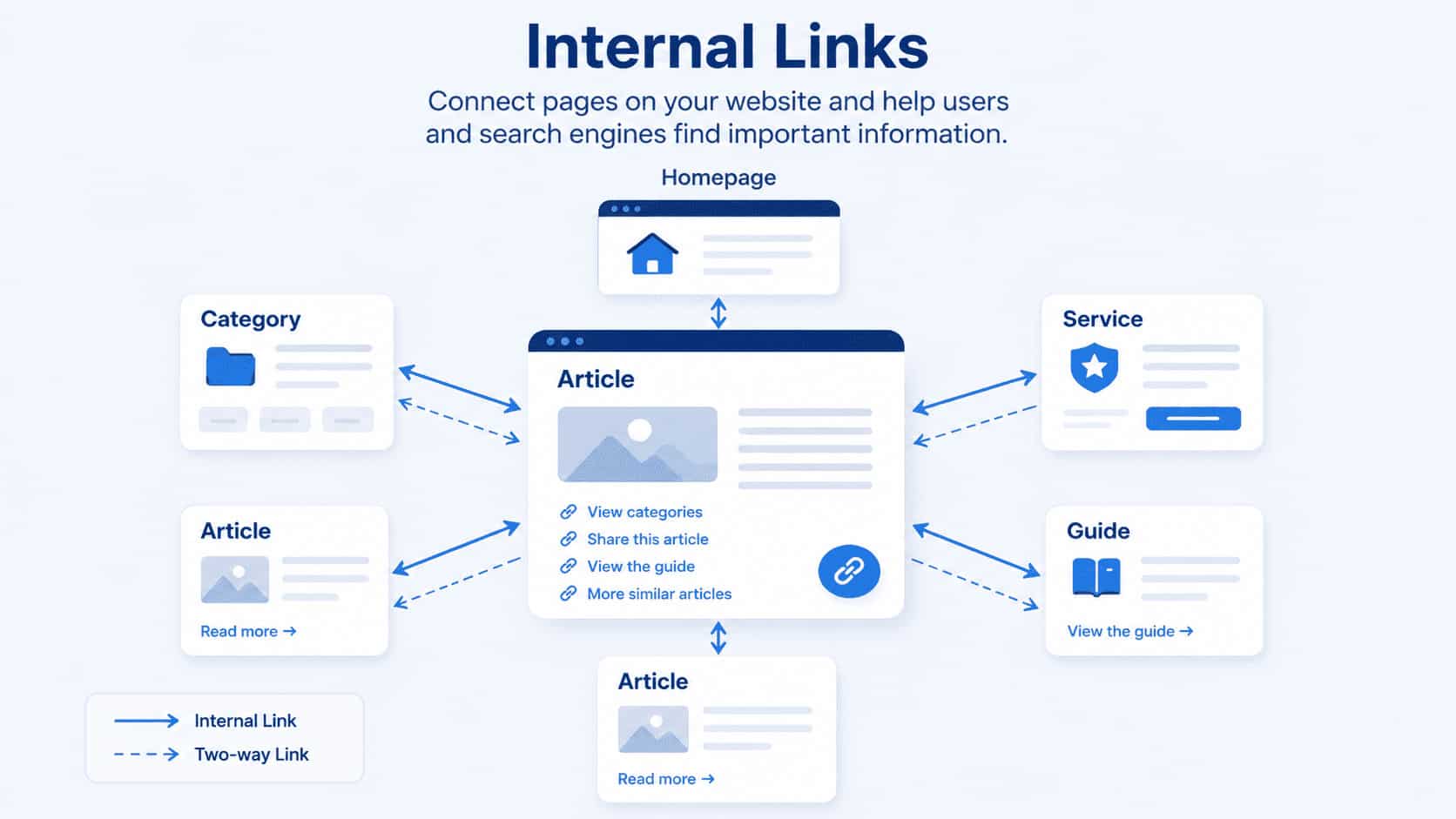
Internal links connect a page to relevant information elsewhere on the same website.
At the page level, a useful internal link should:
Google's link best practices explain that crawlable links generally use an <a> element with an href attribute. Anchor text should help people and Google understand the destination.
Do not turn every article into a directory of services. A relevant link is better than several unrelated links added to meet a quota.
This page-level work does not decide the entire site's link graph, hierarchy, orphan-page policy, or click-depth targets. Those questions require a site-wide architecture review.

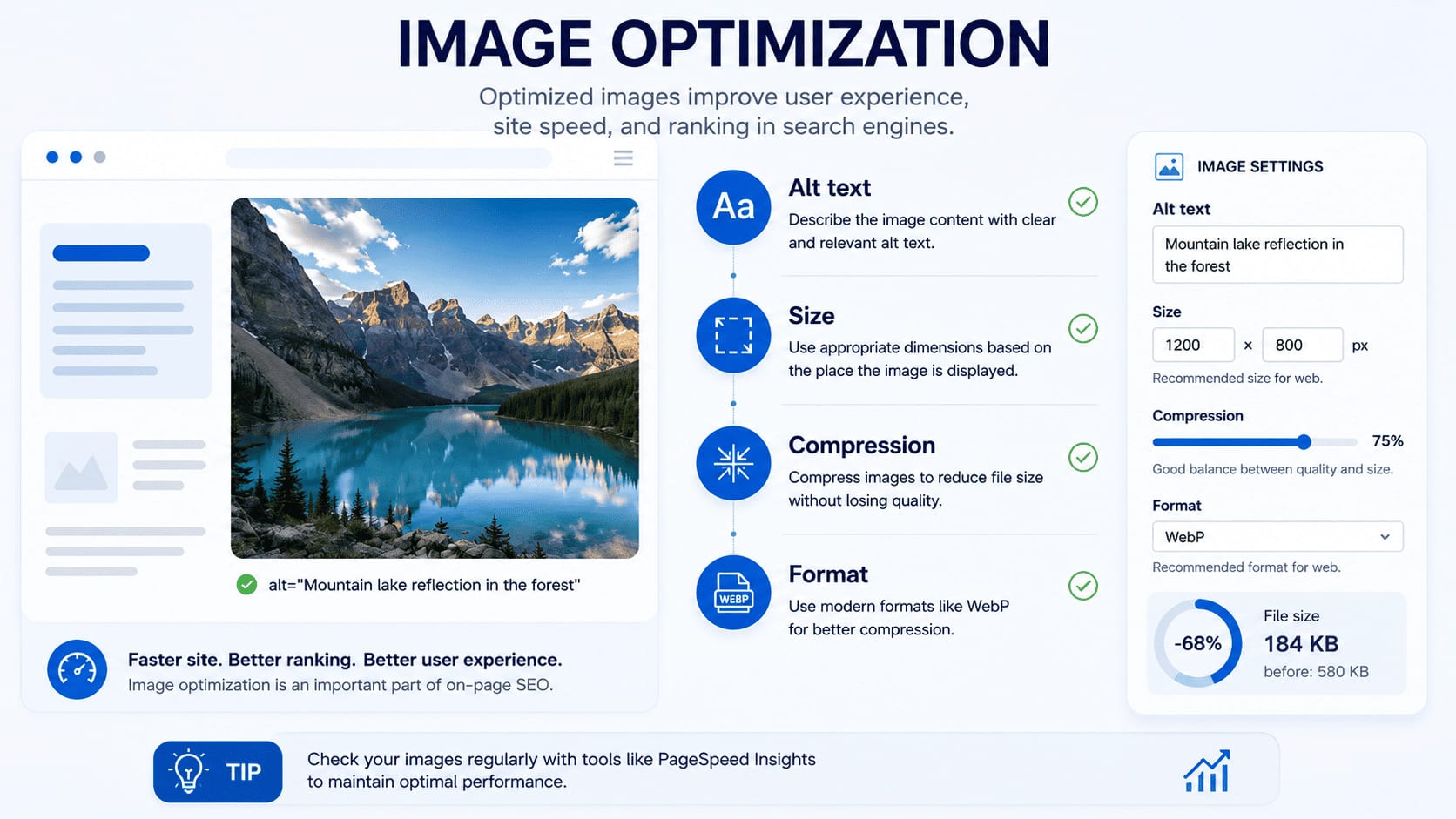
Images should support the surrounding content instead of filling space between paragraphs.
For each meaningful image, review:
Alternative text should describe the image in context.
<img src="on-page-seo-elements.webp"
alt="Main on-page SEO elements for a single web page">
Do not fill alt text with a list of keywords. Decorative images may need an empty alt attribute instead of a forced description.
Google's image SEO best practices emphasize making images discoverable and optimizing the pages where those images appear. Google can use alt text, nearby content, captions, filenames, and visual analysis to understand an image.
Image optimization also includes the user experience. A high-resolution image that adds no information and delays the main content is not an SEO improvement.
Structured data provides machine-readable information about entities and content on a page.
For an article, appropriate types and properties may include:
Article or BlogPosting;BreadcrumbList;Person author;Organization publisher;datePublished;dateModified;Choose markup based on the content that is actually present and on Google's supported search features.
Do not add:
Google's structured data introduction explains that markup must describe the page it appears on. Valid structured data can make a page eligible for certain search features, but it does not guarantee a rich result or a higher ranking.
There is no special "AI schema" required for AI Overviews or AI Mode.
Readers should be able to understand who created or reviewed expert content and why that person is qualified to discuss the topic.
A strong article may show:
Do not update the displayed date without reviewing the content. A meaningful update may include:
Trust is demonstrated through accuracy, transparency, evidence, and accountable authorship. It is not created by adding unsupported superlatives.
On-page content cannot perform normally if the page is unavailable to users or search systems.
For the specific page being edited, confirm:
noindex;These are page-level safeguards, not a full crawling or indexing diagnosis. If the review uncovers a pattern across many URLs, move the investigation into the technical SEO workflow.
Page experience should also be judged by real use, not one isolated laboratory score. For LCP, INP, CLS, and practical performance work, see the Core Web Vitals and Page Speed guide.
Before editing, record the baseline. After the page has been recrawled and enough time has passed, compare like-for-like periods.
In Google Search Console, filter performance data to the exact page and review:
Do not judge the edit by one keyword or one day of data. Search demand, seasonality, news events, result features, competitor changes, and normal measurement noise can influence performance.
Also review business and user outcomes, such as:
Search visibility is useful only when the page attracts an appropriate audience and helps that audience complete the intended task.
An immediate movement does not prove causation. Treat on-page work as a measured process, not a promise of a specific ranking.
A URL that tries to teach a topic, sell a service, compare vendors, publish news, and answer every related question has no clear primary job.
Choose the main intent. Keep supporting details that help complete it and direct genuinely separate tasks to their appropriate pages.
Keyword repetition cannot replace a useful answer.
Use the primary term where it improves clarity. Use accurate related terminology where the subject requires it. Read the passage aloud. If it sounds unnatural to a person, repeating it for a crawler will not improve the content.
Words such as "complete," "ultimate," and "definitive" create an expectation. Do not use them unless the page actually covers the essential decisions, limitations, and actions.
The title tag, H1, description, and opening should describe the same resource.
Minor wording variations do not always require separate URLs.
Pages created for "on page SEO," "on-page SEO," "onpage SEO," and "internal page optimization" may compete for the same intent. Decide whether the user actually needs distinct resources before splitting the topic.
Keyword-to-URL assignments belong to a broader content and architecture review. Do not create another page during a routine on-page edit.
Linking every paragraph to a service page does not improve relevance.
Use a link when the destination gives the reader a useful next step. Make the anchor understandable and place it in a sentence that explains the relationship.
Markup should not contain authors, ratings, dates, questions, prices, or other facts that are absent from the visible content.
Validate the markup and check whether the selected type is supported for the intended search feature.
A fresh date attached to unchanged or outdated content can mislead readers.
Review the facts, sources, examples, process, and links. Change the update date when the revision is substantive enough to justify it.
Rewriting a paragraph cannot resolve an accidental noindex, a server error, a conflicting canonical, or content that is unavailable in rendered HTML.
Confirm the page-level technical conditions and move broader patterns into a technical diagnosis.
Without a baseline and follow-up measurement, the team cannot tell whether an edit helped.
Document the change, allow time for recrawling and evaluation, then review both search performance and user outcomes.

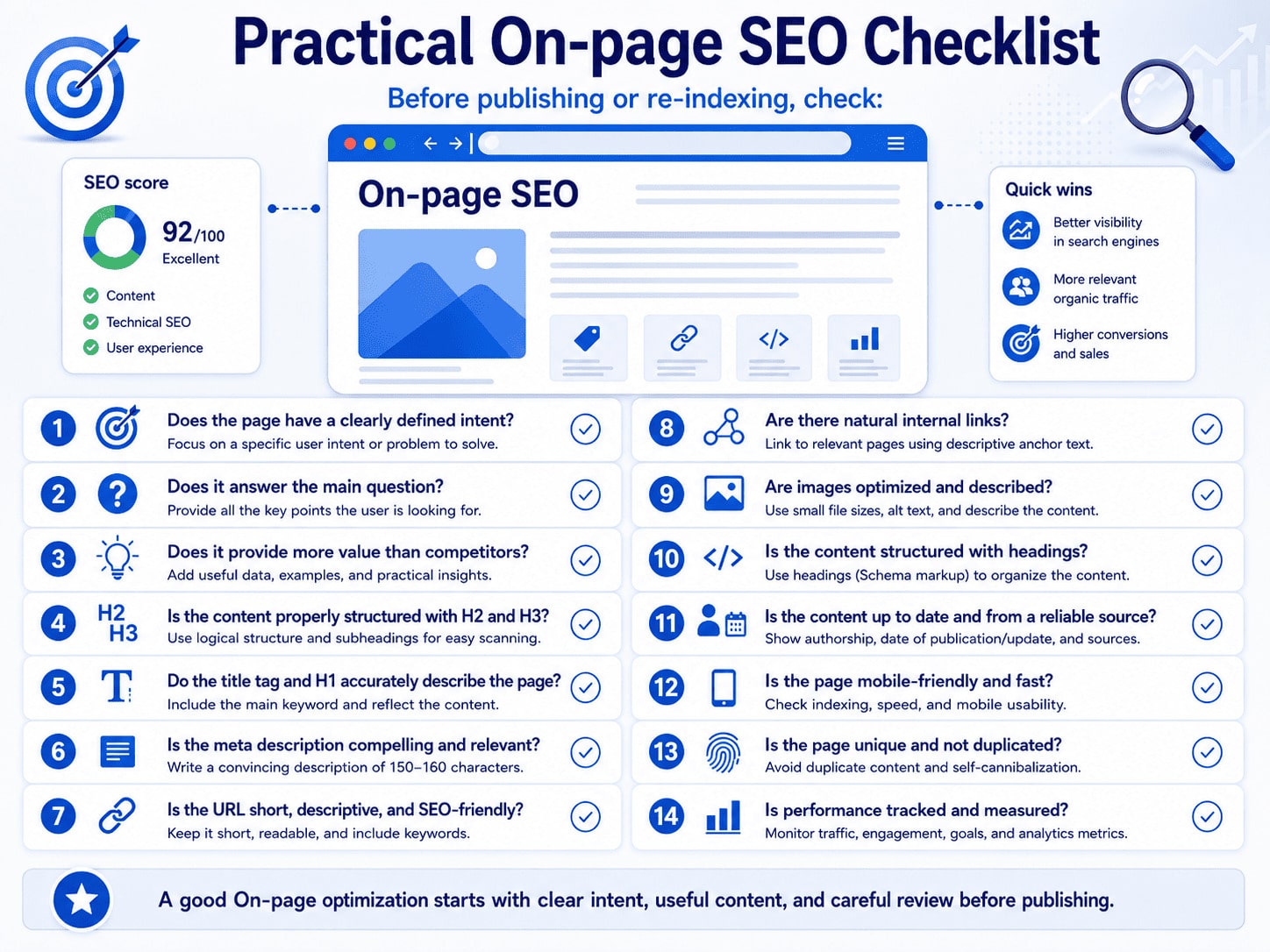
Before publishing or requesting another crawl, confirm:
On-page SEO is the improvement of content, organization, and HTML elements within a specific web page. It includes search intent, main content, the title tag, H1 and section headings, the meta description, page-level links, images, structured data, and relevant usability checks.
No. On-page SEO focuses on the content and elements of a particular page. Technical SEO addresses crawling, indexing, rendering, canonicalization, performance systems, and other technical conditions that often affect many pages.
There is no universal correct number. Use the primary phrase where it is needed for clarity and use related terminology naturally when the topic requires it. A fixed keyword density is not a reliable optimization target.
It should be long enough to complete its purpose without unnecessary material. A narrow question may need a short answer. A complicated process may need definitions, examples, limitations, and several steps. Word count is not a substitute for usefulness.
One clear primary H1 is the simplest and most understandable pattern. Multiple H1 elements are not automatically a penalty, but several equally prominent titles can make the page hierarchy ambiguous.
Do not treat the meta description as a direct ranking lever. Its practical role is to summarize the page and potentially influence how the result is presented and whether the right user chooses to click. Google may instead generate a query-specific snippet from visible page content.
Structured data helps search systems understand page information and may make a page eligible for supported rich results. It does not guarantee a rich result or a higher position.
Usually not without a separate migration review. The wording of the URL is only one small signal, while an established address may already have links, history, analytics continuity, and translation relationships. Do not change it as a routine copy edit.
Use the same durable practices that support Google Search: create helpful and reliable content, make important information available as text, use clear sections, support claims, show authorship, use relevant images, make markup match the page, and keep the page indexed and eligible for snippets. There is no special AI schema or guaranteed inclusion method.
There is no fixed timeline. Google must recrawl and reprocess the page, and performance also depends on demand, competition, page quality, site conditions, and result features. Measure over an appropriate period instead of promising an immediate ranking change.
Effective on-page SEO does not begin with a keyword counter. It begins by defining what the page must accomplish for a specific audience.
Search intent, useful content, title tags, headings, descriptions, links, images, structured data, trust signals, and page-level technical conditions should reinforce the same purpose.
The goal is not to publish another URL for a closely related phrase. The goal is to make the existing page the clearest and most useful resource for its assigned task, while sending separate intentions to the pages that already serve them.