Logo
SEO & Pricing

What Are GEO and AEO? The Difference Between SEO, AEO and GEO

Published on: 03/07/2026
Modified: 14/07/2026

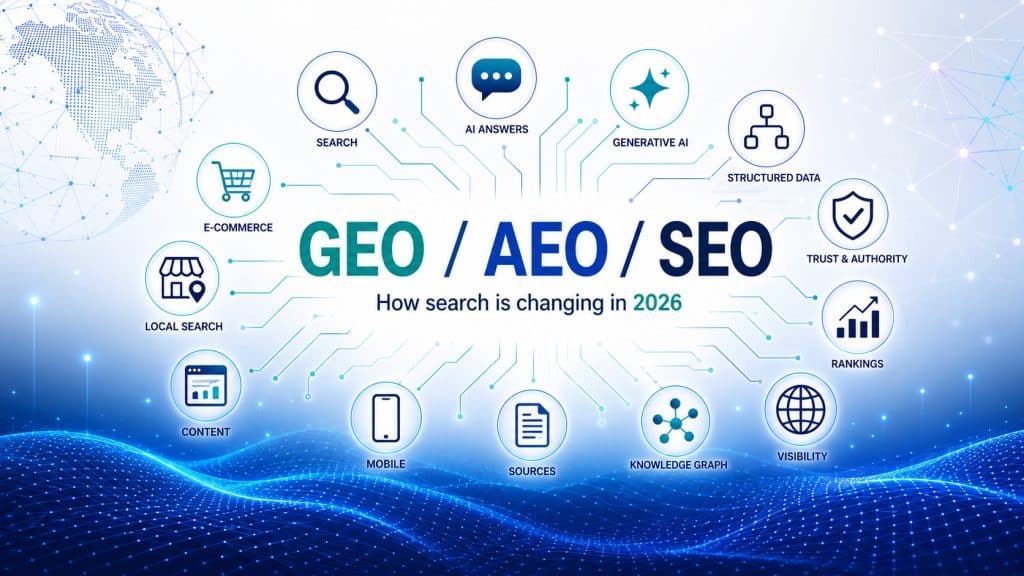
GEO and AEO are concepts used to optimize content and digital presence in an environment where search engines and AI systems provide direct or generated answers.

SEO aims to ensure that a website is understood, indexed and shown for relevant searches.
AEO places emphasis on clear and accurate answers to specific questions.
GEO places emphasis on content, brands and sources being used or cited in generated answers.

These areas are not three separate systems that can be implemented independently. A strong technical and content SEO foundation remains necessary. AEO and GEO add a stronger focus on how answers are formulated, how information can be verified, how authorship is presented clearly and how different systems extract and display sources.

SEO, AEO and GEO in Brief

what is geo aeo and seo
ConceptFull NameMain TaskTypical Visibility
SEOSearch Engine OptimizationMake the website accessible, understandable and relevant for organic searchTraditional results, rich results, local and product results
AEOAnswer Engine OptimizationMake the content provide a clear, accurate and self-contained answerDirect answers, featured snippets, voice and AI answers
GEOGenerative Engine OptimizationMake the source or brand used in a generated answerCitations, links, mentions and synthesized recommendations in AI interfaces

The table is a practical distinction, not a universal technical standard. In the industry, AEO, GEO, AI Search optimization and other related terms are often used with overlapping meanings.

The most useful question is not which abbreviation is “correct”, but what specific problem needs to be solved:

  • the website is not crawled and indexed correctly;
  • the page does not answer the question clearly enough;
  • several URLs compete for the same topic;
  • the information cannot be verified easily;
  • the brand is presented inconsistently;
  • a specific AI platform does not discover or use the correct source.

What Is SEO?

SEO is the foundation on which the other approaches are built. It covers the website’s technical accessibility, page structure, content, internal links, external signals and the measurement of organic performance.

The main objective is not simply to use keywords. Both the search engine and the user must understand:

  • what the purpose of each page is;
  • which page owns a specific topic;
  • how the individual URLs are connected;
  • who stands behind the information;
  • whether the claims are current and reliable;
  • what action the user can take.

Google states that core SEO practices continue to apply to AI features in Search. There is no reason for a website with crawling problems, unclear architecture and weak content to jump directly to “GEO tricks”.

For ongoing and comprehensive work on organic visibility, see the SEO optimization service.

What Is AEO?

AEO stands for Answer Engine Optimization. In practice, it is a way of structuring and editing content so that the user receives a clear answer without having to assemble it from multiple general paragraphs.

AEO does not mean turning every page into an FAQ. A good answer may be:

  • a short definition;
  • a comparison;
  • a sequence of steps;
  • a solution based on specific conditions;
  • a selection table;
  • an explanation of exceptions;
  • a technical instruction;
  • a clear position supported by a source.

What a Useful Answer Looks Like

A useful AEO structure usually includes:

  • a direct answer to the question;
  • the necessary context;
  • the conditions under which the answer is valid;
  • the important exceptions;
  • evidence or sources;
  • a next step for the user.

For example, the question “Does GEO replace SEO?” does not require a long introduction. A useful answer begins with “No”, followed by an explanation of why technical accessibility, indexing, structure and authority remain the foundation of visibility.

What AEO Does Not Mean

AEO is not:

  • mechanically adding dozens of questions;
  • repeating the same keyword;
  • artificially splitting short answers across multiple URLs;
  • removing necessary context;
  • writing only for machines;
  • a guarantee of a featured snippet or AI citation.

A clear answer is useful only when it is accurate, sufficiently complete and placed on the correct page.

What Is GEO?

GEO stands for Generative Engine Optimization. The term was formalized in the academic paper “GEO: Generative Engine Optimization”, which examines how the visibility of sources can be evaluated and improved in the answers of generative systems.

The authors of the study report visibility improvements of up to 40% in some of their experiments. This is the result of a specific benchmark and should not be presented as a guarantee for ChatGPT, Google AI Overviews, AI Mode or any other real-world platform.

On a practical level, GEO examines whether:

  • the system can access the information;
  • the correct URL owns the topic;
  • the answer is clear and extractable;
  • the claims can be verified;
  • the organization, author and services are presented consistently;
  • other reliable sources confirm the important facts;
  • the content adds something beyond a general summary.

GEO is not one setting or one type of file. Different AI platforms use different systems for search, crawling, retrieval and citation. For this reason, general principles must be distinguished from the specific technical requirements of each platform.

What Is the Difference Between AEO and GEO?

AEO focuses on the quality and structure of the answer. GEO addresses the broader issue of source and brand visibility within a generated answer.

QuestionAEOGEO
Main focusClear answerUse and visibility of the source
Main objectA specific question and its answerPage, domain, organization, author and external confirmation
Typical taskHow to explain the topic clearlyHow the correct source can be discovered, understood and confirmed
Main riskA superficial or unclear answerUnverifiable claims, an unclear owner URL or conflicting signals
Does it guarantee visibility?NoNo

In practice, a strong page can follow both AEO and GEO principles at the same time. It provides a direct answer, but also shows the author, date, sources, limits of the claims and its place within the website architecture.

Does GEO Replace Traditional SEO?

Does GEO Replace Traditional SEO?

No. GEO does not remove the need for SEO.

Search engines and AI platforms do not work in exactly the same way, but strong visibility continues to depend on fundamental qualities:

  • technically accessible content;
  • a clear purpose for the page;
  • logical structure;
  • a useful answer;
  • current facts;
  • a sufficient evidence base;
  • internal links;
  • a recognizable organization or author;
  • external confirmation where necessary.

Google explicitly recommends that website owners continue applying established SEO practices to AI features in Search. Special AI markup or a universal shortcut does not replace a high-quality page.

The most accurate sequence is:

  1. SEO foundation — the website must be crawlable, indexable and understandable.
  2. Clear answer — the page must solve a specific user task.
  3. Verifiability — important claims must have a source or clearly identified practical origin.
  4. Topical ownership — one topic should have one primary owner URL.
  5. Platform-specific review — specific crawlers, eligibility rules and measurement methods should be checked for each system.

Core Principles of GEO/AEO Content

One Primary URL for Every Important Topic

When several pages try to provide a complete answer to the same question, the website creates ambiguity both for the user and for systems that need to select a source.

A useful architecture defines:

  • which URL owns the topic;
  • which pages mention it only contextually;
  • where an internal link should be placed;
  • when information should be consolidated;
  • when a separate URL is genuinely necessary.

GEO/AEO is not a reason to create a page for every wording of the same question.

A Direct Answer Without Losing Context

The main answer should be easy to find. This does not mean that it should be oversimplified.

For complex topics, it is necessary to explain:

  • the conditions;
  • the limitations;
  • the risks;
  • the different scenarios;
  • the sources;
  • how the user can apply the information.

Facts Should Be Separated from Experience and Assumptions

A strong page clearly shows when a claim comes from:

  • official documentation;
  • a primary source;
  • reliable data;
  • practical experience;
  • professional interpretation;
  • a hypothesis that has not yet been confirmed.

This is especially important in AI Search, where platforms do not publish complete information about how they select all sources.

The Author and Organization Should Be Recognizable

The user should be able to understand:

  • who published the material;
  • who carries editorial responsibility;
  • what experience the author or organization has;
  • when the information was updated;
  • how an important fact can be verified;
  • whether the page has a commercial interest.

Describing oneself as an “expert” is not evidence. A specific biography, real experience, primary data and consistent external confirmation are more useful.

The Content Should Add Information Gain

A page that merely repeats widely available definitions has difficulty justifying its existence.

Real additional value may include:

  • an original selection methodology;
  • original data;
  • an expert comparison;
  • clear limitations and exceptions;
  • a practical example;
  • collected and verified official sources;
  • an answer to a question that other materials leave unclear.

Artificially increasing the length is not information gain.

Internal Links Should Show the Boundaries

An internal link is not only a way to distribute SEO value. It shows which page owns the more detailed explanation.

This material owns the definitions and comparison between SEO, AEO and GEO. Specific platform mechanics are separated:

  • for the discovery and citation of sources in ChatGPT, see how ChatGPT chooses which websites to cite;
  • for requirements, limitations and reporting in Google, see Google AI Overviews and AI Mode.

This allows each page to solve its own problem instead of three URLs repeating the same information.

What GEO/AEO Is Not

GEO/AEO is not:

  • a guarantee of citation or recommendation;
  • adding one file and considering the work complete;
  • a special schema that automatically ensures AI visibility;
  • publishing hundreds of short AI articles;
  • creating a page for every long-tail phrase;
  • mechanically adding FAQ sections;
  • hiding keywords or instructions for models;
  • fake brand mentions;
  • buying random links;
  • presenting an assumption as an official ranking factor;
  • replacing technical SEO and high-quality content.

There is no stable universal tactic that works identically across all AI systems. Platforms differ, and answers may change depending on the query, language, context and the moment of testing.

When You Need GEO/AEO Work

GEO/AEO has practical value when the business:

  • offers a service or product that requires prior research;
  • has expert information that can be published;
  • wants to be represented accurately in AI answers;
  • has many similar pages and unclear topical ownership;
  • discovers conflicting information about its brand;
  • already invests in SEO but has no plan for AI Search visibility;
  • needs to distinguish the overall strategy from the requirements of specific platforms.

Not every project needs new pages. Often, the correct solution is to improve the existing owner URL, add evidence and correct the internal links.

When analysis and implementation on the website are required, not only an explanation, see the AI search engine optimization service.

How to Choose the Correct Type of Work

ProblemMain Direction
Pages are not indexed or the website has technical barriersTechnical SEO and SEO audit
The content does not answer questions clearlyAEO editing and improvement of the owner page
Several URLs cover the same topicOwnership and cannibalization review
The brand is described differently across different sourcesEntity and factual consistency
It is unclear how ChatGPT finds and displays sourcesChatGPT-specific guide and technical review
It is unclear how Google AI Overviews and AI Mode workGoogle AI features guide and Search review
A complete strategy and implementation are requiredAI Search optimization service

This table prevents a common mistake: calling every problem “GEO”, regardless of whether the actual cause is technical, content-related, architectural or brand-related.

Frequently Asked Questions

What Does GEO Mean?

GEO stands for Generative Engine Optimization. It is an approach for improving the clarity, accessibility and verifiability of content and brand signals so that they can be used in generated answers.

What Does AEO Mean?

AEO stands for Answer Engine Optimization. It places emphasis on creating accurate, self-contained and well-structured answers to real user questions.

What Is the Main Difference Between AEO and GEO?

AEO focuses on the quality of the answer. GEO addresses the broader visibility of the source, organization and information in generated answers.

Does GEO Replace SEO?

No. GEO is built on an SEO foundation. If the website cannot be crawled, the pages do not have a clear purpose or the content is not reliable, there is no stable foundation for AI visibility.

Should I Create New Pages for GEO?

Only when there is a separate search intent and a genuine user problem that cannot be covered by the existing owner URL. In all other cases, it is better to improve the current page.

Does GEO Guarantee Citations in ChatGPT or Google?

No. Technical accessibility, clarity, evidence and topical architecture can be improved, but the final selection of sources is made by the relevant system.

Is Optimization the Same for All AI Platforms?

No. The general principles overlap, but crawlers, sources, interfaces and measurement methods differ. For this reason, platform-specific details must be checked separately.

Image source: ChatGPT

5/5 - (1 vote)
crosschevron-down