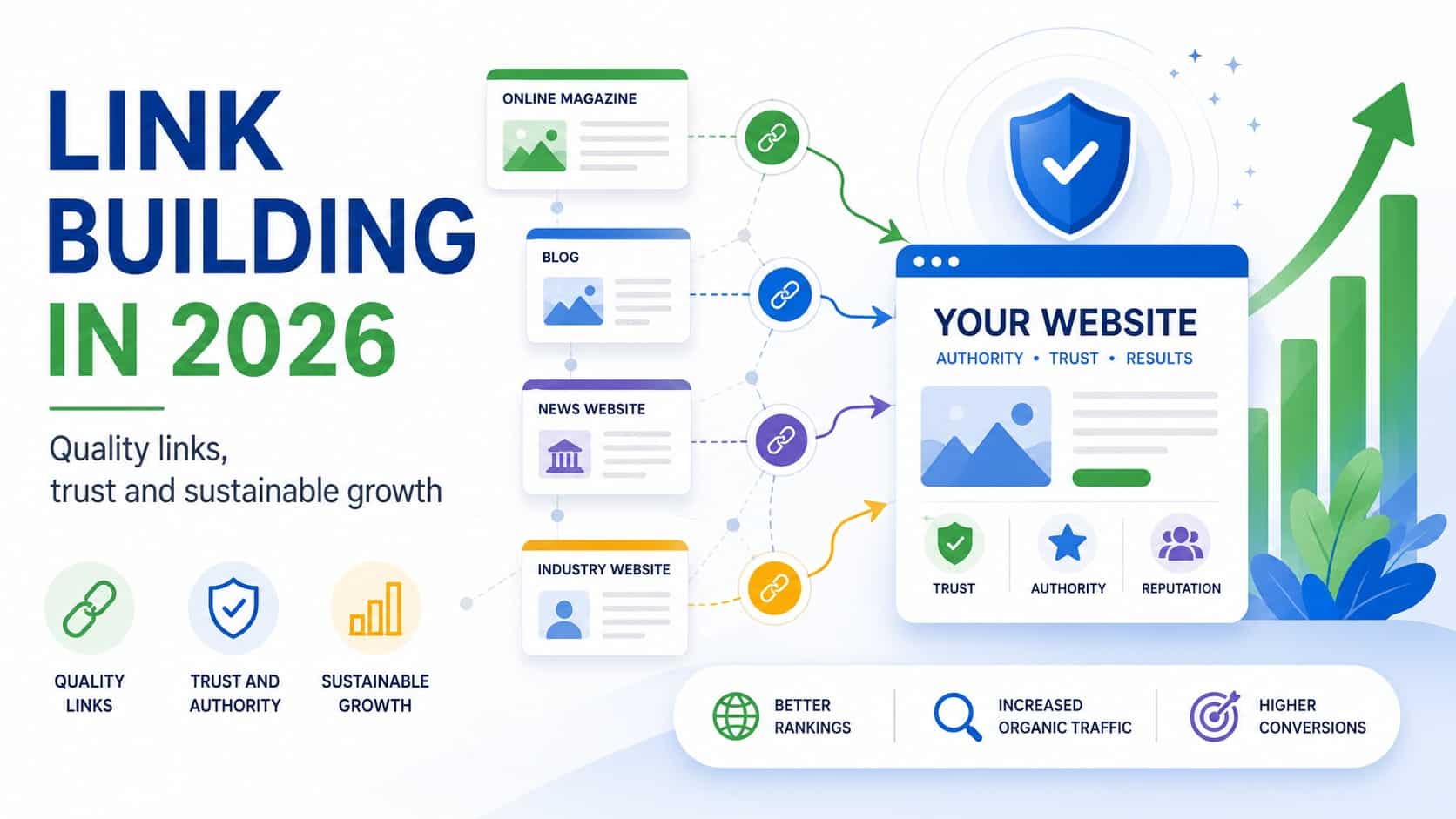
Link building is the process of earning links from other websites to pages on your site. These incoming links are called backlinks.
Effective link building is not measured only by the number of links acquired. The reason a link exists, the relationship between the source and target topics, the quality of the specific source page, the anchor text, and the value for real users matter more.
Link building is only one part of a complete SEO optimization process. A technically sound website, useful content, clear internal architecture, and strong target pages provide the foundation that allows relevant external links to add value.

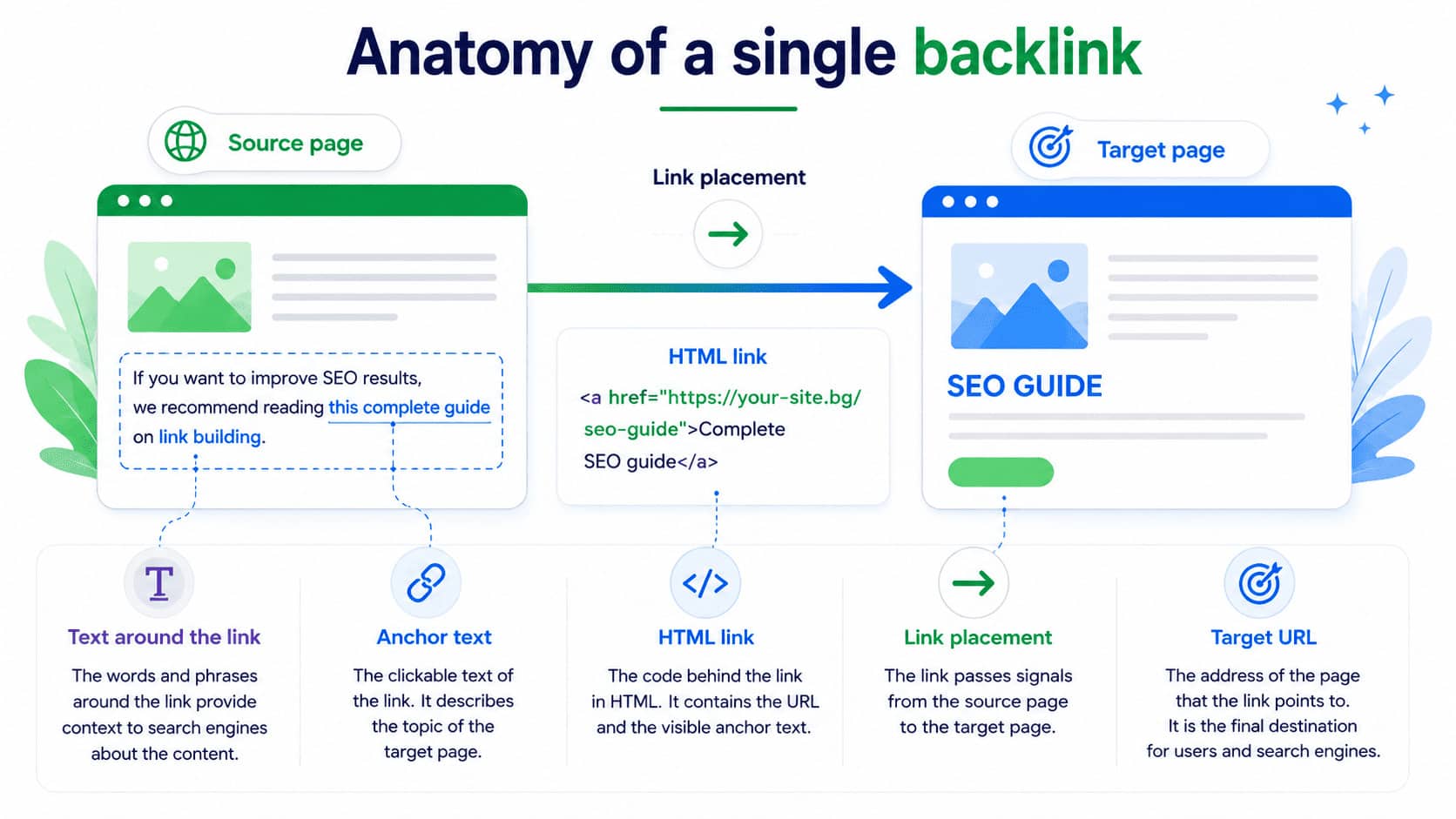
A backlink is a hyperlink from a page on one website to a page on another website.
A basic HTML link looks like this:
<a href="https://example.com/market-research/">market research</a>
In this example:
href contains the address of the target page;Google uses links to discover pages and as one of the signals that help it understand relevance. For a standard HTML link to be reliably crawlable, it should normally use an <a> element with a valid href attribute, as described in Google's link best practices.
No. Link building is part of Off-Page SEO, but it does not cover every external signal associated with a website.
| Term | Primary focus |
|---|---|
| Link building | Acquiring and evaluating incoming links |
| Off-Page SEO | Links, brand mentions, citations, reviews, reputation, and digital PR |
| Internal linking | Links between pages on the same website |
| Outbound linking | Links from your website to external sources |
This guide focuses specifically on backlinks, anchor text, source quality, and sustainable ways to earn links.
Broader questions about reputation, independent mentions, local citations, reviews, and digital PR belong to the separate Off-Page SEO and external authority guide.
Links can serve several different purposes.
Search engines follow crawlable links to reach new or updated content. An external backlink is not the only way Google can discover a page. Internal links, XML sitemaps, and previously known URLs can also lead Google to it.
It is therefore inaccurate to claim that every page needs an external backlink before it can be found. A relevant link can support discovery and provide additional context, but it is one path among several.
The anchor text, the sentence around the link, and the subject of the source page help explain why two pages are connected.
For example, a link to a guide about electric vehicles makes sense inside an article about electric vehicle maintenance costs. The same link placed in an unrelated gardening article has no comparable value for the reader.
A link can be valuable even when it has no direct effect on rankings. When it appears in a useful article for the right audience, it can generate:
When independent, topically related sources refer to a page, that pattern can indicate that the page contains useful, original, or important information.
This does not mean every backlink improves rankings. Google may give a link little weight, ignore it, or identify it as part of a manipulative scheme.

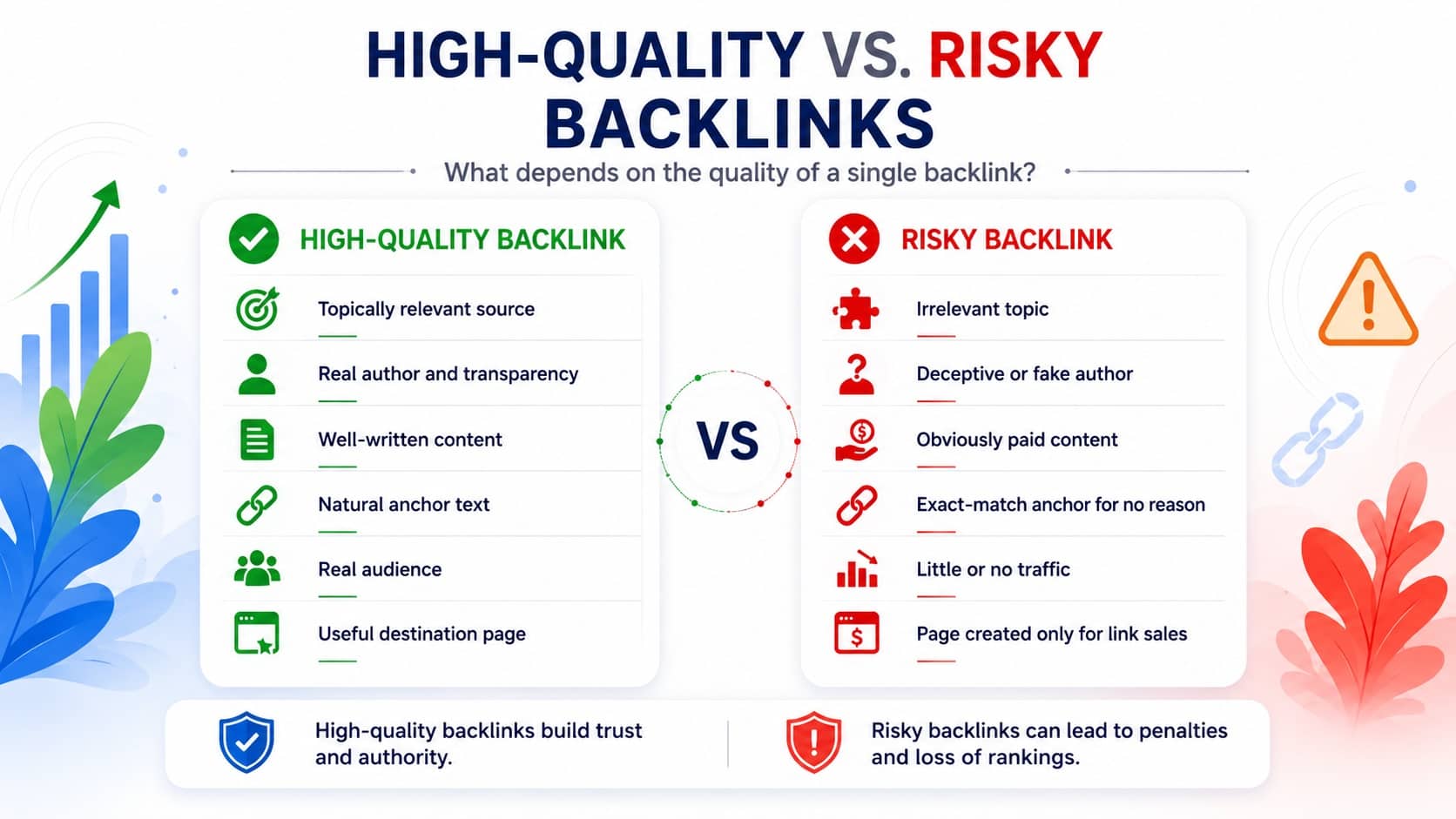
Backlink quality cannot be reduced to one score. It depends on several factors that should be reviewed together.
The source website, the specific source page, and the target page should have a logical relationship.
A link from a small specialist publication may be more appropriate than one from a large general news site if the specialist article is closer to the subject and reaches the right audience.
The two websites do not need to cover exactly the same topic. The important question is whether a reader can understand why the link appears in that context.
A useful link normally has a specific function. It may:
If a link can be removed without changing the meaning or usefulness of the source article, the editorial reason for including it may be weak.
Do not evaluate only the domain. Review the page where the link will appear.
Check whether:
A strong domain does not automatically make every page on that domain a good source.
The source page is only half of the decision. The page receiving the link must also deserve the reference.
The target page should:
External links cannot permanently compensate for a weak, confusing, or irrelevant target page. Improving content, headings, and internal structure is part of making that target genuinely useful.
An editorial link inside the main content usually has clearer context than an automatically repeated link in a footer, sidebar, or template.
That does not make every footer link a problem. A web developer credit, for example, may have a legitimate attribution or navigation purpose. Risk appears when the same optimized link is distributed across the templates of many websites to influence rankings.
The anchor should describe the destination naturally. The words before and after it also matter because they establish context.
The best anchor is not necessarily the one that repeats the target keyword most precisely. It is the one that helps the reader understand what the linked page contains.
Ask a practical question:
Could someone in the intended audience see this link, follow it, and find information that is genuinely useful?
If the answer is yes, the link has value beyond a possible ranking effect.
Strong editorial links tend to remain in place because they continue to serve a purpose.
Links that disappear after a few weeks, move among unrelated articles, or appear on pages created primarily to sell placements are less durable.
SEO tools often display proprietary metrics such as DR and DA when users compare websites.
Neither metric belongs to Google, and neither is used by Google as a direct ranking score. They can support an initial comparison, but they cannot determine by themselves whether a particular backlink is useful.
No. Third-party authority metrics can help with:
They should not be the only selection criteria.
A high-DR domain may contain weak, irrelevant, or obviously paid articles. A lower-DR domain may have a small but genuine and highly relevant audience.
A practical review combines tool metrics with a manual assessment of the topic, authors, content, audience, visibility, and editorial reason for the link.
Backlinks can be grouped by how they were earned and what function they serve.
An editorial link is added by an author or editor because the linked page improves the source article.
It may point to:
These links are often difficult to earn because the target page must provide enough value to justify the citation.
Digital PR links may result from:
The goal of digital PR should not be to force an exact keyword into an anchor. It should be to create a story or resource that editors have a reason to use.
Membership in a real association, chamber, professional community, or local business organization may lead to a relevant profile or resource link.
The value comes from the genuine relationship between the organization and the business, not merely from being listed in a directory.
Manufacturers, distributors, technology partners, and suppliers sometimes maintain official partner pages, project pages, or customer directories.
This can be a natural opportunity when the business relationship is real and the information helps users.
Some websites maintain curated lists of:
A link makes sense when your resource genuinely improves the list.
Guest contributions can be useful when they provide original expert content to a relevant audience.
The method becomes risky when it turns into a large-scale pattern of repeated articles, weak content, and optimized anchors published mainly to manipulate rankings.
Original diagrams, infographics, photographs, and data visualizations may be reused by other publishers.
When a website uses your original visual, it is reasonable to ask it to identify the source and link to the page where the visual was first published.
Providing a product for an independent test does not guarantee a positive review or a followed link.
When a product or service is provided in exchange for coverage or a link, that relationship should be disclosed. Google's spam policies include exchanges of goods or services for links among the examples that may qualify as link spam when the purpose is to pass ranking credit.

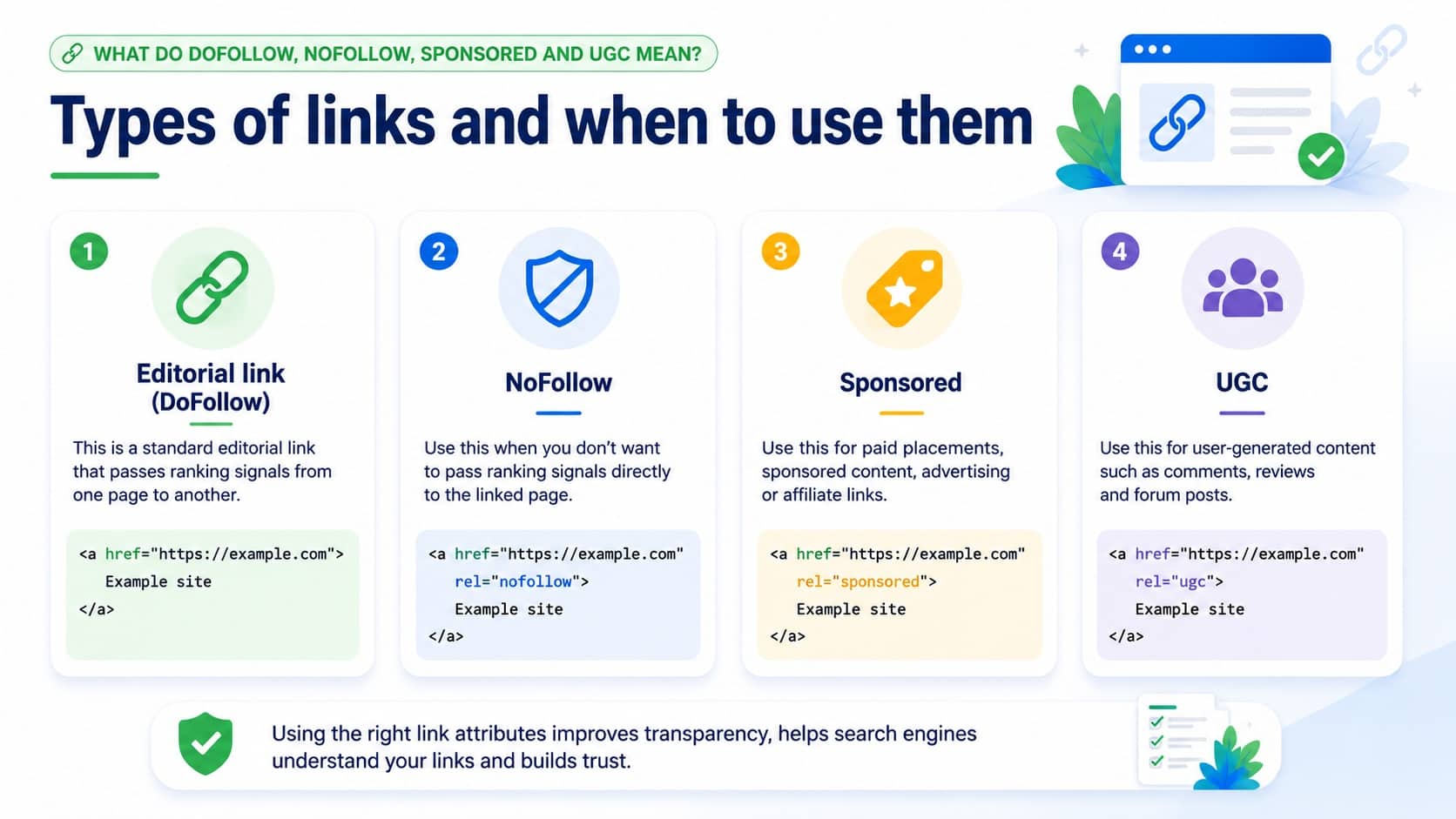
A standard link that an editor adds independently does not require a special rel value:
<a href="https://example.com/research/">see the research</a>
"Dofollow" is an informal SEO term, not an actual HTML attribute. It usually refers to a regular link without nofollow, sponsored, or another qualifying value.
rel="sponsored"Use this value for advertising, sponsorships, and paid placements:
<a href="https://example.com/" rel="sponsored">sponsor</a>
rel="ugc"Use this value for links in user-generated content such as comments and forum posts:
<a href="https://example.com/" rel="ugc">user source</a>
rel="nofollow"Use this value when the other values do not apply and the publisher does not want Google to associate the site with the linked page:
<a href="https://example.com/" rel="nofollow">external source</a>
Google recommends sponsored for paid links and ugc for links in user-generated content. Nofollow remains appropriate in some cases. The distinctions are explained in Google's documentation on qualifying outbound links.
No.
A nofollow link can:
Do not judge a link only by whether it is followed or nofollowed.
Anchor text is the visible, clickable text of a link.
For example:
<a href="https://example.com/backlink-analysis/">backlink profile analysis</a>
"Backlink profile analysis" is the anchor.
Google recommends descriptive, concise anchor text that is relevant to both the source and target pages. Repeating keywords excessively in anchors can make the text unnatural.
The anchor contains the name of a company, website, product, or author.
Example:
according to research by SeoWebDesign
This type of anchor clearly identifies the source.
The visible text is the web address itself.
Example:
seo-webdesign.bg
URL anchors are a normal part of a natural backlink profile.
The anchor uses phrases such as:
These anchors can be appropriate in context, but they provide little information by themselves.
The anchor describes the broader subject without necessarily repeating the exact target keyword.
Example:
methods for evaluating external sources
The anchor includes part of an important phrase while remaining natural in the sentence.
Example:
a practical backlink analysis
The anchor exactly matches a target search phrase.
Example:
link building
One exact-match anchor is not automatically a problem. Risk comes from repeatedly acquiring optimized links with the same commercial wording.
When an image is used as a link, its alt text can help describe the destination.
Linked images should therefore use concise, meaningful alt text rather than a list of keywords.
There is no universal percentage that is correct for every website.
A natural backlink profile depends on:
Fixed formulas such as "20% exact match, 30% partial match, and 50% branded" cannot guarantee safety or results.
The better approach is not to control every anchor artificially. Create a clear reason for the link and allow the editor to use wording that fits the article.
A sustainable strategy starts before the first outreach email.
Review:
The goal is not to label every weak domain "toxic." The goal is to understand the actual pattern.
Do not send every external link to the home page or directly to commercial pages.
Appropriate targets may include:
Distribution should reflect genuine reasons for citation, not a preset formula.
A generic article that restates widely available information rarely attracts strong editorial links.
Resources with greater citation potential include:
This type of resource is often called a linkable asset because other authors have a practical reason to cite it.
Potential sources may include:
Do not build the list only from DR. Check topical and editorial suitability first.
Ask:
Weak outreach often begins like this:
Hello, we have a quality website with high DR. Please link to us.
A stronger message explains:
Example:
Your guide to electric vehicle costs cites data through 2023. We published a 2023-2026 comparison based on public price data and documented service intervals. The table could update your section on annual maintenance.
This approach presents a real editorial benefit rather than a request for a backlink with no supporting reason.
After publication, check:
Track more than newly acquired links. Review:
Original data gives other authors something they cannot find everywhere else.
For research to be credible and easy to cite, publish:
A useful link may disappear because:
When the old resource has a relevant replacement, contact the publisher and provide the current URL.
If a website has mentioned your brand, author, research, or product without linking to the source, you may ask whether a link can be added.
The request is strongest when the link helps readers verify information or reach the original resource.
This method involves finding a broken external source in a relevant article and proposing a working resource that serves the same purpose.
Do not offer an unrelated home page or product page as a replacement. The new resource must genuinely replace the missing information.
Journalists and authors often need:
The response should be specific, accurate, and ready to use. Generic promotional statements rarely make good editorial sources.
Publish original visuals on an indexable page and identify:
This makes correct attribution easier.
Google defines link spam as creating incoming or outgoing links primarily to manipulate rankings. Its spam policies include examples such as buying or selling links for ranking purposes, excessive exchanges, automated programs, low-quality directories, widely distributed footer links, and optimized links in paid articles.
Paying for advertising or sponsored coverage is not prohibited by itself. The problem is using the paid placement to pass ranking credit without appropriate qualification.
Paid links should use rel="sponsored" or, where appropriate, nofollow.
Software that posts at scale in profiles, directories, comments, forums, and unrelated websites rarely creates editorial value.
Volume does not turn poor sources into strong ones.
A private blog network, or PBN, is a group of websites built or controlled mainly to place links and influence rankings.
Common signs may include:
Partners and related organizations may naturally refer to each other.
The pattern becomes risky when it turns into a broad scheme:
Link to us and we will link to you.
The concern is greater when the exchange offers no benefit to users.
One high-quality expert contribution is not inherently a problem. Risk comes from distributing many near-identical articles across multiple websites with optimized anchors.
A legitimate industry or local directory can be useful. A directory with thousands of unrelated categories, automatic approval, and no audience does not provide the same value.
Generic comments posted only to place a link form an obvious pattern.
Example:
Great article! Visit our website for cheap loans.
This does not contribute to the discussion and can damage the brand's reputation whether or not the link affects rankings.
A link repeated across hundreds or thousands of pages through a footer or sidebar can create a disproportionate pattern.
The risk is especially high when the anchor is a commercial keyword and there is no clear navigation or attribution reason.
One random low-quality or spam link is usually not a reason to panic.
Any public website can receive links from:
The broader pattern matters more, including whether the website owner intentionally participates in manipulative schemes.
Risk is greater when there is:
No.
Do not use the disavow tool only because an SEO platform labels a domain "toxic" or because it has a low DR.
Before acting, determine:
Disavowing links at scale without careful analysis can remove the value of legitimate sources. Google describes disavow as an advanced feature that most websites do not need and warns that incorrect use can harm search performance. Review the official disavow guidance before using it.
There is no universal number.
The need for external links depends on:
A page may rank for a narrow informational query with few external links if it provides the most useful answer.
For a competitive commercial topic, even a large number of backlinks cannot guarantee results when the page misses the search intent or the site has technical and content problems.
Not all of them.
Many natural backlinks point to informational resources, data, tools, and research because those pages provide a clearer reason for citation.
The internal architecture can then connect the useful resource to relevant categories or business pages.
Do not use an informational article only as an intermediate page for transferring signals. An internal link should help the visitor continue to a relevant next topic.
The number of links created is only an operational metric. It does not prove that a campaign is successful.
Ten links from one domain do not equal ten independent sources.
Review:
Identify which URLs receive the links.
An unbalanced profile in which nearly every link points to one commercial page may indicate an artificial process.
Look for:
Determine whether people actually use the link.
A link with a lower third-party metric can be highly valuable when it sends qualified visitors, subscribers, or inquiries.
Measure:
Links do not work in isolation, so do not attribute every movement automatically to the most recent placement.
Use Google Search Console to review queries, pages, and search visibility.
Check after 3, 6, and 12 months:
Backlinks can support visibility in generative systems indirectly, but there is no guaranteed formula.
Independent links and citations can help information, an author, or an organization become:
This does not mean that a certain number of backlinks guarantees inclusion in an AI Overview or a citation from ChatGPT.
Google states that its established SEO principles continue to apply to AI Overviews and AI Mode. It also warns against pursuing inauthentic mentions only for AI visibility. The company says there is no special AI schema or separate technical requirement for inclusion. See Google's official guidance on AI features and websites.
You do not need a separate "AI link building" system or a fixed writing format. The more durable goal is to publish something useful and verifiable enough that other sources have a real reason to reference it.
A page designed to attract links and citations should make its information easy to verify and reuse responsibly.
Explain an important term near the beginning of its section.
For example:
Anchor text is the visible, clickable text of a hyperlink.
That is clearer than a long introduction that delays the definition for several paragraphs.
When you use a statistic, identify:
Avoid citing a blog that cites another blog that refers to a missing primary source.
For original research, explain how the data was collected and processed.
This adds practical value and helps other authors decide whether the results are appropriate to cite.
A table should be understandable without a long separate explanation.
Use clear column headings, units, dates, and source notes.
A broad claim such as:
Quality links are important.
is less useful than:
An editorial link from a specialist analysis that cites your original data has a clearer purpose than an exact-match link in a general paid article with dozens of unrelated outbound links.
Readers and automated systems should be able to determine:
Link building is the process of earning relevant incoming links from other websites to useful pages on your site.
No. Google may use a link for discovery, give it little weight, ignore it, or identify it as manipulative.
Quality, relevance, and a genuine editorial reason matter more than a large number of random links.
Yes. They can send referral traffic, create visibility, and lead to independent citations later.
No. DR is a third-party metric. Review the specific source page, topic, author, audience, and editorial reason for the link.
One random link is usually not a reason to panic. Systematic patterns created deliberately to manipulate rankings carry more risk.
There is no fixed timeline. Google must discover, crawl, and process the source and target pages. Visible results also depend on competition, content quality, technical condition, and other signals.
No. Natural profiles include branded, URL, topical, generic, partial-match, and other anchors that fit the context.
Paid advertising and sponsorships are allowed when the links are qualified correctly, such as with rel="sponsored". Buying followed links to manipulate rankings violates Google's spam policies.
Not necessarily. Some websites earn links through original data, tools, brand recognition, partnerships, or media coverage. Outreach introduces a useful resource to the right people. It does not replace the value of the resource itself.
Before pursuing or accepting a link, ask:
The final question is especially useful. If a link has value for the audience, reputation, and discovery of the resource, it has a stronger foundation than a placement created only for short-term ranking influence.
Sustainable link building does not begin by looking for a place to insert a keyword. It begins by creating a page, dataset, tool, visual, or expert resource that deserves to be used as a source.
Relevant links can then be earned through genuine editorial value, precise communication, and access to the right audience.
Backlink counts are easy to report. The more important question is whether each source has a logical reason to cite the target page. That reason makes the link understandable to readers, durable over time, and less dependent on short-lived tactics.