Your online store may have good products, competitive prices and effective advertising, but that does not automatically mean Google understands the catalog correctly or shows your most important pages to potential customers.
We provide specialized SEO for online stores that connects the catalog structure, categories, product pages, technical condition and real business priorities. We work to a specific monthly plan, complete the agreed tasks and measure the effect on organic traffic, transactions and revenue when the tracking setup allows it.
The service is suitable for established online stores that want to develop their organic channel continuously instead of relying only on paid advertising, promotions and occasional SEO actions.
The problem is rarely limited to one keyword or one technical error. For online stores, results depend on how the entire catalog is organized, connected, indexed and presented to users.
A specialized SEO service is suitable when you recognize one or more of the following situations:
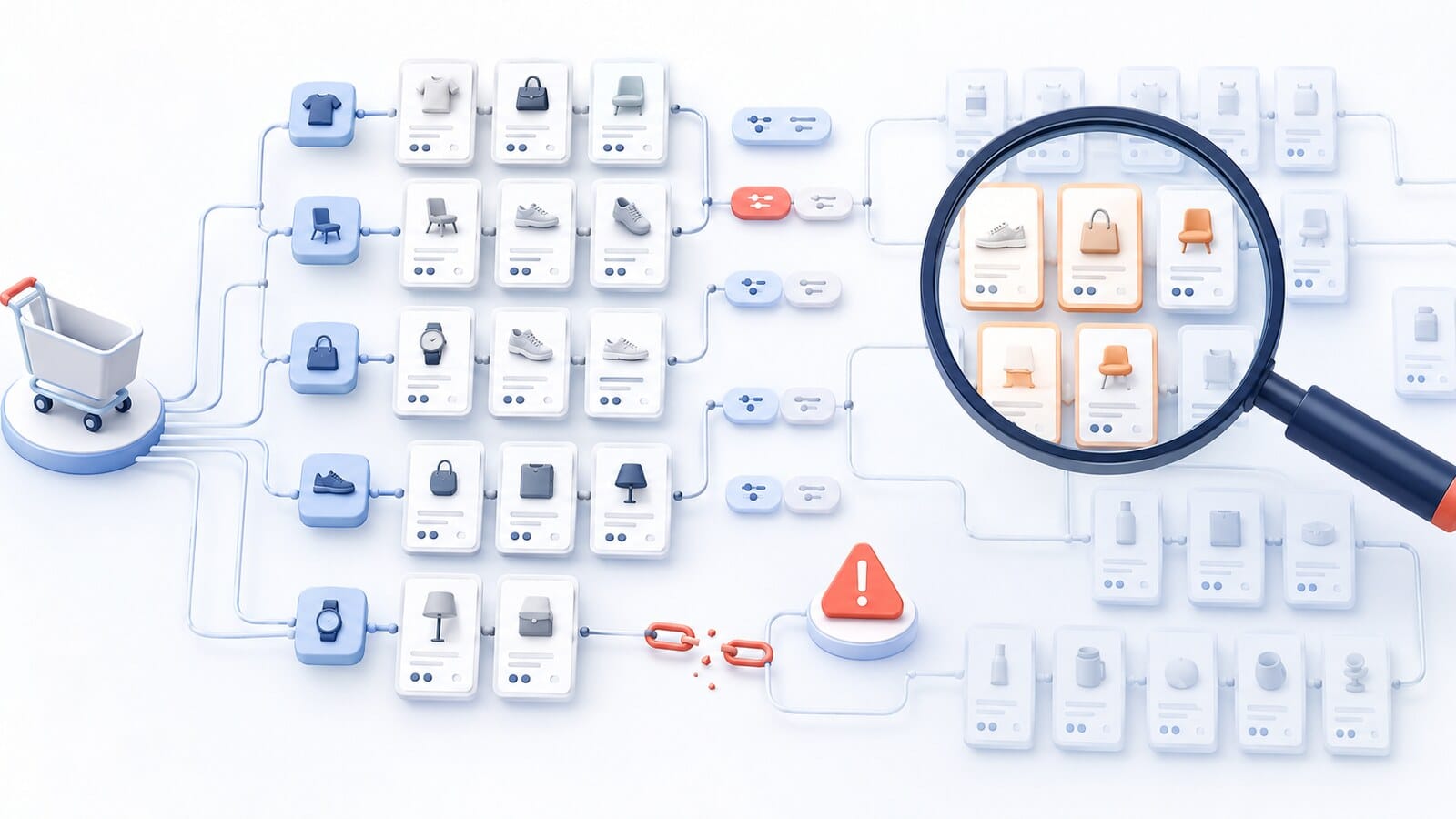
The goal of the service is not simply to attract more visitors. The goal is to help more relevant users reach the right categories and products while giving the store a clearer, manageable and sustainable organic channel.
When the structure is built only around suppliers, internal codes or administrative convenience, important product groups may not have their own category or a suitable landing page.
In other cases, too many nearly identical categories are created. They compete with one another and make the experience more difficult for both users and search engines.
A strong category is more than a list of products. It should answer a clear user need, present the right range and help the customer compare and choose.
When a category has no clear topic, useful context, suitable filters or internal links, it struggles to become a strong organic landing page.
Identical descriptions, incomplete specifications, weak images and missing trust signals limit both SEO potential and conversions.
A product page should help the customer understand whether the product is suitable, how it differs from the alternatives and what they will receive when they order.
Filters are important for user experience, but they can create thousands of combinations with little or no search demand. This wastes crawl resources, creates duplication and makes it harder to decide which pages should be indexed.
Only some filter combinations have a valid reason to become standalone landing pages.
Inconsistencies in price, availability, GTIN, MPN, SKU or variant data can affect rich results, Merchant Center and trust in the product information. The Product Schema and Merchant Center guide explains which data needs to match.
This is not only a technical problem. Incorrect or delayed information can lead to disapproved products, weaker performance and a poor user experience.
The catalog changes every month. Products, categories and promotions are added. Availability changes. Some URLs accumulate value, while others remain without traffic or sales.
That is why e-commerce SEO is not a one-time setup. It requires an ongoing process for monitoring, implementation and regular improvement.
The exact scope depends on the size of the catalog, the platform, its technical condition, the competition and the business priorities. Not every store needs the same actions or the same monthly workload.

Online stores always have more potential tasks than can be completed at the same time. That is why we do not start with the longest list of errors or select topics based only on search volume.
Every task is evaluated against several criteria:
The product group's potential to generate revenue and profit
Whether there is enough relevant demand and what the intent is
Whether investing resources in the category or product group makes commercial sense
Whether the business can realistically serve additional demand
When the work must be completed to allow enough time for results
Whether the issue blocks indexing, crawling or the correct presentation of a large part of the catalog
Whether the change affects one URL, one template or the entire store
Whether a developer, copywriter, product team or external provider is needed
Whether another issue must be solved first
Whether the result can be tracked through landing pages, transactions and revenue
The right priority is usually a combination of quick improvements and larger structural tasks. Some actions can produce a visible effect relatively quickly, while others create the foundation for growth over the following months.
We begin with the store, its data and the real goals of the business. We review the main categories, product catalog, platform, current visibility and available tracking.
We clarify:
We prepare a list of problems and opportunities, then arrange them according to expected value and their dependencies.
The plan may include:
We work within the agreed scope and document what has been completed. Depending on the project, implementation may include changes made directly by our team, tasks assigned to a development team or joint work with an e-commerce manager, product team and copywriters.
We do not consider a recommendation complete simply because it has been sent. What matters is verifying the actual implementation after the change.
We monitor changes in visibility, organic landing pages, clicks, transactions and revenue. The data is considered alongside availability, promotions, seasonality and other factors that may affect the result.
The next tasks are selected according to real progress, not a static list created at the beginning of the engagement.
E-commerce SEO performance cannot be measured by rankings alone. A high position for a weakly relevant search may have no real business value.
When the tracking setup is correct, we monitor:
We do not promise guaranteed rankings or a fixed increase in revenue. Organic results depend on the competition, the condition of the store, technical capabilities, product range, prices, availability and consistency of implementation.

We promise a clear process, reasoned decisions, real work and transparency about what has been completed and why.
The two services solve different problems.
In this case, see our e-commerce website development service.
The project is not an online store, or the main scope is SEO for a company website, services, a B2B project or another type of site. In this case, see our SEO services.
We work with stores on different platforms when we have access to the required data and a realistic ability to implement changes.
The service is suitable for:
WooCommerce stores;
Shopify stores;
OpenCart and Magento projects;
custom e-commerce platforms;
stores with small, medium or large catalogs;
B2C and B2B e-commerce;
stores serving one market or using a multilingual structure;
businesses planning expansion, migration or a major catalog change.
The platform matters, but it is not the only factor. What matters more is whether the necessary changes can be implemented and whether the teams have clear responsibilities.
E-commerce SEO cannot be priced reliably based only on the number of products.
The price and monthly workload depend on:
the size and complexity of the catalog;
the number of important categories, subcategories and product templates;
the platform and its technical limitations;
the number of filter and parameter URLs;
the condition of product data and Merchant Center;
the need for development work;
the amount of content required;
the competition and number of priority product groups;
the markets and language versions;
the available in-house team;
how transactions and revenue will be measured.
After the initial review, we propose a specific scope and monthly plan. Larger catalogs may require an initial stage for diagnostics, prioritization and preparation of the implementation backlog.
Choose an indicative monthly scope based on the size of the catalog, current issues and business priorities.
720 €
For small stores or businesses that want to begin with a limited number of priority product groups.
900 €
For established stores that want continuous development of their organic channel.
1 200 €
For large catalogs, competitive markets, multilingual stores or projects with continuous technical and content tasks.
Important: These plans define an indicative monthly scope. Specific tasks are prioritized according to business value, technical risk and the current condition of the store. A larger structural or technical task may replace several smaller actions. After the initial SEO review, we confirm the appropriate plan and actual scope. All prices include VAT.
Illustrative scenario for SEO Growth or SEO Scale, not a completed project: if the shared product page template does not display important specifications, correcting and checking it may replace several individual text revisions. The work targets a shared issue for the affected products. The specific trade-off depends on the work required and the confirmed scope.
E-commerce problems are rarely solved with text alone or with a technical setting alone. Our team combines SEO strategy, content work and WordPress development, making it easier to implement and verify important changes.
We do not create categories and content simply because a phrase has search volume. We assess whether the page has a clear role, whether the business can serve the demand and whether the investment makes commercial sense.
Every important topic and product group should have the correct landing page. We avoid unnecessary URLs, duplication and content created only for coverage.
The service includes implementation within the agreed scope or specific coordination with the responsible team. After a change, we verify that the result has been implemented correctly.
The monthly report shows what changed and on which pages, why the tasks took priority, how the changes were verified, what the data shows and which tasks come next. We also identify tasks still awaiting implementation or verification, including those that depend on your team.
SeoWebDesign has worked on SEO and web development projects since 2010. A specific assessment requires a review of your store, catalog and current data.
There is no universal timeframe. It depends on the current condition of the store, the competition, the size of the catalog, technical issues and the speed of implementation.
Some corrections can improve crawling, indexing or the presentation of individual pages relatively quickly. Structural changes, category development and sustainable organic growth usually require continuous work over a longer period.
Yes, provided the platform allows the necessary changes and we have access to the data, templates and technical team. Before making an offer, we check what can be implemented directly and what depends on an external developer or platform provider.
No. This is rarely the best first priority.
We first identify the important product groups, template-level issues and pages with the greatest potential. Some improvements can be made through better structure, specifications, media, trust signals and template elements without giving every product a long individual description.
No. Some filter combinations may have genuine search demand and deserve a standalone landing page. Others create duplication and crawl waste.
The decision depends on search intent, business value, the uniqueness of the result and whether the page can be managed effectively over the long term.
It depends on whether the product will return, whether there is a suitable replacement, whether the page receives organic traffic and whether it remains useful.
A temporarily out-of-stock product should often keep its URL. A permanently discontinued product may remain accessible, direct users to an alternative or be redirected depending on the specific case. We do not apply one rule to the entire catalog without checking it.
Yes, for consistency between product pages, structured data and feed information. We check price, availability, identifiers and variant data and coordinate the required corrections.
Full advertising campaign management is not part of this SEO service unless agreed separately.
SEO and paid advertising have different roles. SEO can reduce dependence on paid traffic and develop a sustainable organic channel, but it should not be treated as an immediate replacement for every advertising campaign.
The best allocation depends on margin, seasonality, growth rate and the store's current visibility.
Yes. A standalone diagnostic is a separate service. It ends with findings and a prioritized plan but does not include the continuous monthly implementation work described on this page.
For a standalone diagnostic project, see our SEO audit service.
Yes. When the client's team will carry out the work, we can take responsibility for strategy, control and coordination within a clearly agreed scope.
When you primarily need guidance, mentoring or an independent review, SEO consulting may be more suitable.
To propose a realistic scope, we first need to understand how the catalog is structured, which product groups are important and what the current data shows.
Send us:
We will review the project and propose an individual e-commerce SEO scope with clear priorities, a working process and next steps.


