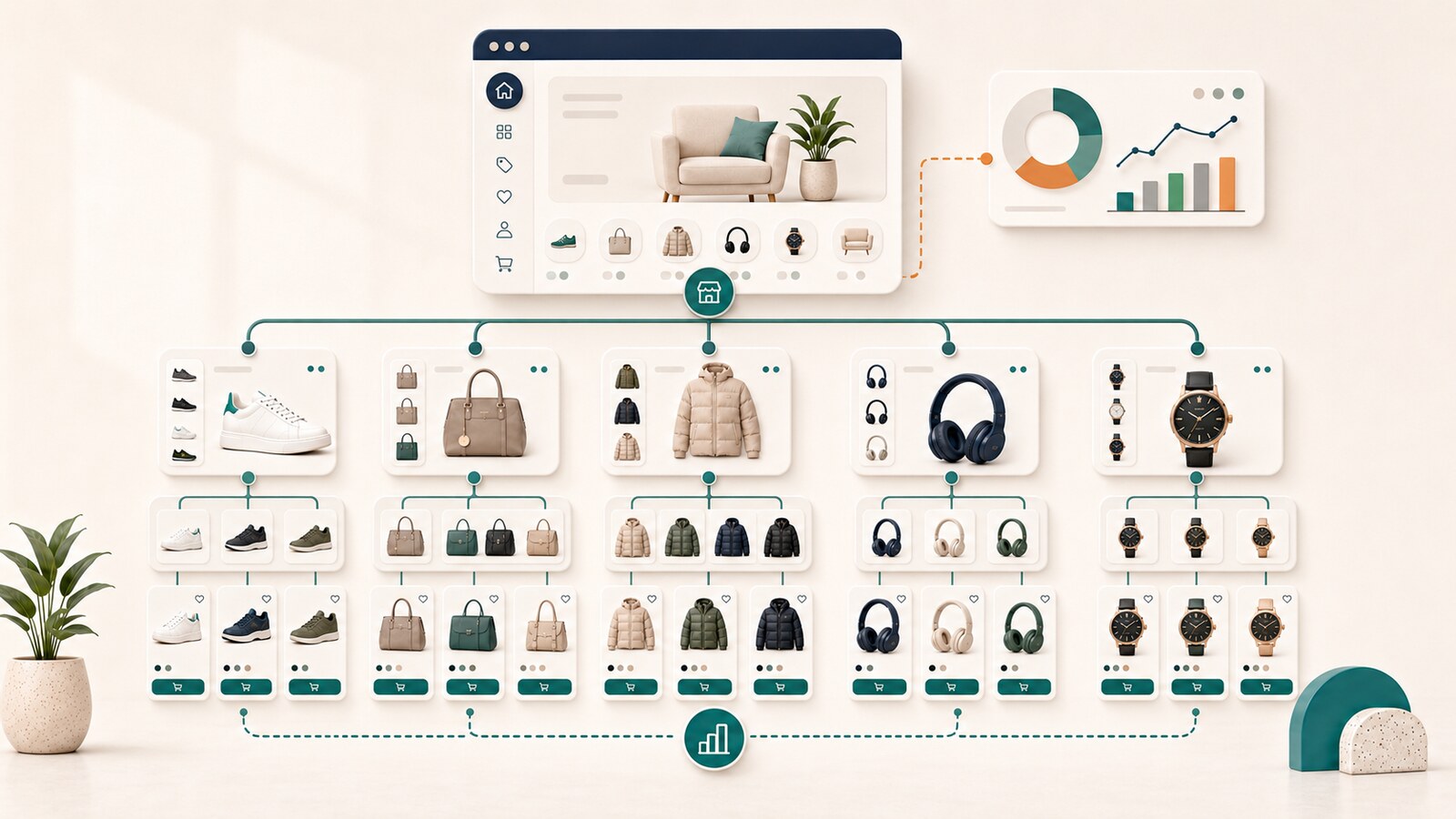
Topical authority is a practical SEO model in which a website becomes more useful and recognizable within a subject area by covering important user tasks through clear, connected, and trustworthy pages.
This does not mean publishing hundreds of articles for every possible keyword. A large number of URLs can produce the opposite result:
The more useful question is not:
How many articles should we publish about this topic?
It is:
Which real tasks must we solve, which URL should answer each task, and how do we know when the topic is covered well enough?
This guide explains how to build topical authority with the minimum useful number of pages, clear boundaries, and demonstrable value.
Topical authority can be described as a website's ability to demonstrate consistent knowledge, experience, and useful coverage within a defined subject area.
It is built at two levels:
For example, a website offering SEO services might have:
These URLs should not repeat the same generic SEO article. Each one should perform a separate function within the site's overall topic structure.
Google does not publish topical authority as a single, standalone ranking factor that can be measured with a specific score.
Its official documentation does, however, confirm several principles closely related to the practical idea of topical authority:
Topical authority should therefore be used as a practical framework for content quality and site structure, not as a promise that publishing a particular number of articles will automatically produce rankings.
DR and DA are metrics created by third-party SEO platforms. They can support backlink analysis, but they do not fully measure whether a website solves a particular topic well.
A website with a high DR may still have weak, outdated, or unsuitable content for a specific subject. A smaller website may provide a far more useful and specialized answer.
Google explains that E-E-A-T is not one specific ranking factor. It is a framework for evaluating experience, expertise, authoritativeness, and trustworthiness.
Topical authority overlaps with these principles, but it is not a synonym for them. A website may cover a topic broadly while still lacking reliable sources, editorial accountability, or real experience.
Five focused primary pages can cover a topic better than fifty repetitive resources.
The number of URLs does not prove:
Using every possible term and variation does not create meaningful depth. Google has systems for understanding concepts, language, and closely related meanings. Every phrasing does not need its own URL.
Even excellent topic coverage does not guarantee a position. Results depend on many factors, including relevance, quality, competition, links, technical accessibility, user context, and the specific query.
Topical authority should not be built by maximizing the number of pages. A more sustainable model is the minimum number of URLs that covers the topic without important gaps or unnecessary overlap.
Every new URL should earn its place.
Before creating a page, check whether it:
When the answer is unclear, improving the existing primary page is often the better action.

Every important topic should have one primary URL.
The primary page provides the main and most complete answer to a specific task. Other pages may mention the subject, but they should not repeat its full scope.
A related page is justified when it:
Example:
| Page | Primary task | What it should leave to another page |
|---|---|---|
| SEO optimization | Help the user choose ongoing SEO execution | Complete educational guides to every SEO discipline |
| Search intent | Match a user task to the correct page type | Diagnosis of competing URLs |
| Cannibalization | Diagnose and resolve overlap between existing URLs | Full classification of search intent |
| Topical authority | Plan complete topic coverage with the minimum useful number of primary pages | Full internal-linking or website-structure methodology |
This allows the pages to complement one another instead of competing as variations of the same general SEO guide. If existing pages already compete for the same task, use the SEO cannibalization guide to assess the overlap before adding another URL.

Improve an existing primary page as far as it usefully can be improved before creating another URL.
A page is not complete merely because it is long. It is sufficiently developed when it:
Create the next URL only when the additional subject requires an independent task, format, or level of depth.
Start by asking why the website should be useful within this topic.
Define:
Google recommends that a website have a primary purpose or focus and that content be useful to an existing or intended audience. Publishing about random trending topics does not build sustainable authority.
Do not begin with a long keyword export. Begin with real tasks.
For each subject area, document:
One task may include many closely related searches. Each wording does not need to become a separate page.
Create a simple page-scope table:
| Field | What to record |
|---|---|
| Topic | The subject or problem |
| Primary URL | The single primary URL |
| User goal | What the user wants |
| Page type | Service, category, product, guide, or another format |
| Covers fully | What the page covers in full |
| Leaves to another page | What it delegates elsewhere |
| Related pages | Only URLs with an independent task |
| Conversion path | The next useful step |
If two URLs receive nearly identical entries, the boundary is not clear enough.
For each primary page, check whether it:
This reveals whether a new URL is necessary or whether the existing primary page should be improved first.
New content should add something that is currently missing.
Original value may include:
Rephrasing the first few Google results is not enough.
Internal links should help the user move to a more appropriate resource. The guide to internal linking explains how to plan those paths and choose useful anchor text.
At a conceptual level:
A full review of internal-link structure, click depth, and link text belongs in a separate internal-linking analysis.
Reliable topic coverage requires more than a clear structure.
Check whether:
Google recommends evaluating content through the questions Who, How, and Why. The reason the content exists is especially important.
Topical authority declines when a website publishes but does not maintain its content.
Each primary page should be reviewed periodically for:
Google explicitly notes that changing dates or adding and removing content in bulk merely to make a website appear fresh is not a useful strategy.

| Situation | Correct action | Reason |
|---|---|---|
| The primary page has a gap, but the user goal remains the same | Update | One URL can solve the task more completely |
| The subtopic belongs naturally within the main answer | Expand the primary page | It does not justify a separate page |
| The subtopic serves a separate user goal and provides independent value | Create a separate URL | It has a clear task and boundary |
| Two URLs solve the same task | Merge | One stronger page is clearer for the user |
| An old URL has been permanently replaced | Redirect | Users and signals are sent to the current page |
| A page has no useful role or value worth retaining | Retire | This reduces the maintenance burden and confusion |
| The topic is outside the business focus and expertise | Do not create it | Search volume alone is not a sufficient reason |

There is no official topical-authority score. Use a set of indicators that reflects the real objective.
Track:
Group related queries by user goal and monitor:
Do not evaluate the topic through one keyword alone.
Check whether the correct primary pages appear for their respective tasks. Overall traffic growth is not enough when the wrong page attracts unsuitable visitors.
Measure whether the content leads to:
Track:
Backlinks, citations, mentions, and recommendations can indicate that content is useful and recognized. They do not replace correct topic coverage and should not be manufactured through unnatural schemes.
This increases the risk of overlap and thin content. One focused page can often satisfy several closely related searches.
A competitor's topic map may provide ideas, but it does not prove that every page they publish is necessary for your audience or business.
Entering unrelated topics only because they appear to offer traffic potential can dilute the website's focus and produce content without trust or original value.
Automation is not a problem by itself. The problem is publishing large volumes of unoriginal content created primarily to manipulate Search.
New articles do not automatically fix outdated pages, duplication, or incorrect internal links.
A strong backlink profile does not prove that a particular topic is covered correctly.
Google does not specify a preferred word count. Length should follow the task, not a predefined SEO template.
A hub page, categories, and many links do not solve the problem when the individual URLs have no independent function.
Imagine a website that offers SEO services and wants to build strong coverage of core SEO topics.
A weak approach would be to publish:
These titles may all attempt to solve almost the same broad task.
A stronger approach is to assign a separate page to each task:
| Primary page | Independent task |
|---|---|
| SEO optimization | Help users choose an ongoing service and execution |
| Search intent | Select the correct page type |
| Cannibalization | Diagnose competing URLs |
| Topical authority | Plan topic coverage and page roles |
| Internal linking | Manage internal links, link text, and pages with no internal links |
| Website structure | Organize page types within hierarchy and navigation |
Each page then receives:
This treats topical authority as a way to organize useful content, not as a race to publish.
There is no universal number. The requirement depends on the topic, user tasks, existing primary pages, and the depth genuinely needed. The objective is the minimum useful number of URLs without important gaps or overlap.
There is no fixed period. It depends on the current state of the website, content quality, competition, technical accessibility, internal and external signals, and the rate of maintenance. A specific ranking timeline should not be promised.
Not necessarily. That model can be useful, but it is not a mandatory technical structure. What matters is having clear primary pages, useful related guides, and logical relationships between them.
No. Links should be contextual and useful. There is no magical number of internal links per page.
Yes. A small website can cover a narrow topic exceptionally well when it has real expertise, original value, and clear architecture. Website size alone does not determine the quality of coverage.
External links and mentions can support discovery, trust, and authority, but they do not compensate for weak, repetitive, or incorrectly targeted content.
Publish when there is a real problem to solve or a meaningful update to make. Artificial frequency and changing dates without substantial improvements do not create value.
A topic is covered sufficiently when important user problems have clear primary pages, the main gaps are resolved, no significant overlap remains, and a proposed new URL cannot demonstrate an independent task and meaningful original value.
For a small website, a topic map may be managed through a simple page-scope table. For a large website, online store, or long-running blog, the analysis normally has to combine:
With our SEO optimization service, we build and maintain the topic structure as part of ongoing SEO execution, from page responsibilities and content to internal links and performance monitoring.
When you have an internal team and need strategy, an independent review, or implementation guidance, SEO consulting is usually the more appropriate format.
Sources reviewed on August 22, 2026.