Product variations may look like a minor technical detail until the catalog starts generating hundreds of nearly identical URLs, conflicting availability data, and confusing product pages.
The same product may be offered in different colors, sizes, materials, power ratings, capacities, or configurations. For customers, this is a normal part of choosing. For the website, however, each variation may change the URL, product name, image, price, availability, SKU, and content.
The problem is not that variations exist. The problem is whether the store has a clear and consistent model for managing them.
A product variation is a choice within one primary product that changes a specific attribute of the offer.
Typical examples include:
Not every difference requires a separate SEO page. Some variations are only states within one product URL. Others may represent a sufficiently different task, specification set, and search demand to justify their own URL.
The primary product page should explain what the product is, who it is for, and what a customer should check before purchasing.
Variation management solves a different set of problems:
A strong product description cannot compensate for a chaotic variation architecture.

The first step is to understand what kind of difference each variation represents.
Color, pattern, or finish often does not change the primary purchase task. These variations can usually remain within one product URL when they have no independent value or stable search demand.
Size changes the physical fit, but it does not always change product intent. For shoes and clothing, one URL with a clear selector is often more useful than dozens of separate pages.
Capacity, memory, power, or connectivity can change price, audience, and use. These cases require a more careful decision.
A different material can affect durability, maintenance, weight, and price. In some cases, this is a genuinely different offer rather than only a visual choice.
A package of two, four, or ten units may have different pricing, search demand, and purchase intent. A bundle should not automatically be treated as an ordinary variation.
A product with many combinable options can create a very large number of URL states. Most of those states do not need crawlable and indexable pages.

There is no universal rule. The decision should follow the value of the variation for the customer and the store's ability to maintain the page.
A separate URL should not be created only because the platform can technically generate one.
Answer these questions:
The more negative answers you have, the weaker the justification for a separate page.
When a customer selects a variation, the page should respond consistently.
The selected state may be preserved through:
Regardless of the model, confirm that:
A common mistake is to point every variation to one parent URL through canonical. This can be reasonable for closely related variations without independent value, but it is not correct for every catalog.
If a separate variation has its own task, content, availability, and search demand, an unconditional canonical to the parent can conflict with the intention to treat it as an independent owner.
The opposite mistake is to give every color and size a self-canonical URL even though the pages are almost identical and cannot be maintained.
The decision must be consistent across:
The exact implementation depends on the platform and should not be copied mechanically from another store.

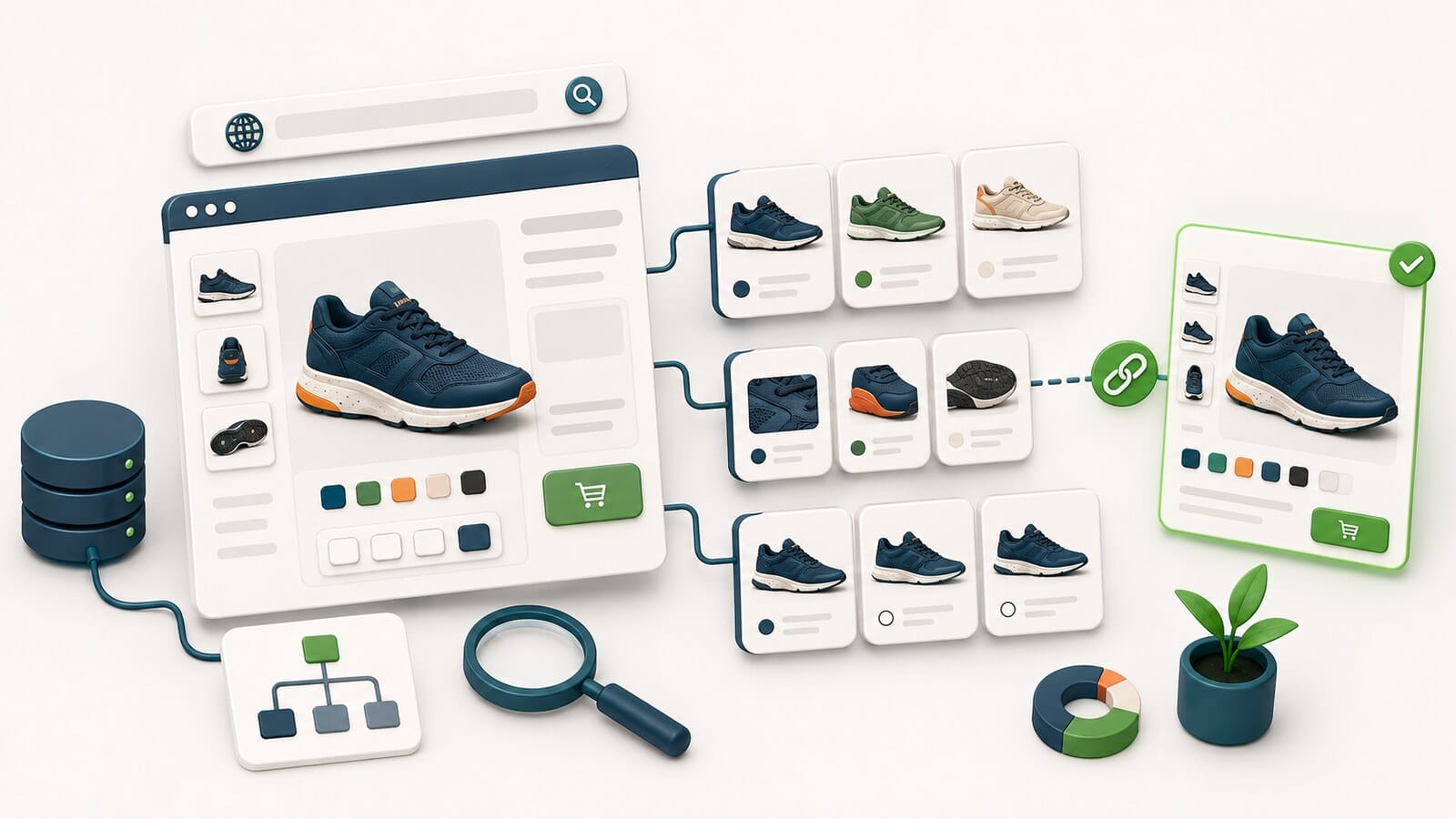
When a customer selects a size, color, or configuration, the page should display information for that exact variation.
Confirm that the selection updates:
If the image shows a black product, the selector indicates blue, and the cart receives red, the issue affects UX, data quality, and commercial risk at the same time. The Product Schema and Merchant Center guide covers consistency between the visible product, structured data, and feed.
For visually distinct variations, the primary image should change with the selection.
Useful images may show:
One generic image for every variation is sufficient only when the difference is not visual or does not influence the decision.
A variation selector should not display generic information when individual variations have different terms.
The customer should understand:
A message such as "from $X" is not sufficient when the selected variation is substantially more expensive and the exact price is not updated clearly.
Products with several attributes can produce combinations that do not exist.
For example, a certain color may not be available in every size.
A good product page should:
An unavailable variation and a discontinued product are not the same thing. Long-term URL lifecycle decisions belong to the separate guide for out-of-stock and discontinued products.
A package can change:
When the bundle represents a separate offer, it may deserve its own product page. When it is only a quantity choice, it may remain a variation within one URL.
The primary question is whether the customer is buying the same product in a different quantity or a genuinely different commercial package.
The variation selector must work on small screens as well.
Check for:
Color should not be the only way to identify the selected variation.
When variations remain within one URL, category and related-product links should normally point to the primary product page or to a clearly selected relevant state.
When separate variations are justified as independent URLs, they should be discoverable through crawlable links and should not depend only on a JavaScript selector.
Do not create internal links to thousands of variation URLs when those URLs have no independent role.
Do not begin by editing every product manually.
Track technical, behavioral, and business signals together.
Useful indicators include:
Fewer URLs are not automatically a success. More indexable variations are not automatically a success either. The objective is a clear architecture that represents real product decisions.

A more detailed review is appropriate when:
In these cases, e-commerce SEO should treat variations as one connected problem involving SEO, UX, development, merchandising, and product data.
When the URL model is defined while the store is being built, the rules should be part of e-commerce website design rather than added after thousands of incorrect URLs have accumulated.
No. A separate URL is justified only when the color has independent value, search demand, and a maintainable page. In many stores, colors are more useful as a selector within one product URL.
Usually not. Sizes often serve the same product task and are easier to manage within one URL. Exceptions are possible when the options represent genuinely different products or audiences.
Not as a universal rule. It may be appropriate for closely related variations, but it can be incorrect for variations with independent value and their own owner intent.
Yes, when it works consistently and does not create unnecessary indexable combinations. The complete URL model, canonical signals, and internal-link logic matter together.
They should not be treated as competing goals. A usable selector, accurate product information, and clear URL signals are parts of the same solution.
Product variations should not be managed through an automatic rule such as "everything under one URL" or "every variation receives a separate page."
The right model begins by classifying variations and understanding the purchase task. It then selects a URL structure that can be maintained and that keeps images, price, availability, specifications, and cart state consistent.
When variations are clear to customers and the signals are consistent, an online store reduces duplication, technical debt, and the risk of incorrect orders. That is the real objective of managing product variations for SEO.