Logo
SEO & Pricing

Off-Page SEO in 2026: Authority, Mentions, and Reputation

what is off page seo
Published on: 25/07/2026
Modified: 27/07/2026

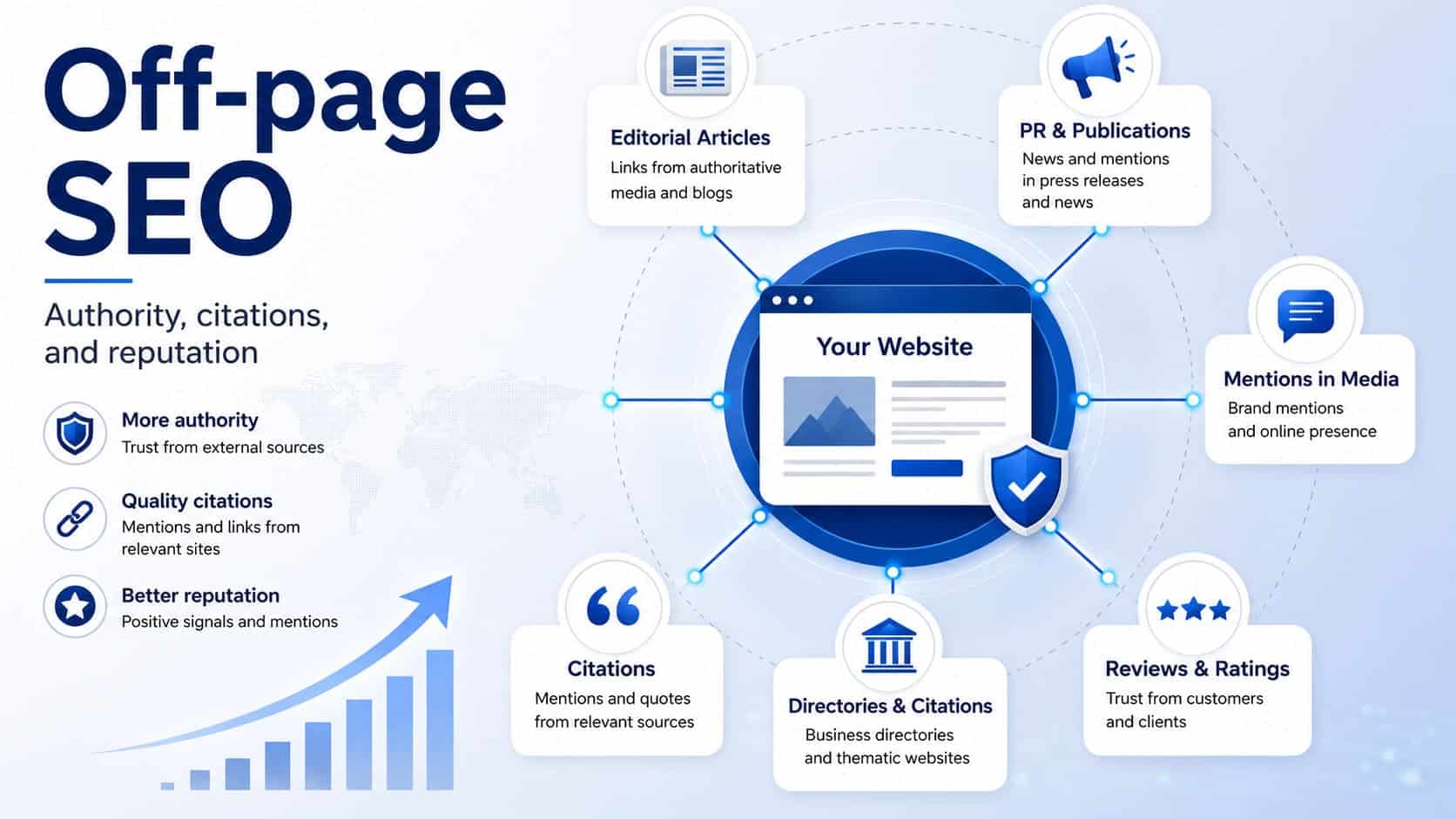
Off-page SEO covers the signals, mentions, relationships, and activities beyond your own website that help people and search systems understand its authority, reputation, and connection to a topic.

It includes editorial links, media coverage, digital PR, local citations, customer reviews, expert visibility, professional relationships, and consistent brand information across reliable external sources.

This guide covers the broad strategy for external authority and reputation. It does not replace the detailed process for earning backlinks, choosing outreach prospects, or managing an individual link acquisition campaign. Technical, content, and external work belong together within a complete SEO optimization program.

What Is Off-Page SEO?

Off-page SEO is the work of building and managing the external authority of a website, organization, or brand.

When independent, topically relevant sources cite, mention, review, or recommend a resource, those signals can support discovery, recognition, referral traffic, and trust.

Off-page SEO may include:

  • editorial links from other websites;
  • media coverage and digital PR;
  • citations of research, data, tools, or expert commentary;
  • linked and unlinked brand mentions;
  • organization and author profiles;
  • local business citations;
  • customer reviews;
  • professional memberships and partnerships;
  • distribution of useful content to relevant audiences.

Not every external signal is a direct ranking factor. A social post, an unlinked mention, a conference profile, or a directory listing should not automatically be presented as the cause of a higher search position.

Its value may instead come from:

  • helping new audiences discover the brand;
  • sending relevant visitors;
  • confirming business or expert information;
  • creating opportunities for later editorial coverage;
  • supporting local discovery;
  • improving reputation and recognition;
  • giving journalists, authors, customers, and partners a source they can verify.

The correct question is not only, "Will this pass ranking value?" It is also, "Does this external presence help a real audience understand, verify, or reach the organization?"

On-Page SEO and Off-Page SEO Are Different

On-page SEO happens within the website. Off-page SEO describes the external environment around it.

On-Page SEOOff-Page SEO
Improves a page on the websiteBuilds authority beyond the website
Covers content and page structureCovers references, mentions, and reputation
Includes title tags, H1s, and metadataIncludes media and industry coverage
Controls internal linksEarns external references
Improves images and relevant markupDevelops digital PR and public trust
Is largely controlled by the site ownerOften depends on independent third parties

The two areas are not interchangeable.

External links cannot turn a weak, misleading, or irrelevant page into the best answer for a user. At the same time, a useful page may remain difficult to discover in a competitive market when nobody outside the website knows it exists.

For improvements made within the page itself, see the separate On-Page SEO guide.

Off-Page SEO Is Broader Than Link Building

Link building is an important part of off-page SEO, but the terms are not identical.

  • Link building focuses on earning or acquiring external links to a website.
  • Off-page SEO covers the broader work of building recognition, reputation, trust, and topical authority beyond the website.

An expert interview may contain a link, but it may also mention only the person and organization. A profile in a professional association may verify a company's membership and activity. Customer reviews may influence a buying decision without passing ranking value through a standard followed link.

The distinction matters because a reputation and authority strategy cannot be measured only by backlink totals.

This guide explains the external authority system as a whole. The separate link building guide covers backlink quality, acquisition methods, anchor text, link attributes, and campaign-level link decisions in greater detail.

Why External Authority Matters

Any website can describe itself as experienced, reliable, innovative, or trusted. Independent evidence is stronger because the organization does not fully control what an outside editor, customer, association, or expert chooses to publish.

External authority can create several types of value.

Discovery

Search engines and people can discover a new page through links from pages they already know. Google's link best practices explain that links help Google find pages and understand their relevance.

A normal crawlable HTML link from an accessible page can create a path to content. The link still needs a logical editorial reason to exist.

Topical Context

A reference from an article about a specific subject provides context about the destination.

That context comes from more than anchor text. It also comes from:

  • the topic of the source page;
  • the surrounding paragraph;
  • the purpose of the citation;
  • the audience of the publication;
  • the relationship between the source and destination.

A topically relevant reference with a clear reason is more understandable than a keyword-rich link inserted into an unrelated article.

Referral Traffic

A well-placed reference can send visitors who are already interested in the subject.

This is practical value even when the link is qualified with nofollow or sponsored. A campaign that produces qualified visits, inquiries, subscribers, or customers may be useful without being evaluated only as a ranking tactic.

Recognition and Trust

Consistent appearances in reliable media, industry publications, associations, local platforms, and professional sources can help people recognize the brand and verify its activity.

One mention rarely changes perception by itself. A coherent external presence develops over time through accurate facts, useful contributions, real relationships, and responsible reputation management.

Future Citations

One strong study, data resource, expert definition, or public tool can be discovered by other journalists and authors. Those later citations may appear without additional outreach.

The compounding effect is one reason original, well-maintained resources can be more valuable than a temporary campaign built around disposable guest posts.

The Main Areas of Off-Page SEO

1. Editorial References

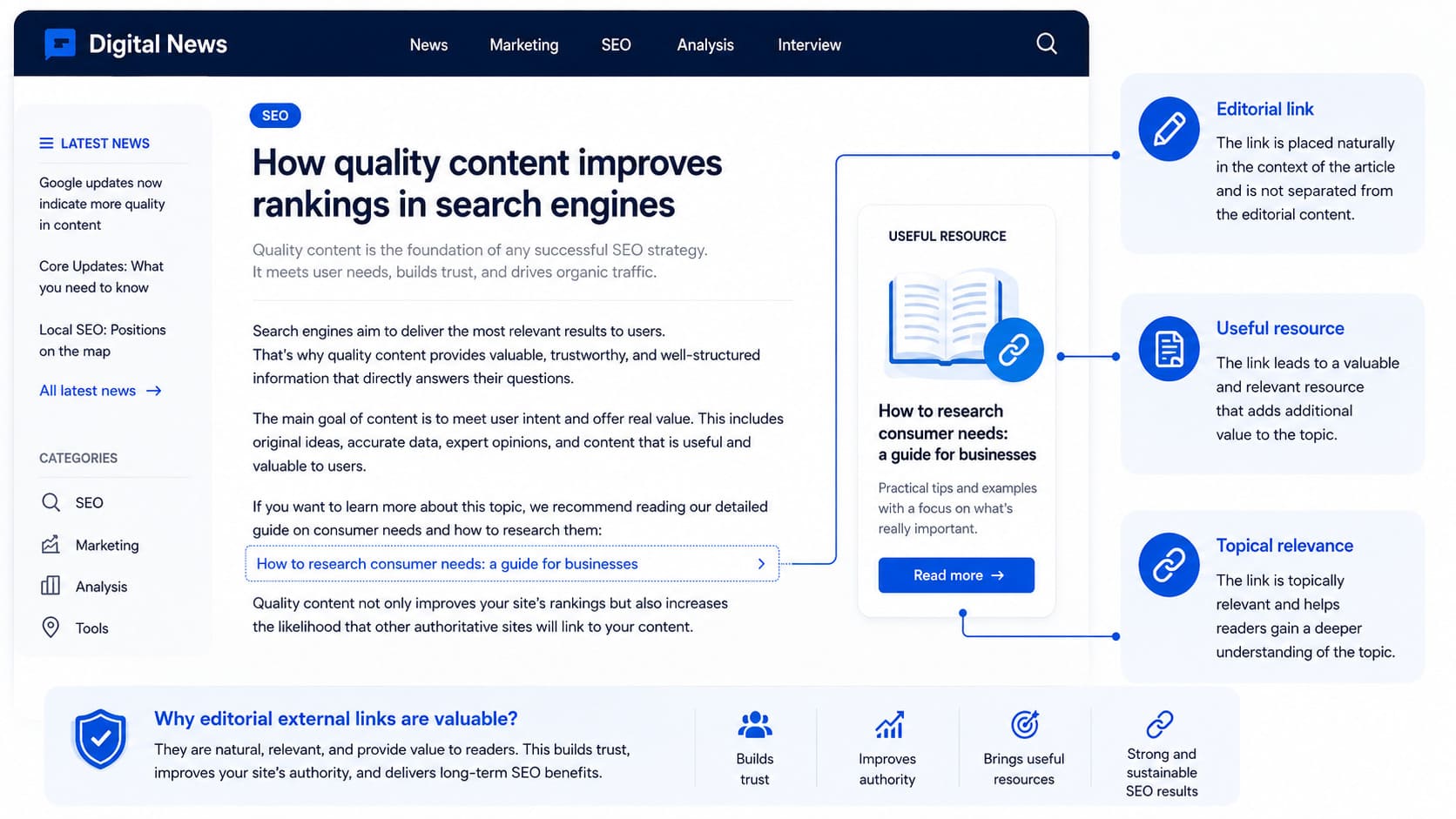
An editorial reference exists because an author or editor decided that the destination supports, explains, verifies, or expands the source material.

Examples include:

  • citing an original study;
  • referencing a detailed guide;
  • linking to official statistics;
  • using a verified expert comment;
  • recommending a useful tool;
  • including a company in a relevant industry analysis;
  • crediting an original chart, image, or dataset.

The strongest editorial reference is not automatically the one from the domain with the highest third-party metric. It has a credible reason to exist and helps the source publication serve its audience.

Detailed methods for earning these links are covered in the link building guide. At the off-page strategy level, the priority is to create information and relationships that make an independent reference reasonable.

2. Digital PR

off page seo digital pr

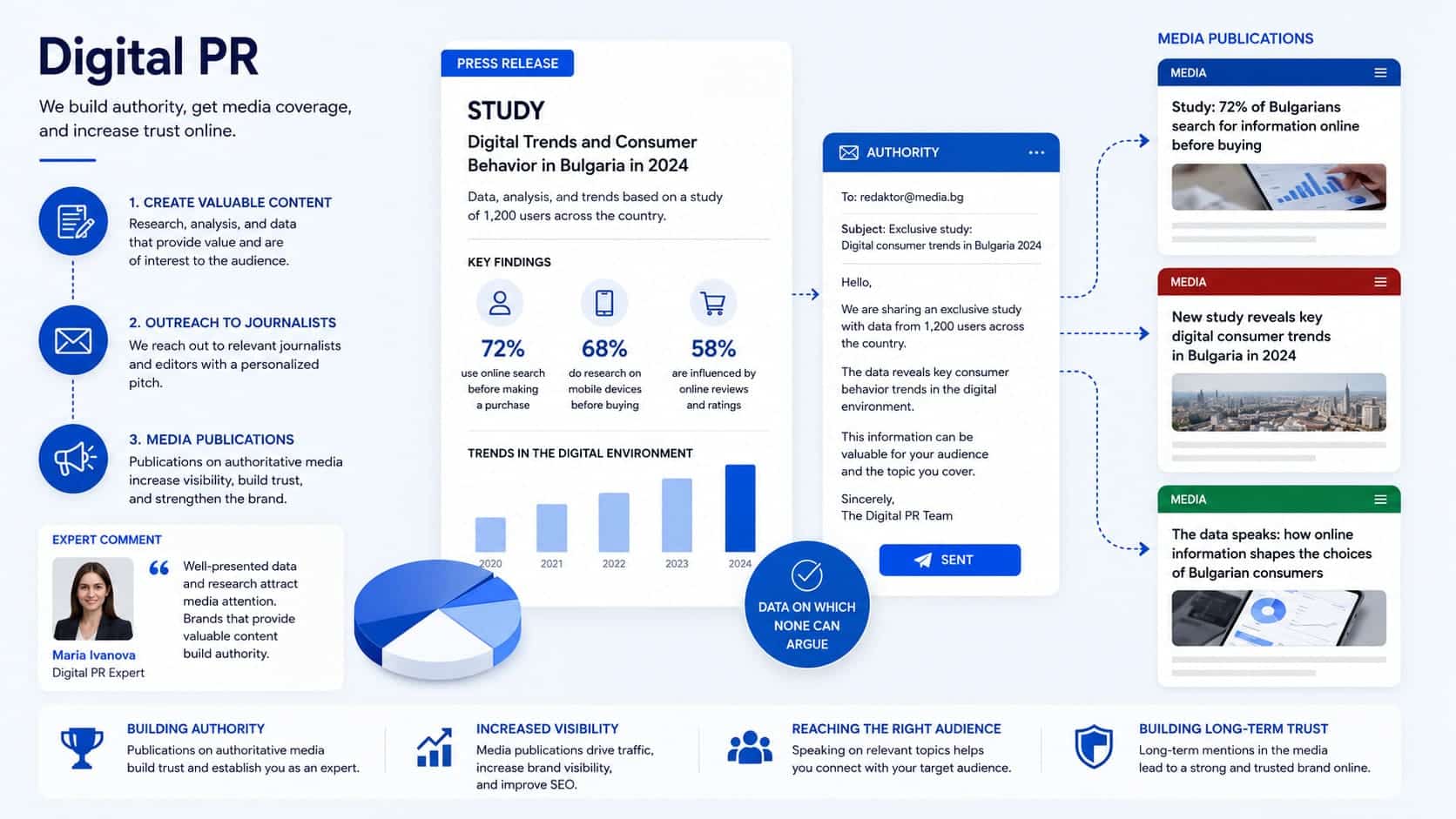
Digital PR combines communications, expert positioning, research, and media relations to earn attention beyond the organization's own channels.

Useful PR assets may include:

  • original research;
  • analysis of market data;
  • a public dataset;
  • an interactive tool;
  • expert commentary on a current issue;
  • a transparent case study;
  • an evidence-based forecast;
  • a map, chart, or original visualization;
  • a documented industry benchmark.

Good digital PR does not begin with a list of websites where a placement can be purchased. It begins with the question:

Why would a journalist, editor, researcher, or professional author find this information useful for their audience?

The answer should be specific. "We want exposure" is not a reason for another publication to cover a story.

A PR Asset Needs Evidence

A publishable claim should have:

  • a clear source;
  • a defined methodology;
  • an appropriate sample;
  • a date;
  • limitations;
  • a named person who can answer questions;
  • a stable page where the supporting material can be reviewed.

Do not present a small internal observation as a national trend. Do not remove inconvenient data points or imply causation when the analysis only shows correlation.

Credibility is part of the asset. A weak methodology may attract short-term attention while damaging the brand when the claim is examined.

3. Brand Mentions

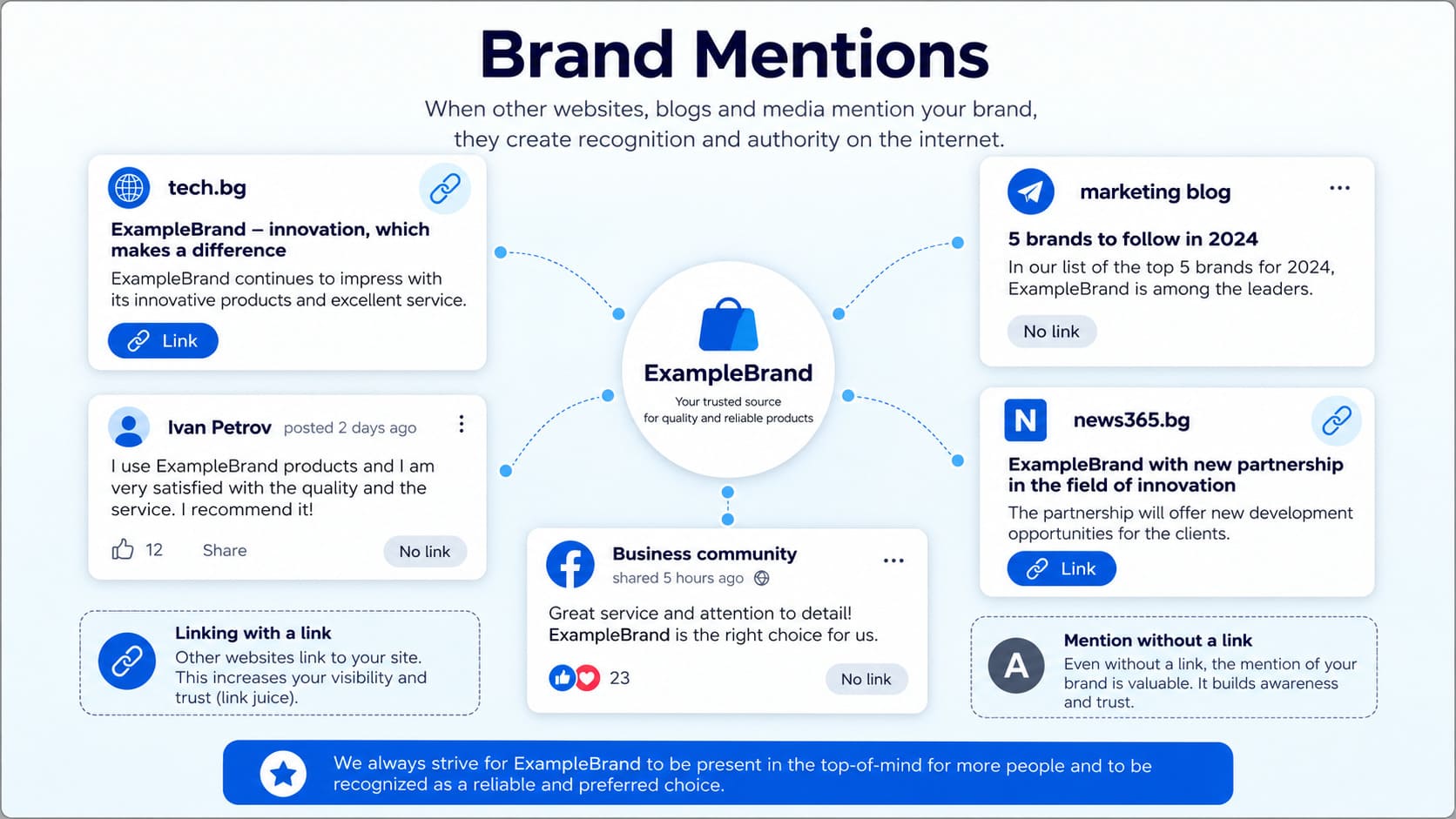
A brand mention is the use of an organization, product, or expert name in an external source.

It may be:

  • linked or unlinked;
  • part of a news article;
  • included in an interview;
  • listed in a professional profile;
  • discussed in an analysis;
  • posted in a customer review;
  • cited in an academic or industry resource;
  • used in a podcast, video, or event description.

Do not claim that every unlinked mention directly improves rankings.

Its practical value depends on the source and context. A meaningful mention can support recognition, branded searches, referral visits, journalist discovery, and future editorial links. An automatically generated mention on a low-quality page may have no useful effect.

Keep Brand Facts Consistent

External sources should use accurate, consistent information about:

  • the official name;
  • product and service descriptions;
  • leadership and authors;
  • location and service area;
  • founding or operating dates;
  • qualifications;
  • contact information;
  • data and claims.

Consistency does not mean forcing every publication to repeat the same promotional paragraph. It means avoiding factual contradictions that make the organization difficult to verify.

4. Reputation and Customer Reviews

off page seo reputation customer reviews

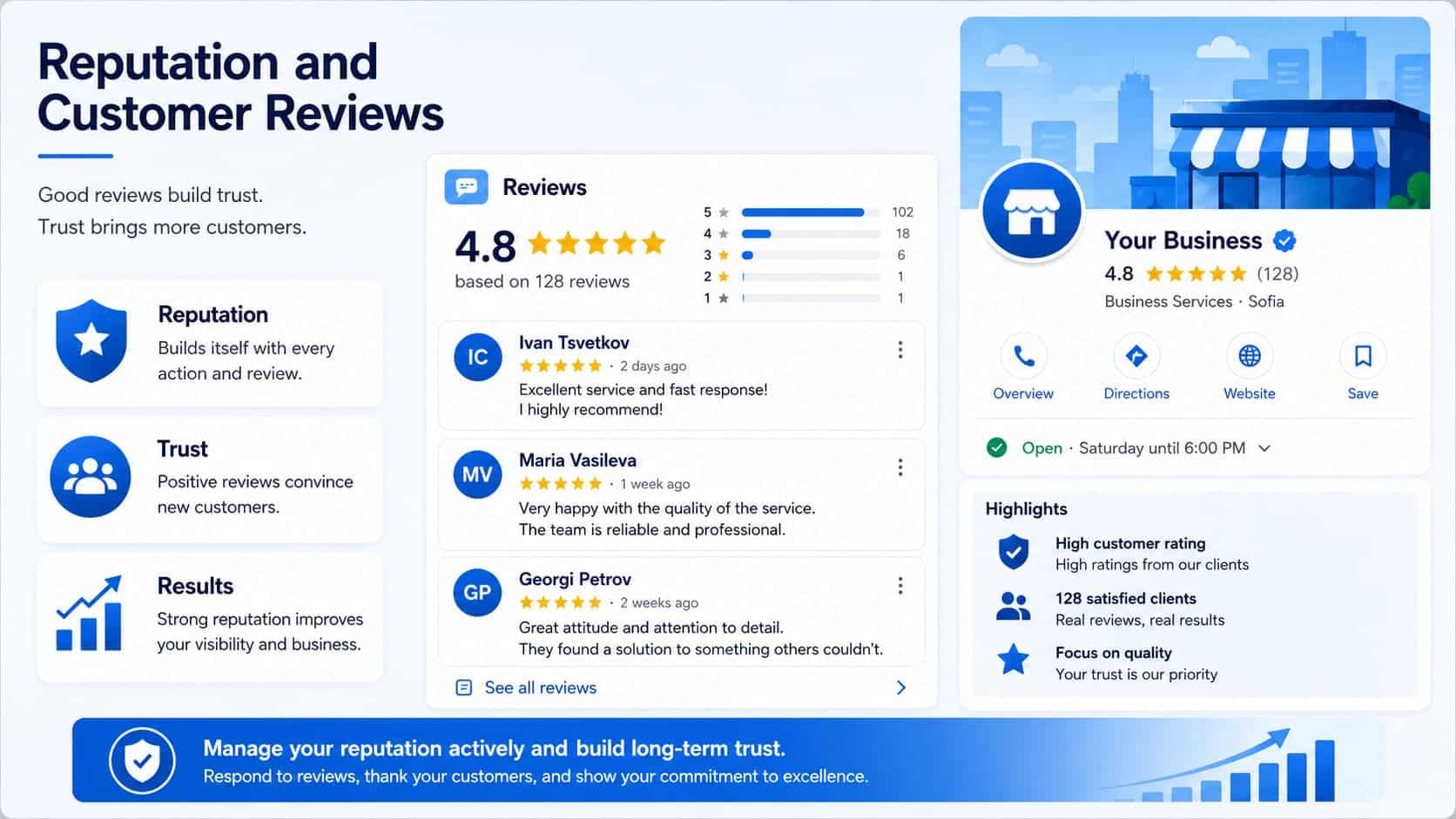
Reviews matter when people compare local businesses, stores, professionals, products, and services.

Reputation work includes:

  • making it easy for real customers to leave honest feedback;
  • responding appropriately to positive and negative reviews;
  • investigating repeated service problems;
  • reporting content that violates a platform's rules;
  • maintaining accurate profiles;
  • training teams to handle complaints consistently;
  • monitoring whether agencies or vendors use prohibited review tactics.

Do not buy fake reviews, use invented identities, or condition an incentive on a positive rating.

The FTC's Consumer Reviews and Testimonials Rule guidance explains the federal rule addressing deceptive and unfair conduct involving reviews and testimonials. The rule covers practices such as fake or false reviews, certain undisclosed insider reviews, and incentives conditioned on a particular sentiment.

Businesses should also review the terms of each platform and obtain qualified legal advice for their specific practices.

Responding to Negative Reviews

A public response should:

  • remain calm and factual;
  • avoid disclosing private customer information;
  • acknowledge the issue without inventing facts;
  • explain a useful next step;
  • move account-specific details to a private channel;
  • avoid pressuring the reviewer to remove an honest opinion.

Repeated criticism is operational data. If many customers report the same delay, billing problem, or communication failure, reputation management should address the cause rather than only the public comments.

5. Local Citations

A local citation is an external mention of core business information in a directory, map service, local publication, industry platform, or other relevant source.

It commonly includes:

  • business name;
  • address or service area;
  • phone number;
  • website;
  • business hours;
  • primary category;
  • short factual description.

The information should remain accurate. Old phone numbers, duplicate profiles, inconsistent names, and incorrect addresses can confuse customers and platforms.

Google's Business Profile guidelines require eligible businesses to represent themselves accurately and consistently. Business Profile eligibility, address display, service areas, and categories should follow the current rules rather than a citation template copied from another business.

For businesses serving a defined city or area, citations belong within a broader Local SEO strategy, not a campaign to create as many directory links as possible.

6. Expert Presence Beyond the Website

Authority is connected to the people who create, review, and stand behind information.

Useful external evidence may include:

  • author profiles in professional publications;
  • conference or webinar participation;
  • podcast appearances;
  • interviews;
  • verified qualifications;
  • membership in relevant organizations;
  • citations of expert commentary;
  • consistent professional biographies;
  • profiles on institutional or industry websites.

The goal is not to create dozens of empty profiles. Each profile should be real, accurate, maintained, and connected to the person's actual work.

Verification Matters More Than Volume

An expert profile is stronger when it shows:

  • the person's real role;
  • relevant experience;
  • subjects on which the person is qualified to comment;
  • published work;
  • an institutional or company connection;
  • a way to verify important credentials.

Do not add qualifications that cannot be substantiated. A polished biography cannot replace actual expertise.

7. Partnerships and Professional Relationships

Real business relationships can create natural opportunities for relevant references and mentions.

Examples include:

  • an official partner profile;
  • joint research;
  • an integration between products;
  • a documented customer or partner case study;
  • an educational initiative;
  • membership in a professional association;
  • a transparently disclosed sponsored event;
  • a resource page for customers and partners.

The link or mention should follow from the relationship. It should not be the only reason the relationship exists.

Partnership pages need editorial control. Do not require optimized followed links in a contract when the publisher would not otherwise choose to place them. Google's spam policies identify required links and excessive cross-linking created for ranking purposes as potential link spam.

8. Distribution of Useful Content

off page seo useful content distribution

Even an excellent resource may remain unnoticed if the right audience never learns about it.

Distribution may include:

  • notifying people cited in the resource;
  • sharing with relevant professional communities;
  • including it in a topical newsletter;
  • presenting original data to journalists;
  • publishing useful extracts through social channels;
  • using the material in webinars, presentations, and training;
  • contacting publications for which the resource is genuinely relevant.

Social engagement should not be promised as a direct ranking boost. Social channels are distribution environments where people can discover, discuss, visit, recommend, or cite the resource.

Distribution should match the asset. A technical dataset may be useful to trade journalists and analysts. A local consumer survey may fit local media. A professional checklist may be valuable to associations, training programs, and practitioners.

How to Evaluate an External Source

No single metric can determine whether a publication, website, profile, or reference is valuable.

DR, DA, Authority Score, and similar values are estimates from third-party SEO tools. They are not official Google scores and should not be the only decision criterion.

Review the source in context.

Topical Relevance

Is there a genuine relationship between the source subject and the destination?

A citation in a specialized article within the same industry usually has clearer editorial logic than a link inserted into an unrelated post.

Editorial Quality

Look for:

  • real authors;
  • a visible editorial purpose;
  • original reporting or analysis;
  • corrections and update practices;
  • clear ownership;
  • useful content for a defined audience.

Be cautious when a site publishes large volumes of short articles across unrelated industries and nearly every article contains optimized commercial links.

Real Audience

Ask whether the source reaches people who could reasonably care about the destination.

Traffic estimates from SEO tools can help with research, but they are not exact analytics. Review the publication's audience, distribution, engagement, and relevance rather than treating an estimate as verified traffic.

Context of the Reference

The surrounding copy should explain why the destination is useful.

A reference attached to a relevant source, statistic, definition, or practical next step is easier to justify than a random commercial phrase.

Outbound Link Pattern

Review where the site links and why.

A publication that repeatedly links to gambling, loans, crypto offers, health products, and unrelated services through optimized anchor text may exist primarily to sell placements.

One unusual link is not proof of a problem. Evaluate the overall pattern, editorial quality, and context.

Technical Accessibility

The source page should be public and technically accessible.

Check:

  • the final response code;
  • noindex;
  • canonical behavior;
  • robots restrictions;
  • whether the link is present in the rendered HTML;
  • whether the content remains available after publication.

A link on an inaccessible or temporary page may offer little discovery or referral value.

Placement and Durability

A reference in the primary article content is different from one hidden in an automatically generated archive, author box, unrelated sidebar, or sitewide footer.

Also review whether published pages remain accessible or are routinely deleted after a short period.

Standard, Sponsored, UGC, and Nofollow Links

External links can use different rel values.

Standard Link

<a href="https://example.com/research/">Original research</a>

This link has no additional qualification.

Sponsored

<a href="https://example.com/" rel="sponsored">Sponsor</a>

Google recommends sponsored for advertisements, paid placements, sponsorships, and other compensated links.

UGC

<a href="https://example.com/" rel="ugc">Community resource</a>

Google recommends ugc for links in user-generated content such as comments and forum posts.

Nofollow

<a href="https://example.com/" rel="nofollow">External resource</a>

nofollow can be used when the publisher does not want to associate the site with the destination in the standard way and another value is not more appropriate.

Google's outbound link qualification guidance says sponsored is preferred for paid links, while nofollow remains acceptable for that purpose.

Do not evaluate an opportunity only by asking whether it provides a standard or nofollow link. A relevant media placement may generate discovery, trust, referral traffic, and later coverage even when its link is qualified.

The detailed selection and interpretation of link attributes are covered in the link building guide. Off-page strategy should ensure that paid, editorial, and user-generated relationships are represented honestly.

When External Promotion Becomes Link Spam

Google defines link spam as creating links to or from a site primarily to manipulate search rankings.

Its current spam policies for Google Web Search identify practices such as:

  • buying or selling links for ranking purposes;
  • excessive link exchanges;
  • automated link creation;
  • low-value content created mainly for linking;
  • links from hacked sites;
  • hidden links;
  • spam in comments and forums;
  • optimized links in paid advertorials or distributed press releases;
  • large-scale low-quality guest posting;
  • required links that do not let the third-party publisher qualify them.

Paid advertising and sponsorship are legitimate parts of the web. The SEO risk appears when compensation is hidden and links are structured to pass ranking credit or manipulate results.

Paid Content Also Needs Clear Disclosure

Search qualification and consumer disclosure are related but different responsibilities.

A rel="sponsored" value helps search systems understand a compensated link. It does not automatically tell a reader that an article, endorsement, or recommendation is advertising.

The FTC's endorsement guidance explains that material connections between advertisers and endorsers may need clear and conspicuous disclosure. The correct disclosure depends on the facts, format, and audience.

Use both the proper public disclosure and the appropriate link qualification. Do not treat one as a substitute for the other.

Natural Anchor Text at a Strategy Level

Anchor text is the visible text of a link.

A natural external profile may contain:

  • the brand name;
  • the plain URL;
  • the title of a resource;
  • an author's name;
  • a partial description;
  • a contextual phrase;
  • a generic phrase when it fits the sentence.

Not every external link needs to use the primary commercial keyword. A highly repetitive exact-match profile can look controlled and manipulative.

With genuine editorial coverage, the publisher often chooses the wording that works best for its readers. A brand should not damage an otherwise strong relationship by demanding awkward anchor text.

Detailed anchor evaluation and campaign decisions are covered in the link building guide.

Create Resources Worth Citing

The most durable way to support editorial references is to publish something another author has a reason to use.

Original Data

Publish a study, a documented analysis of anonymized first-party data, or a repeatable observation about a market.

Explain:

  • the source of the data;
  • the collection period;
  • sample size;
  • inclusion and exclusion rules;
  • calculation method;
  • important limitations.

A result without methodology is difficult to evaluate and risky to cite.

Practical Tools and Templates

Useful assets may include:

  • calculators;
  • checklists;
  • worksheets;
  • templates;
  • decision trees;
  • public reference tables;
  • comparison tools.

The tool should solve a real problem. A thin template created only to collect links is unlikely to earn long-term use.

Transparent Case Studies

A case study should show:

  • the starting situation;
  • the work completed;
  • the time period;
  • measured results;
  • constraints;
  • what cannot be generalized.

"We increased traffic" is not enough. Readers need context to understand what changed and why the case matters.

Expert Definitions

Clear explanations of complex concepts may be cited by other authors when they reflect real expertise and avoid unnecessary marketing claims.

Definitions should be specific enough to distinguish the term from related concepts.

Original Visualizations

A chart, map, diagram, or infographic can make complex information easier to interpret and reuse.

Publish the source data or methodology where practical, and explain the usage or attribution terms.

Maintained Reference Resources

A glossary, timeline, database, benchmark, or comprehensive guide can continue earning citations when it is updated consistently.

Changing the date without reviewing the underlying content is not maintenance. Update the facts, sources, examples, and limitations.

Off-Page SEO for AI Search and Citations

External authority also matters in a search environment where users receive generated summaries, comparisons, and answers.

Independent sources can contribute to a richer digital record when:

  • the brand is described consistently;
  • experts have verifiable profiles and publications;
  • original data is cited elsewhere;
  • key facts do not contradict one another;
  • media and industry sources confirm real activity;
  • content is connected to identifiable people and organizations;
  • external publications use accurate references.

This does not mean a business can "train" an AI system by repeating the same claim across a network of controlled sites.

Google's 2026 guide to generative AI features specifically advises against seeking inauthentic mentions. It says foundational SEO, useful original content, crawlability, and compliance with Search policies remain important.

For other AI systems, discovery, retrieval, and citation behavior may differ. No off-page campaign can guarantee that a particular model will mention or cite a brand.

The objective should be an accurate, useful, verifiable external presence, not a collection of repeated superlatives such as "best company" or "leading solution."

The separate GEO and AEO guide explains the broader relationship among SEO, answer engines, and generative search.

A Practical Framework for External Authority

The framework below stays at strategy level. Detailed prospecting, outreach, link negotiation, and anchor decisions belong to the link building guide.

1. Audit Existing External Signals

Review:

  • which domains link to the website;
  • which pages receive links;
  • the common anchor patterns;
  • important lost links;
  • suspicious or manipulated patterns;
  • linked and unlinked brand mentions;
  • local citation consistency;
  • expert and organization profiles;
  • review volume, quality, and repeated complaints;
  • how the profile compares with real search competitors.

Google Search Console's Links report shows a sample of top linked pages, linking sites, and linking text. Third-party tools can provide additional discovery, but their link indexes and proprietary metrics will differ.

This work can be part of a full SEO audit when external authority needs to be evaluated together with content, indexation, and technical condition.

2. Define the Authority Gaps

Identify where the external record is weak or inconsistent.

Examples include:

  • a strong service with no independent explanations or case studies;
  • research that is useful but difficult to cite;
  • experts with no verifiable external profiles;
  • conflicting business information;
  • important pages receiving no references;
  • media coverage that points only to the homepage;
  • reviews revealing a recurring operational issue;
  • competitors earning coverage through data the business could produce more credibly.

Do not convert every gap into a link quota. Different gaps require different responses.

3. Select the Pages and Entities That Need Support

Not every external reference should point to the homepage.

Logical destinations may include:

  • original research;
  • a useful tool;
  • a primary category;
  • a detailed informational guide;
  • an important service page;
  • a public case study;
  • a reference resource;
  • an author or organization profile when that is the subject.

The source should have a clear reason to reference that exact destination.

Also consider the entity being established. Is the campaign supporting a brand, product, service, location, expert, study, or tool? The answer affects the sources, claims, and evidence that make sense.

4. Build a Citable Asset

Before promotion, prepare:

  • original information or a useful synthesis;
  • a clear practical purpose;
  • a transparent methodology;
  • facts that are easy to verify;
  • supporting visuals;
  • author and organization information;
  • a publication or update date;
  • a stable URL;
  • a contact for questions and corrections.

The resource should still be worth publishing if no website links to it immediately.

5. Match the Asset to Relevant Audiences

Choose audiences and sources according to:

  • subject matter;
  • editorial purpose;
  • reader needs;
  • geographic relevance;
  • type of evidence;
  • format;
  • the source's actual standards;
  • whether the resource improves an existing story or solves a reporting problem.

Do not start with an automated list of thousands of domains. Start with the people and publications for whom the asset is genuinely useful.

6. Maintain Accuracy and Relationships

Monitor:

  • new and lost editorial references;
  • referral traffic;
  • media contacts;
  • brand mentions;
  • review trends;
  • local profile accuracy;
  • expert profiles;
  • changed or removed publications;
  • opportunities to update cited data;
  • factual errors that need correction.

Off-page SEO accumulates over time. One strong resource can have long-term value, but the external record still needs maintenance.

How to Measure Off-Page SEO

No single metric can represent the entire outcome.

Use a group of measurements tied to the campaign's actual purpose.

Editorial Links and Referring Domains

Track important new and lost referring domains, but review them in context.

Count alone does not show relevance, editorial quality, placement, referral value, or business impact.

Distribution Across Pages

Check whether external references support only the homepage or also point to research, guides, tools, categories, services, locations, and other useful destinations.

Referral Traffic

Measure:

  • sessions from the source;
  • engaged visits;
  • signups;
  • inquiries;
  • purchases or other appropriate actions;
  • assisted conversions when the analytics setup supports them.

Do not attach tracking parameters to internal links. For external campaign links, follow the organization's approved analytics and disclosure policy rather than inventing a tracking structure in article copy.

Brand Mentions

off page seo brand mentions

Monitor media coverage, interviews, discussions, videos, podcasts, and unlinked references.

An unlinked mention may be a useful relationship or correction opportunity. It is not automatically a request to pressure the publisher for a link.

Review and Reputation Trends

Evaluate:

  • recurring topics;
  • response quality;
  • resolution time;
  • changes in service issues;
  • platform compliance;
  • suspicious review patterns.

The goal is not only a higher average score. It is a more accurate and trustworthy customer record.

Local Citation Accuracy

For local businesses, track whether major profiles show the correct name, address or service area, phone number, hours, category, and destination URL.

Search and Topic Visibility

Review whether supported pages improve across a relevant topic group, not only one keyword.

An external campaign should be evaluated alongside content changes, technical work, seasonality, brand campaigns, and other factors. Correlation does not prove that one link or mention caused a ranking change.

Branded Search

Growth in searches for the brand or expert name may indicate greater recognition. Interpret it alongside PR activity, advertising, events, seasonality, and offline exposure.

Media and Professional Relationships

Useful outcomes include:

  • journalists returning for expert comment;
  • associations inviting participation;
  • repeat citations of maintained data;
  • partners collaborating on a new resource;
  • customers discovering the organization through trusted sources.

These relationships may produce value beyond one report or one link.

Common Off-Page SEO Mistakes

Evaluating Sources Only by DR or DA

A high proprietary metric does not guarantee topical relevance, a real audience, editorial standards, or referral value.

Buying Large Numbers of Cheap Links

Volume cannot replace editorial logic. A large group of low-quality placements can create a manipulated pattern without building reputation.

Repeating Exact-Match Anchors

When many links use the same commercial phrase, the profile can appear controlled and unnatural.

Sending Every Link to the Homepage

Research, tools, guides, categories, and service pages can also deserve direct references.

Publishing on Unrelated Websites

A link to an SEO service inside an article about an unrelated subject has little editorial logic even when the source has a strong third-party score.

Promoting Weak Content

Distribution and outreach cannot compensate for a resource that lacks original value, evidence, clarity, or a useful purpose.

Treating Social Signals as a Guaranteed Ranking Factor

Social platforms can support distribution, community, recognition, and discovery. Likes and shares should not be sold as an automatic ranking increase.

Hiding Paid Relationships

Paid and sponsored relationships need appropriate consumer disclosure and link qualification.

Creating Empty Profiles

Hundreds of unused directories and social profiles rarely establish real authority. Maintain the profiles that serve a genuine audience or verification purpose.

Ignoring Review Compliance

Fake reviews, hidden insider relationships, sentiment-conditioned incentives, and suppression of honest negative feedback create legal, platform, and reputation risk.

Confusing Repetition With Verification

Publishing the same self-promotional claim on many controlled sites does not make it independent evidence.

Off-Page SEO Checklist

practical off page seo checklist

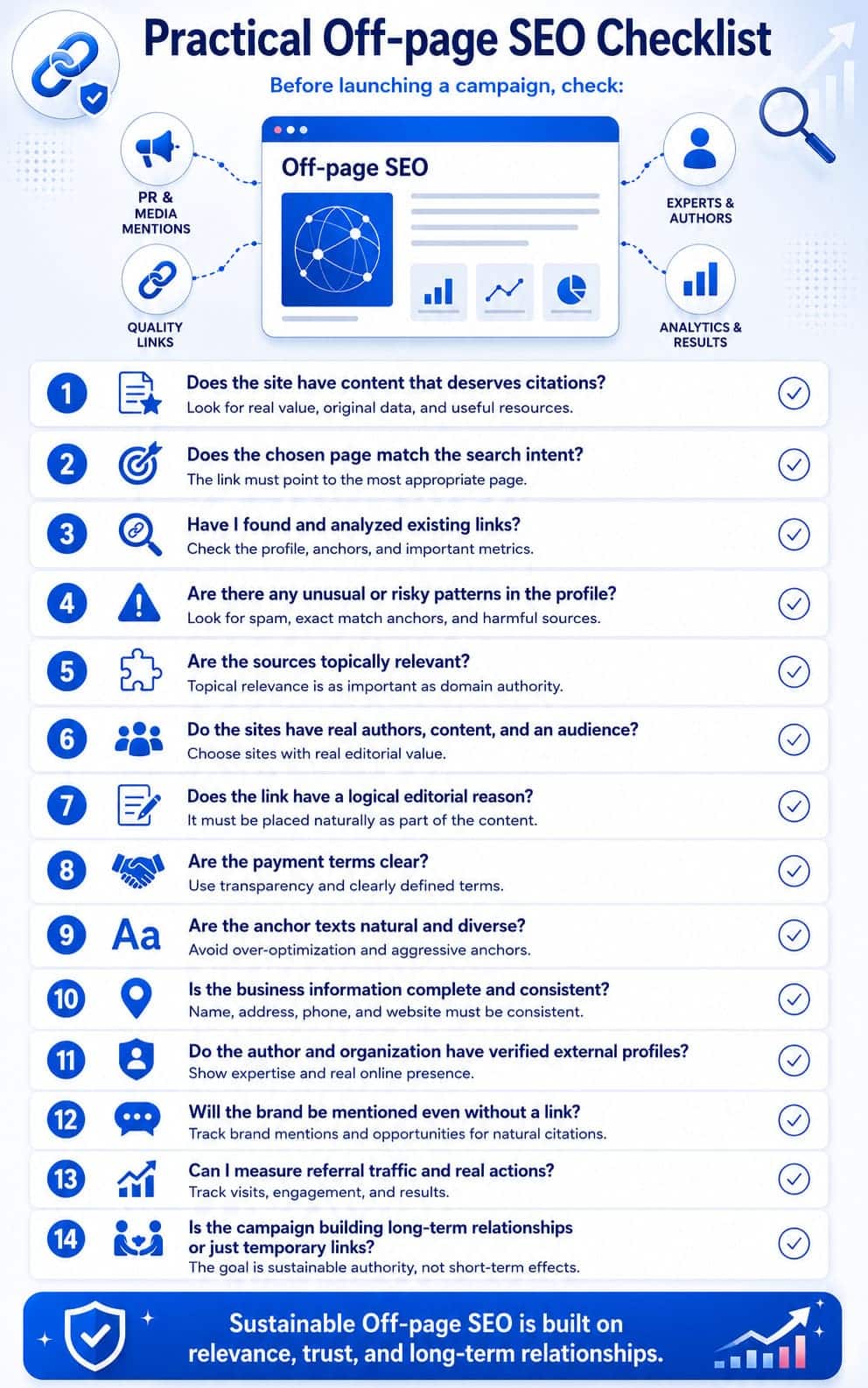
Before starting an external authority campaign, confirm:

  • [ ] The website has a resource worth citing.
  • [ ] The target page satisfies its search intent.
  • [ ] Existing external links and mentions have been reviewed.
  • [ ] Suspicious patterns are documented without assuming every unfamiliar link is harmful.
  • [ ] The campaign supports a defined brand, expert, product, service, location, or resource.
  • [ ] Potential sources are topically relevant.
  • [ ] Sources have real authors, content, and an appropriate audience.
  • [ ] Every requested reference has a logical editorial reason.
  • [ ] Paid relationships will be disclosed clearly.
  • [ ] Compensated links will use an appropriate rel value.
  • [ ] Anchor text will remain natural and varied.
  • [ ] Brand and business information is accurate and consistent.
  • [ ] Expert profiles reflect verifiable experience.
  • [ ] Review collection complies with current law and platform policies.
  • [ ] Local citations follow current Business Profile and directory rules.
  • [ ] Referral traffic and meaningful actions will be measured.
  • [ ] Brand mentions and review trends will be monitored.
  • [ ] Original data includes a methodology and limitations.
  • [ ] The campaign builds relationships, not only temporary placements.
  • [ ] Results will be evaluated with several metrics, not one third-party score.

Frequently Asked Questions

What Is Off-Page SEO?

Off-page SEO is the work of building a website's or brand's authority, recognition, reputation, and visibility beyond its own pages. It includes editorial references, digital PR, brand mentions, reviews, local citations, expert profiles, partnerships, and distribution.

Are Off-Page SEO and Link Building the Same?

No. Link building focuses on external links. Off-page SEO also includes reputation, unlinked mentions, local citations, professional profiles, reviews, media relationships, and digital PR.

How Many Backlinks Are Needed to Reach Page One?

There is no universal number. The result depends on search intent, competition, page quality, topical relevance, source quality, existing authority, and many other factors. A high number of weak links does not guarantee rankings.

What Is the Best Backlink?

The most useful link usually comes from a reliable, topically relevant source, appears in an editorially appropriate context, and helps real readers. Detailed backlink evaluation belongs to the separate link building guide.

Are Nofollow Links Harmful?

No, not by default. A nofollow link from a relevant publication can still generate referral traffic, recognition, trust, and future coverage. A reference should not be judged only by its rel value.

Can a Business Pay for a Publication?

Paid and sponsored content can be part of advertising or PR, but the commercial relationship should be disclosed to readers and the links should be qualified appropriately. Buying links primarily to manipulate rankings creates risk under Google's spam policies.

Do Unlinked Brand Mentions Help?

They can support recognition, reputation, discovery, branded search, and later citation opportunities. They should not automatically be described as a direct ranking factor.
Can Reviews Be Incentivized?

The answer depends on the exact program, disclosure, platform rules, and applicable law. Under the FTC's Consumer Reviews and Testimonials Rule, compensation or incentives cannot be conditioned on a review expressing a particular positive or negative sentiment. Obtain qualified legal advice before launching an incentive program.

How Does Off-Page SEO Support AI Visibility?

Accurate independent coverage, verifiable expert profiles, consistent brand facts, and citations of original work create a richer external record. They may help systems discover or verify information, but they do not guarantee a mention or citation in a particular AI response.

Sustainable External Authority Is Earned Over Time

Effective off-page SEO is not a contest to collect the largest number of backlinks. It is the work of creating legitimate reasons for journalists, customers, experts, associations, partners, and industry publications to discuss a brand and use its resources.

Editorial links are one outcome of relevance, usefulness, evidence, and trust. Digital PR, expert visibility, original data, local accuracy, customer reviews, and professional relationships build a broader external record.

When on-site content, technical quality, and external authority support the same topics and claims, the organization becomes easier for people, Google, and generative systems to understand and verify.

Official Sources

Гласувай
crosschevron-down