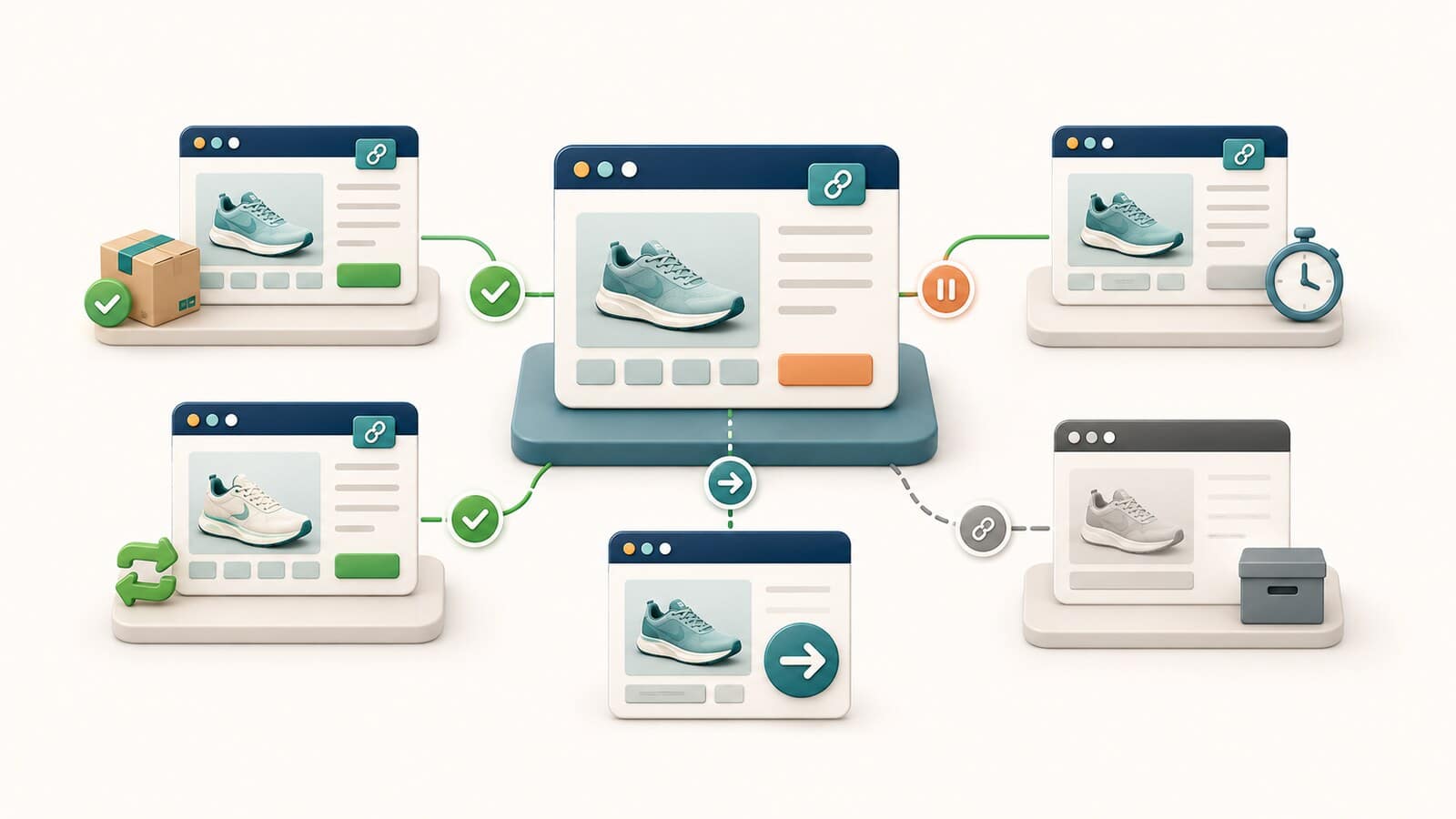
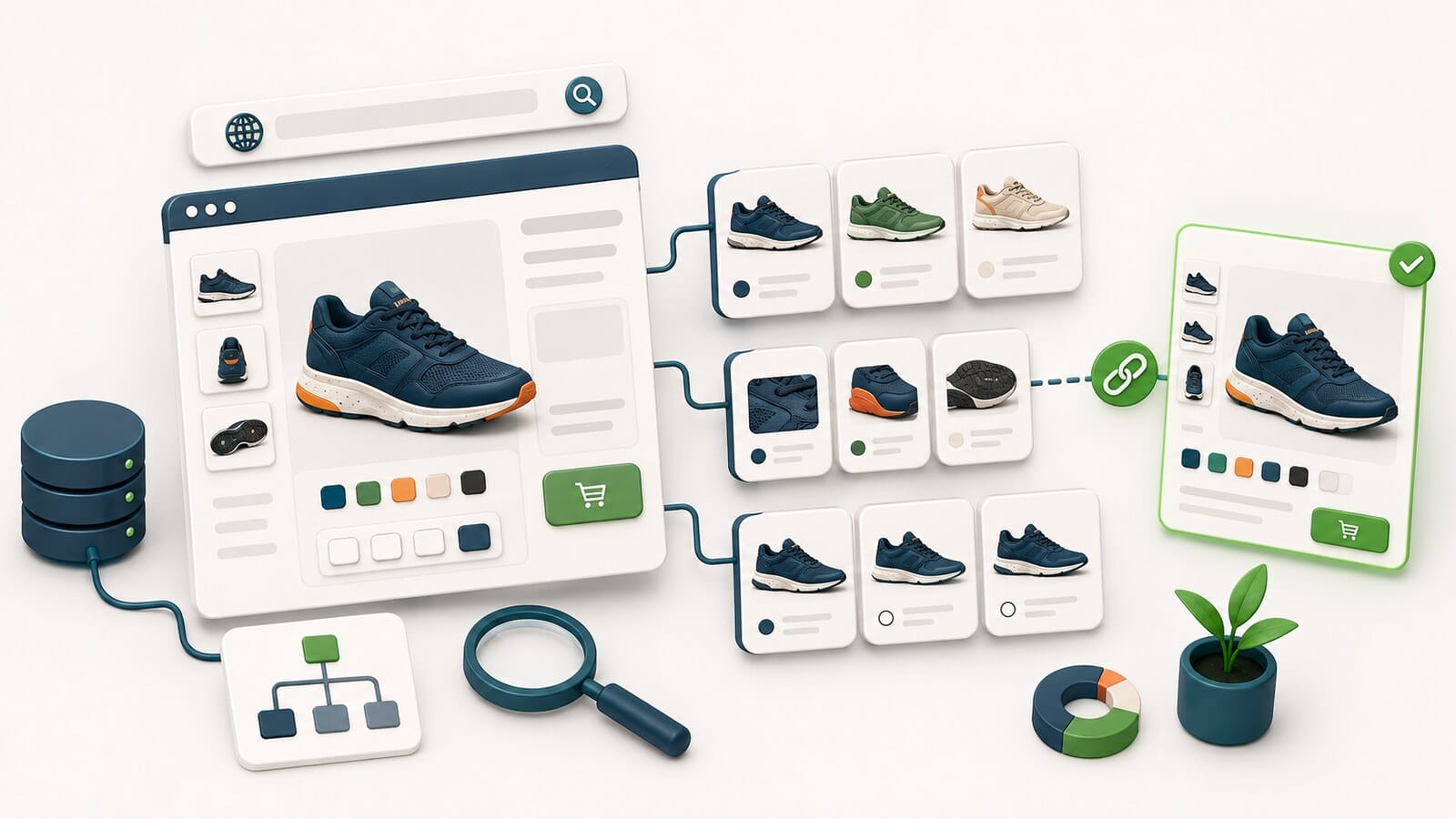
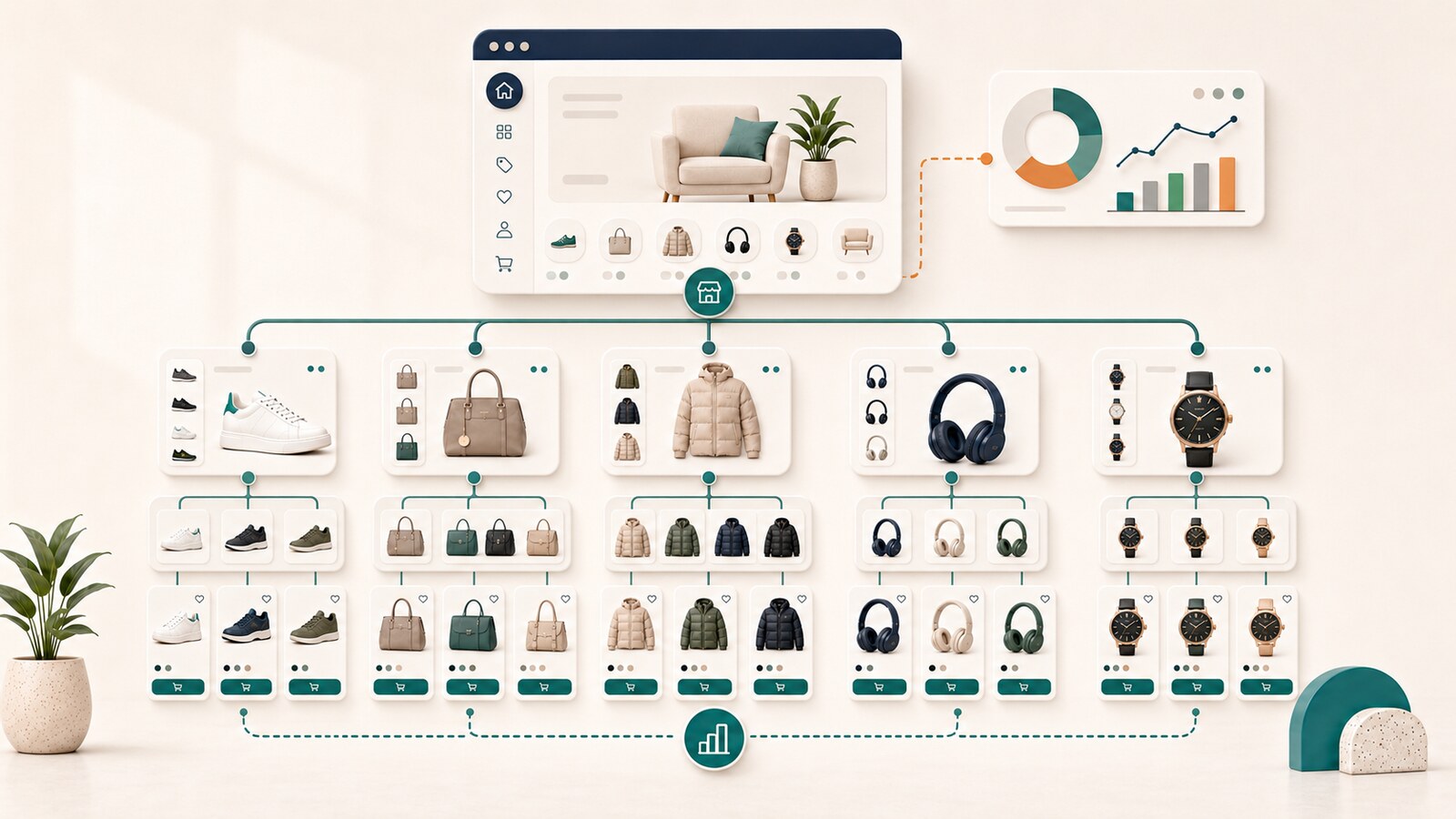
Internal linking is the system of links between pages on the same website. It helps users reach the next logical piece of information and helps search engines discover URLs and understand the relationships between them.
The problem is not solved by mechanically adding several links to every article. A useful system should answer five questions:
When these questions have no clear answer, internal links can become an arbitrary network of anchors that helps neither the user nor the website.
A link is internal when its source page and target page belong to the same website.
Examples include:
Internal linking works simultaneously as:
Google states that it uses links as a relevance signal and to discover new pages for crawling.
Its official recommendations include:
<a> element with an href attribute;This does not mean that every internal link automatically improves rankings. The effect depends on the target page, context, page quality, crawlability, indexability, competition, and many other signals.
These subjects are connected, but they solve different tasks.
| Area | Primary question | Typical scope |
|---|---|---|
| On-page SEO | How is the individual page optimized? | Content, title, H1, headings, images, and individual links |
| Internal linking | How are pages connected as a link graph? | Sources, targets, anchors, orphan pages, click paths, and maintenance |
| Website structure | Where do page types sit within the overall hierarchy? | Levels, navigation, categories, hubs, and placement |
Our existing On-page SEO guide discusses the internal link as one element of an individual page. This guide examines the whole website as a network of source and target URLs.
Internal links connect pages within one website. Backlinks come from other websites.
The distinction matters:
Internal linking does not replace strong external signals. It also cannot make a weak or irrelevant page useful merely by sending it more internal links.

Contextual links appear within the main content and continue a specific idea.
Example:
After the technical diagnosis, the corrections can be implemented as part of ongoing SEO optimization.
Contextual links are usually most useful when:
The main menu provides consistent access to important sections and commercial pages.
It should not replace contextual linking. A page being present in the menu does not mean that a reader will understand when or why it is useful within a specific article.
Breadcrumbs show the path to higher levels and help users return to a parent section.
They serve a different purpose from contextual links. A breadcrumb shows a structural relationship, while a link in the text shows an editorial relationship.
Related posts, recommended products, and related services can help when the selection logic is relevant.
An automated block that displays random or merely recent content is not necessarily useful. The targets should genuinely continue the reader's task.
Footer navigation normally contains persistent service, legal, contact, and utility links.
It should not become a huge list of every SEO target. Excessive site-wide linking can blur the purpose of the navigation and make the page harder to use.
When an image is a link, Google may use its alt attribute as anchor text. A linked image should therefore have descriptive alt text that matches both the destination and the image itself.
The most reliable format is a standard HTML anchor element with an href attribute:
<a href="https://example.com/target-page/">Descriptive anchor</a>
Be cautious with elements that look like links to the user but do not provide a crawlable destination in the HTML.
Check whether:
<a href>;nofollow attribute is present;For JavaScript-generated links, use URL Inspection or inspect the rendered HTML to confirm that the anchor and destination are actually present.

An internal link should lead to the most relevant, active, and preferred URL.
A good target is normally:
Avoid:
Google recommends linking internally to canonical URLs because consistent linking helps identify the preferred version.

Anchor text is the visible, clickable text of a link.
A good anchor is:
Example with a generic anchor:
For more information, click here.
A better version:
Technical and content problems can be identified through an SEO audit.
You do not need to force a unique anchor for every link.
It is natural for the same page to receive similar anchors when those anchors describe the destination accurately. Problems arise when:
Yes. Google explicitly recommends paying attention to the words before and after a link.
The surrounding context should explain:

An orphan page is a URL with no discoverable internal link from another crawlable page on the website.
The page may appear in an XML sitemap or have backlinks, but the absence of an internal link means that it is not part of the normal navigation and content graph.
Orphan pages often arise from:
Not always.
Some utility, campaign, or internal-use URLs may intentionally sit outside the main link graph. If a page is expected to rank, attract organic traffic, or lead to a conversion, however, the lack of relevant incoming links is an important signal to investigate.
An underlinked page has at least one internal link but receives less or less relevant support than its role requires.
Examples:
The number of links alone is not sufficient. Consider:
Click depth is an estimate of how many interaction steps are required to reach a target URL from the home page or another starting point.
A lower depth often improves access, but Google does not have a universal rule that every important page must be exactly two or three clicks away.
Evaluate depth according to:
A page four clicks deep is not automatically a problem when the path is logical and the target is specialized. A money page reachable only through five arbitrary archives probably has an architecture problem.
Links should not be distributed equally across all URLs.
Different page roles need different types of support.
| Page role | Primary link need | Appropriate source pages |
|---|---|---|
| Money page | Commercial context and trust | Relevant guides, navigation, and related services |
| Topic owner | Complete thematic direction | Supporting articles, glossary pages, and service pages |
| Supporting article | Context toward the owner and next step | Owner page, related articles, and category pages |
| Reference page | Definitions and lookup paths | Guides, service content, and glossary entries |
| Utility page | Functional access | Navigation or a specific workflow |
Priority should not be determined by traffic alone.
Check:
Group pages by role:
Without a page role, there is no reliable way to decide which pages should link to one another.
Each important topic should have one primary owner.
Other pages may:
They should not reproduce the entire task or send identical anchors to competing targets.
For every important URL, record which existing pages should support it.
For example, an SEO service page may receive links from:
Every page should provide a logical next step.
An informational resource may link to:
Do not insert the link into an arbitrary paragraph merely so that it exists.
The source context should contain:
Before adding a link, confirm that:
A two-way link is not required for every pair of pages.
It is useful when:
Do not create reciprocal links merely for symmetry.
Maintain a table for a repeatable process:
| Source URL | Target URL | Anchor | Reason | Status |
|---|---|---|---|---|
| On-page guide | SEO optimization | SEO optimization | Execution next step | Planned |
| Internal-linking guide | SEO audit | SEO audit | Diagnostic next step | Implemented |
This limits arbitrary edits and supports future audits.
Use a crawler, a CMS export, or another reliable source to collect:
Look for:
The Links report shows:
This report is useful as Google's known view, but it should not be treated as a complete crawler or a real-time inventory.
Group anchors by target URL.
Look for:
Compare:
A URL that appears in one source but is absent from the crawl graph requires investigation.
An SEO crawler cannot fully show whether a link is useful to a person.
Check whether:
| Situation | Decision | Reason |
|---|---|---|
| An important owner has no incoming links | Add relevant contextual links | The page should be part of the normal graph |
| A source mentions a topic but lacks a detailed answer | Link to the owner | The user receives a useful next step |
| A link points to a redirect | Update it to the final URL | This reduces dependence on the redirect path |
| A link points to a duplicate version | Point it to the canonical URL | Signals become consistent |
| The anchor says "here" | Use a descriptive anchor | The destination becomes clear |
| One anchor points to two competing URLs | Clarify ownership and change the targets | This reduces contradictory signals |
| A page has many irrelevant links | Remove or replace some of them | Quantity does not compensate for a missing reason |
| A related-content block is random | Improve the selection logic | Automation should follow relevance |
| A retired URL still receives links | Update all source pages | This avoids chains and outdated paths |
| A link points to an unpublished draft | Remove it until publication | Users should not reach an inaccessible page |
Every new page should have a link plan before publication.
A minimum process is:
Publishing without incoming links often creates an orphaned or weakly integrated URL.
A redirect alone is not enough during a URL migration.
You should:
Internal links should point directly to the new URL instead of relying permanently on the redirect.
When two pages are merged:
This is different from a full cannibalization diagnosis. The focus here is maintaining the link graph after the URL decision has already been made.
A normal editorial internal link does not need nofollow by default.
Nofollow should not be used as a standard method for sculpting internal signals or repairing poor architecture.
When a page should not be accessible, indexable, or primary, choose the solution that matches the real problem:
Do not use nofollow mechanically instead of making a clear URL-ownership decision.
There is no universal correct number.
Google explicitly states that there is no magical ideal number of links on a page.
The appropriate number depends on:
A short service page may need only a few links. A complete reference guide may naturally contain more.
The practical test is:
Does every link have an independent reason, and does it help the user understand or do something next?
This turns informational content into a catalog and weakens contextual relevance.
Natural repetition is not a problem, but a mechanical template often sounds unnatural and ignores the source context.
When anchors point to competing URLs, the website creates its own unclear ownership signals.
Important pages may be accessible from the menu while remaining absent from relevant editorial contexts.
A redirect is a useful safety mechanism, but the internal graph should use the final destination.
Automation without relevance can create noise, repetition, and unsuitable next steps.
This is rarely necessary and may disrupt expected navigation. The behavior should follow user experience, not an SEO myth.
A naked URL may be suitable in a reference or citation context, but descriptive text is normally easier to understand.
New publications receive links while old pages are not updated. Over time, the graph begins to reflect publishing history rather than the current architecture.
Do not evaluate internal linking through rankings alone.
Track:
A change in the link graph cannot always be isolated from content updates, technical fixes, and external signals. Record the date and exact scope of every significant edit.
There is no universal schedule.
Appropriate moments include:
A small, stable website may need less frequent reviews. A large e-commerce website with constant changes requires more frequent monitoring.
Before considering the internal-linking system complete, check:
Internal linking is the system of links between pages on one website. It supports navigation, discovery, contextual relationships, and the integration of important pages into the broader site graph.
Google uses links as signals for discovery and relevance, but there is no guarantee that adding a specific number of links will improve rankings. Links should be useful, crawlable, and contextually relevant.
There is no universal number. Add links when the destination helps the user continue the task or understand the subject more fully.
Google recommends that every page you care about have a link from at least one other page on the website. Important owners may reasonably have more than one relevant path when those paths are useful.
It is a page with no discoverable internal links from other crawlable pages. It may appear in the sitemap or have external links, but it is not part of the normal internal graph.
No exact-match formula is required. The anchor should describe the target naturally and accurately. Forced keyword stuffing in anchors is not a useful goal.
Only when each link has a separate user reason. Repeating the same target in nearby paragraphs rarely adds value.
They usually work, but internal links should be updated to the final destination. This reduces chains, maintenance, and reliance on old URLs.
No. The Links report is useful, but it should be combined with a crawler, CMS inventory, sitemap, status-code data, canonical data, and a manual review of user paths.
On a small website with only a few pages, corrections may be made manually. On a large website, internal linking requires simultaneous evaluation of:
When ongoing execution, editing of existing pages, and maintenance of the link graph are required, this work belongs within our SEO optimization service.
When the first task is to identify orphan pages, broken links, redirects, conflicting targets, and architecture problems, an SEO audit is the appropriate starting point.
Sources reviewed on July 15, 2026.