Google changes the systems behind Search continuously. Most changes are small and pass without a public announcement. Several times a year, however, Google confirms broader updates that can produce visible changes in rankings and organic traffic across websites, industries, languages, and countries.
This timeline is organized in reverse chronological order. It begins with the latest confirmed update, the June 2026 spam update, and moves back through the major systems and events that shaped Google Search from 1998 onward.
The purpose is not to treat every traffic change as an algorithm penalty. It is to show how Google's priorities developed over time: from keyword stuffing and link manipulation to content quality, search intent, mobile usability, page experience, spam prevention, reliable information, and AI-powered search features.
An unexplained decline rarely has one universal cause. Content, competition, technical access, internal organization, external links, search demand, result features, and user expectations can all change at the same time. Sustainable SEO optimization is therefore an ongoing process, not a one-time configuration.
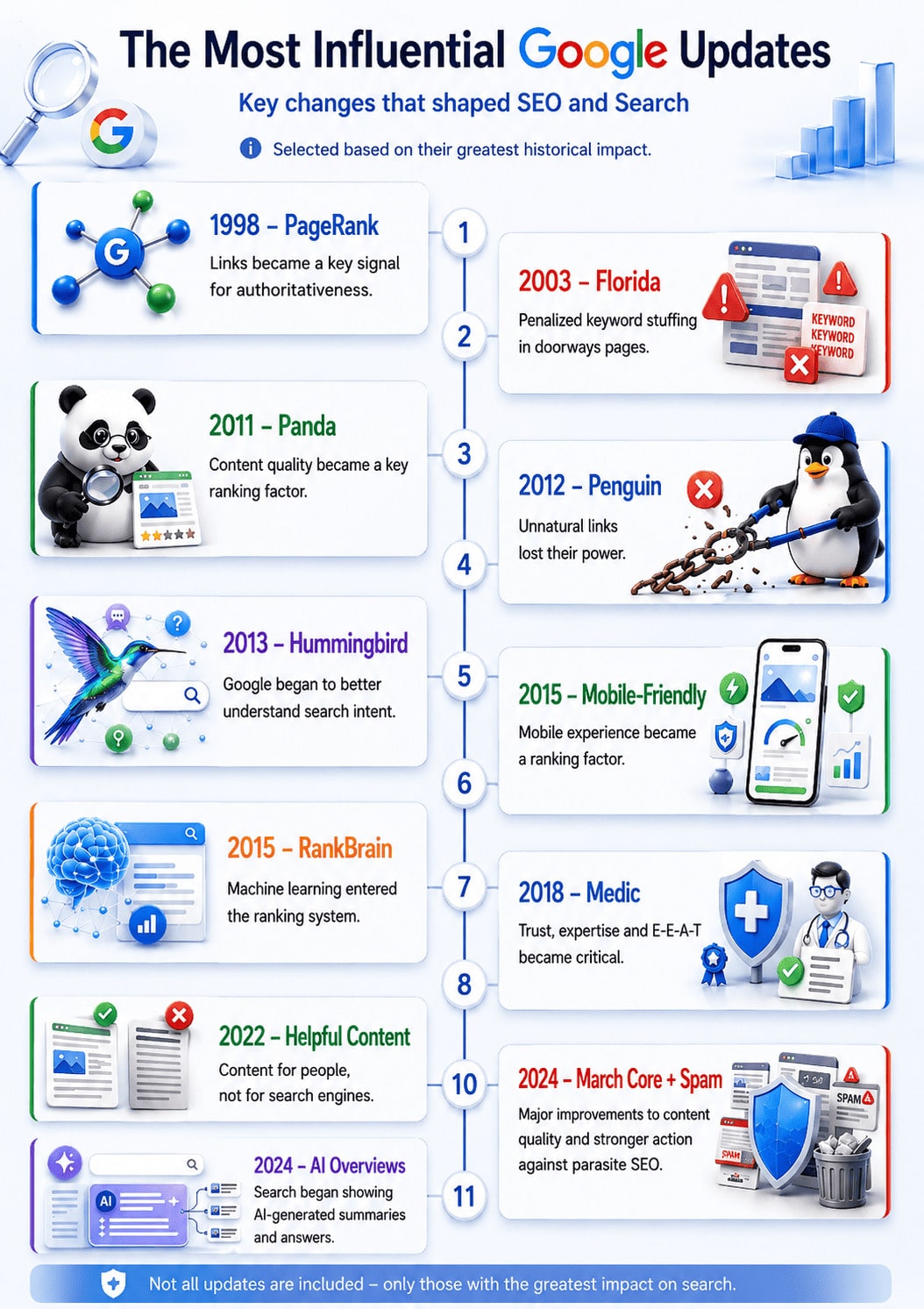
Not every event below is the same type of change.
Google's Search Status Dashboard is the primary source for confirmed modern rollout dates. Historical documentation is less complete, so older entries should be read as context, not as a complete log of every change Google made.
A Google algorithm update is a change to one or more systems involved in understanding, evaluating, and ordering search results.
Google uses many automated systems rather than one single algorithm. Its ranking systems guide explains that some systems are part of the core ranking process, while others address more specific needs.
The main groups covered in this timeline are:
Core updates are broad changes intended to improve the overall quality and relevance of results. Google explains that they do not target individual websites or pages.
A page can lose visibility without violating a policy. Another result may now provide a more useful answer, stronger evidence, a better match for the query, or a more appropriate format.
Google's spam detection systems operate continuously. A confirmed spam update represents a notable improvement to those systems.
Spam updates may affect scaled content created primarily to manipulate rankings, cloaking, doorway pages, hacked content, link schemes, expired domain abuse, site reputation abuse, and other practices described in Google's spam policies.
Panda, Penguin, Hummingbird, RankBrain, BERT, the reviews system, page experience systems, and neural matching changed specific parts of how Search evaluates or understands information.
AI Overviews, AI Mode, Universal Search, Discover, and changes to the search results page are broader product developments. They matter to organic visibility, but they should not automatically be labeled ranking penalties.
The June 2026 spam update began on June 24 and completed on June 26, 2026. It is the latest confirmed ranking update as of July 25, 2026.
The rollout was global and applied to all languages. Google did not publish a list of newly targeted tactics. As with other spam updates, the correct reference point is the full set of Google Search spam policies.
A decline during this period may reflect the loss of signals that Google's systems no longer count. It does not always indicate a manual action or a new site-wide penalty.
Potential areas for investigation include:
Do not assume that every movement between June 24 and June 26 came from this update. Confirm the affected pages, queries, countries, and devices before forming a diagnosis.
The May 2026 core update began on May 21 and completed on June 2, 2026.
This was the second broad core update of the year. It occurred while Google was expanding AI-powered search experiences, but Google continued to state that its established ranking and quality systems support those features.
The update should not be interpreted as a requirement to write for an AI answer. The more durable questions remain:
A core update can reward a stronger competitor without identifying one specific defect on the page that lost visibility.
The March 2026 core update began on March 27 and completed on April 8, 2026.
It followed the March spam update by only two days. That overlap makes simple cause-and-effect claims unreliable. A site that changed during this period may have been affected by spam reclassification, broader quality reassessment, competitor improvements, or a combination of factors.
Google's core update guidance recommends waiting until a rollout has completed before evaluating its effect. A meaningful review should compare pages and queries over an appropriate period rather than reacting to one day of volatility.
The March 2026 spam update began on March 24 and completed on March 25, 2026.
The rollout was global and applied to all languages. Google did not identify a single new tactic, so the update should be assessed against the full spam policies rather than speculation about one technical signal.
If a sharp change aligns closely with this rollout, examine content and link practices that could appear manipulative. A short rollout does not prove that one isolated edit or design choice caused the decline.
The February 2026 Discover update began on February 5 and completed on February 27, 2026.
This was a Discover update, not a standard web ranking core update. Discover recommends content based on a person's interests without requiring an active search query, so its traffic patterns differ from classic organic search.
Publishers should separate Discover changes from web search changes in their analysis. A decline in Discover does not automatically mean that standard search rankings fell for the same reason.
The December 2025 core update began on December 11 and completed on December 29, 2025.
Like other core updates, it broadly reassessed which results were most helpful and relevant. It should not be described as a penalty for one specific tactic unless separate evidence shows a policy violation or manual action.
By late 2025, search results included a growing mix of classic links, rich features, and AI-generated experiences. That made it even more important to separate a ranking loss from a decline caused by result-page changes or lower demand.
The August 2025 spam update began on August 26 and completed in September after a rollout of more than 26 days.
It was a global update across all languages. Sites dependent on scaled low-value pages, doorway patterns, unnatural links, or third-party sections created mainly to use a domain's authority were exposed to greater risk.
The presence of automation or AI alone does not define spam. Google's policy focuses on whether pages are produced at scale primarily to manipulate rankings without adding value.
The June 2025 core update began on June 30 and completed in July after a rollout of more than 16 days.
The extended rollout created a long period of movement. A useful assessment begins with exact page and query data rather than a site-wide traffic total.
A proper review in Google Search Console can separate:
If the decline is broad or difficult to explain, a structured SEO audit is more reliable than rewriting every page at once.
The March 2025 core update began on March 13 and completed on March 27, 2025.
It continued Google's broad reassessment of useful and reliable results during a period of rapidly increasing AI-assisted publishing.
The lesson was not that AI-written text automatically fails. The risk comes from publishing content without a clear purpose, original contribution, review, accountability, or value beyond what already exists.
The December 2024 spam update began on December 19 and completed on December 26, 2024.
It followed immediately after the December core update. When two different updates occur close together, their effects can overlap. A site owner should not diagnose a spam problem solely because traffic changed in late December.
The December 2024 core update began on December 12 and completed on December 18, 2024.
This broad update arrived only a week after the November core update completed. The short interval showed that Google can make significant ranking changes in close succession.
There was no universal recovery action. The appropriate response remained a page-level and site-level assessment of usefulness, search intent, evidence, trust, accessibility, and competitive quality.
The November 2024 core update began on November 11 and completed on December 5, 2024.
It was another broad reassessment following the large changes made earlier in the year. Websites with many similar articles, weak differentiation, or unclear authorship remained vulnerable when stronger results satisfied the same intent.
The August 2024 core update began on August 15 and completed on September 3, 2024.
Google said this update considered feedback received from creators and aimed to better connect people with useful content from a range of sites, including smaller and independent publishers.
Some sites improved, while others did not recover from previous losses. Recovery was never guaranteed by a few cosmetic edits. A site needed to demonstrate meaningful improvements that its audience could recognize.
In 2024, Google announced changes intended to make explicit deepfake content harder to surface and easier for affected people to remove.
This was a search safety and product change, not a conventional core update. It belongs in the broader history because it shows how Search adapted to harmful uses of generative media.
The June 2024 spam update began on June 20 and completed on June 27, 2024.
It continued Google's automated work against spam across languages. The update should be understood alongside the expanded spam policies introduced in March.

Google expanded AI Overviews in the United States in May 2024. This was a major change to the search experience, not a classic algorithm penalty.
AI Overviews can assemble a generated response and display supporting links. Their expansion changed how some informational results were presented and how users interacted with Search.
Google's current guidance says that established SEO best practices still apply and that there is no special AI markup required for inclusion. Detailed mechanics and optimization strategy belong to the separate AI search topic, not this historical timeline.
Google began enforcing its site reputation abuse policy through manual actions in May 2024. The policy addressed third-party content published primarily to take advantage of a host site's ranking signals.
The problem was not the mere presence of freelance, sponsored, affiliate, or partner content. The concern was content designed to exploit a reputable domain while receiving little meaningful oversight and providing little value to the site's established audience.
Google later continued developing algorithmic enforcement. This made so-called parasite SEO a much riskier long-term strategy.
The March 2024 spam update began on March 5 and completed on March 20, 2024.
Google also introduced or clarified policies covering three major forms of abuse:
Expired domain abuse involves repurposing a previously established domain primarily to manipulate rankings with low-value content.
Scaled content abuse involves producing many pages primarily to manipulate rankings, regardless of whether the production method uses AI, human writers, automation, or a combination.
Site reputation abuse involves third-party content that exploits a host site's ranking signals without appropriate first-party involvement or value for the established audience.
The March 2024 core update began on March 5 and completed on April 19, 2024. Its 45-day rollout was unusually long.
Google described the update as more complex than a typical core update because it involved several systems. The company also explained that its former helpful content classifier had become part of its core ranking systems rather than remaining a separately announced system.
This change reduced the value of thinking about "helpful content" as one isolated switch. Multiple systems and signals could contribute to evaluating whether a page was genuinely useful.
The November 2023 reviews update began on November 8 and completed on December 7, 2023.
It applied to review content in several languages and marked the transition to regular improvements that Google would no longer always announce.
High-quality reviews should demonstrate experience, explain evaluation criteria, compare alternatives, include evidence where possible, and help different users make an informed choice.
The November 2023 core update began on November 2 and completed on November 28, 2023.
It overlapped with the reviews update, making attribution difficult for websites that published both general and review content.
The October 2023 core update began on October 5 and completed on October 19, 2023.
It began one day after the October spam update and while a separate ranking incident was active. A traffic change in this period requires careful segmentation rather than an assumption that the newest announcement was the only cause.
The October 2023 spam update began on October 4 and completed on October 20, 2023.
Google said the update improved coverage across several languages and spam types. Sites using cloaking, hacked content, automatically generated low-value pages, or other manipulative patterns faced increased risk.

The September 2023 helpful content update began on September 14 and completed on September 28, 2023.
Many independent publishers and niche information sites reported significant losses. The impact triggered long-running debate about how well Google's systems evaluated smaller creators.
The update reinforced that accurate text alone may not be enough. A page also needs a clear audience, sufficient depth, a reason to trust the source, and a contribution beyond repackaging information already available elsewhere.
The August 2023 core update began on August 22 and completed on September 7, 2023.
It produced broad changes across informational and commercial results. Sites with overlapping articles, weak topic focus, or content that added little beyond competing pages were particularly difficult to defend.
The April 2023 reviews update began on April 12 and completed on April 25, 2023.
Google expanded its reviews system beyond product reviews to reviews of services, businesses, destinations, media, games, and other subjects.
The name of a page was not enough. A useful review needed evidence of experience, a transparent method, meaningful comparisons, advantages, disadvantages, and recommendations for different needs.
The March 2023 core update began on March 15 and completed on March 28, 2023.
As with other core updates, Google did not publish a list of specific defects to fix. A decline called for an assessment of the pages and queries affected, not a generic rewrite of the entire site.
The February 2023 product reviews update began on February 21 and completed on March 7, 2023.
It expanded the product reviews system to additional languages. The system sought content with informed analysis, original research, and evidence from people who understood the products being reviewed.
The December 2022 link spam update began on December 14, 2022, and completed on January 12, 2023.
Google used SpamBrain to improve detection of sites buying links and sites used to pass outgoing links. The effect often appeared as the loss of value from unnatural links rather than a conventional penalty applied to every page.
The December 2022 helpful content update began on December 5, 2022, and completed on January 12, 2023.
It improved the classifier and expanded the system to all languages. Websites built primarily around search traffic without a clear audience or original contribution were more exposed.
The October 2022 spam update began on October 19 and completed on October 21, 2022.
Google did not identify one specific tactic. The correct reference remained its spam policies and the actual patterns present on the affected website.
The September 2022 product reviews update began on September 20 and completed on September 26, 2022.
It continued Google's work to distinguish original, experience-based reviews from summaries of manufacturer descriptions or affiliate lists without meaningful evaluation.
The September 2022 core update began on September 12 and completed on September 26, 2022.
It overlapped with the product reviews update. Websites with review content needed to separate review pages from other page types before assigning a cause.
The first helpful content update began on August 25 and completed on September 9, 2022.
Google introduced a site-wide classifier intended to identify content created primarily for search engines rather than people. The system did not make SEO itself a problem. It targeted content that used search demand as its purpose without satisfying the audience.
The July 2022 product reviews update began on July 27 and completed on August 2, 2022.
It continued rewarding reviews that demonstrated real knowledge, evidence, comparisons, and decision criteria.
For ecommerce website development, the broader lesson was that product and category pages should help customers choose, not function as a thin catalog copied from suppliers.
The May 2022 core update began on May 25 and completed on June 9, 2022.
It was a broad reassessment across content types and regions. There was no single recovery setting.
The March 2022 product reviews update began on March 23 and completed on April 6, 2022.
Google provided additional guidance about in-depth reviews, including evidence of first-hand experience, quantitative measurements where appropriate, meaningful comparisons, and explanations of advantages and disadvantages.
The desktop page experience update began on February 22 and completed on March 3, 2022.
It extended relevant page experience signals to desktop search. Google later clarified that there is no single page experience signal and that strong scores do not guarantee top rankings.
A major website redesign should protect existing URLs, content, internal links, canonical signals, and organic history while improving usability.
The December 2021 product reviews update began on December 1 and completed on December 21, 2021.
Google encouraged evidence such as visuals, audio, or links showing first-hand experience and recommended including multiple purchasing options when appropriate.
The November 2021 core update began on November 17 and completed on November 30, 2021.
It was a broad update released during the holiday shopping period. Google maintained that core updates do not target specific pages or sites.
The November 2021 spam update began on November 3 and completed on November 11, 2021.
Its proximity to the later core update made November a difficult month for simple attribution.
The July 2021 link spam update began on July 26 and completed on August 24, 2021.
Google expanded systems intended to identify and nullify link spam across languages. Paid, affiliate, and sponsored links required appropriate qualification.
The page experience update for mobile began in June and completed in September 2021.
It included Core Web Vitals within a broader set of page experience considerations. A fast page did not automatically outrank more relevant content, and Core Web Vitals never represented the entire user experience.
Google launched the first product reviews update in April 2021.
The update aimed to reward reviews with original research, informed analysis, meaningful comparisons, and substantial value beyond short product summaries.
Google introduced passage-based ranking for US English queries in February 2021 and later expanded it.
The system helped Google identify a relevant passage within a longer page. It did not index the passage as a separate URL.
Clear headings and focused sections made detailed resources easier to understand, but publishers did not need a special passage markup.
The December 2020 core update began on December 3, 2020.
It was the third confirmed core update of the year and caused broad movement across industries. Its impact varied by topic and query.
The May 2020 core update began on May 4, 2020.
It arrived during a period of dramatic changes in search demand caused by the COVID-19 pandemic. Traffic changes could reflect both ranking movement and major changes in what people searched for.
The January 2020 core update began on January 13, 2020.
As with later core updates, Google described it as broad rather than a change targeting one specific tactic.
In late 2019, Google said it had applied neural matching to local search results worldwide.
Neural matching helped Search relate the concepts in a query to the concepts represented by a local business, even when the exact words differed.
For businesses, this increased the importance of accurate service descriptions, relevant categories, local context, and complete information. It also showed why local SEO could not be reduced to repeating a city name.
Google announced BERT for English-language search queries in October 2019 and later expanded it to more languages and applications.
BERT helped Search understand how words relate to one another within a query. Prepositions and context could change the meaning of a phrase, especially in conversational searches.
The practical lesson was not to optimize for BERT as a separate checklist. Clear, natural writing that answered the intended question remained the appropriate approach.
Google announced the June 2019 core update before its rollout. The advance notice was notable because the company had not always publicly named broad changes in advance.
The update reinforced a communication pattern that later became more consistent through Search Central announcements and the Search Status Dashboard.
Google released a broad core update in August 2018. The SEO industry called it the Medic update because many health and medical sites reported substantial movement.
Google did not say that the update targeted only medical websites. Finance and other sensitive topics also experienced changes.
The update increased industry attention on expertise, author information, reputation, and trust for topics that can affect health, financial stability, safety, or well-being. Google later used the term YMYL, or Your Money or Your Life, in its quality evaluator guidance.
E-E-A-T is not one isolated ranking factor or a score exposed to site owners. It is a quality framework centered on experience, expertise, authoritativeness, and trust.
Fred is an unofficial name for changes observed in March 2017.
The sites most frequently reported as affected relied heavily on advertising or affiliate revenue while offering limited original value. Because Google did not publish a detailed Fred specification, claims about one exact target should remain cautious.
The lasting lesson was that a page built mainly to monetize a search visit is vulnerable when it does not first solve the user's problem.
In January 2017, Google began applying a signal to mobile pages where intrusive interstitials made main content difficult to access after a user arrived from a search result.
Not every popup was prohibited. Legal notices, login dialogs for non-public content, and reasonably sized banners could still be appropriate. Full-screen promotions that blocked the expected content created greater risk.
In September 2016, Google announced Penguin 4.0 and incorporated Penguin into its core ranking systems.
Penguin began operating more granularly and in real time. Google increasingly devalued spam links instead of demoting an entire site solely through periodic Penguin refreshes.
This did not make link schemes safe. It reduced the value of manipulative links and allowed changes to be reflected as Google recrawled and reprocessed pages.
Possum is an unofficial name for a major change observed in local results in September 2016.
The update appeared to increase filtering among nearby businesses with similar addresses or categories and made the searcher's physical location more influential.
Because the name and detailed interpretation came from industry analysis, it should not be treated as an official Google specification.
In February 2016, Google removed most right-side text ads from desktop search results and allowed additional ads above organic results for highly commercial queries.
This was not an organic ranking algorithm update, but it changed visible search real estate. A first organic position could appear lower on the screen when several ads were present.
Google confirmed RankBrain in 2015 as a machine-learning system used to help interpret queries and determine relevant results.
It was especially useful for unfamiliar or ambiguous searches. RankBrain did not create a separate optimization formula. It made literal keyword matching an even less complete model of relevance.
Pages still needed to explain a subject clearly and satisfy the intent behind the query.
In May 2015, Google confirmed a change to how its core ranking systems assessed quality.
The SEO industry often called the change Phantom because Google had not initially announced it. Reports frequently associated the update with thin content, heavy advertising, weak usefulness, and poor user experience.
The label is historical industry terminology, not the official name of a permanent Google system.

The mobile-friendly update began in April 2015 and was widely nicknamed Mobilegeddon.
It gave mobile-friendly pages an advantage in mobile search results. Small text, horizontal scrolling, closely spaced controls, and layouts designed only for desktop became clear disadvantages.
The update made mobile usability a basic requirement for professional web design, not an optional enhancement.
In August 2014, Google announced that HTTPS would be used as a lightweight ranking signal.
The direct ranking weight was small, but the direction was important. Secure transport later became a normal expectation for user trust, browser behavior, and technical reliability.
Google launched the local search update commonly called Pigeon in the United States in July 2014 and later expanded it.
The update connected local ranking more closely with Google's broader web ranking signals and improved distance and location parameters.
Local visibility increasingly depended on the business profile, website quality, relevance, location, citations, links, reviews, and consistent business information working together.

Google announced Hummingbird in September 2013 and said the underlying change had already been active for about a month.
Hummingbird was a major rewrite intended to better understand the meaning of complete queries rather than matching isolated words.
It helped move SEO away from one page for every slight keyword variation and toward resources organized around a user need and its related concepts.
Google launched the first Payday Loan update in June 2013.
It targeted heavily spammed queries and industries, including payday loans and some adult, pharmaceutical, and gambling terms. Later versions expanded the effort.
The update demonstrated that Google could apply stronger spam controls where manipulation was unusually concentrated.
Google released the Exact Match Domain update in September 2012.
Before the change, a domain that exactly matched a competitive query could receive an advantage even when the site offered weak content.
The update reduced the benefit for low-quality exact-match domains. A descriptive domain was not a violation, but the name alone could no longer substitute for a useful website.

Google launched Penguin in April 2012 to address webspam, particularly patterns associated with unnatural links and over-optimization.
Sites dependent on paid links, link networks, low-value directories, and heavily repeated exact-match anchor text often lost visibility.
Penguin changed link building by making context, editorial purpose, source quality, and natural patterns more important than raw volume.
The Venice update in early 2012 improved the use of local signals within standard organic results.
Google could show location-relevant pages even when a query did not explicitly contain a city name. This expanded the role of localized organic pages for clinics, lawyers, restaurants, repair services, stores, and other local businesses.
Google released the page layout algorithm, also called Top Heavy, in January 2012.
It affected pages with excessive advertising above the fold when users had to scroll before reaching the expected main content.
The change connected visible layout and content access with search quality. A page designed primarily around ad impressions offered a weaker experience.
Google announced the Freshness update in November 2011.
The system aimed to provide newer results when freshness mattered, including news, recurring events, current products, and frequently changing topics.
Freshness did not mean that every page needed an artificial new date. Historical resources and evergreen explanations could remain relevant for years, while time-sensitive buying guides required genuine updates.

Google launched Panda in the United States in February 2011 and expanded it internationally.
Panda addressed low-quality content, copied material, thin pages, excessive advertising, and content farms built around large volumes of shallow articles.
The update affected entire content models, not only one keyword placement. Originality, depth, usefulness, and overall site quality became much harder to ignore.
Google later incorporated Panda into its core ranking systems.
The Mayday update in 2010 affected many long-tail search results.
Large sites with thin category, tag, or product pages often lost traffic from specific queries. The update showed that creating a page for every possible phrase did not guarantee relevance.
A page needed enough unique value to deserve visibility for the detailed query it targeted.
Google completed the Caffeine indexing system in 2010.
Caffeine was an infrastructure change, not a quality penalty. It allowed Google to discover and make new or updated information searchable much faster.
The faster index benefited news, forums, blogs, and time-sensitive pages. It also increased the amount of low-quality content Google could discover, adding pressure for later quality systems such as Panda.
Vince is the industry name for a 2009 change associated with stronger visibility for established brands on some competitive queries.
Google did not describe the change as a simple preference for large companies. Recognizable brands often carried signals related to trust, links, user demand, and reputation that were difficult for thin affiliate sites to match.
Smaller organizations could still compete by building genuine expertise, strong resources, customer recognition, and independent references.
Google launched Universal Search in May 2007.
The search results page began blending web pages with news, images, video, local information, books, and other vertical results.
Organic visibility was no longer only a contest among blue text links. The appropriate content format, media assets, local presence, and search features became part of the opportunity.
Big Daddy was a major infrastructure update rolled out across Google data centers in 2005 and 2006.
It affected how Google handled URL canonicalization, redirects, duplicate pages, and site architecture. Some websites experienced indexing changes because their technical signals were inconsistent.
Big Daddy helped establish technical SEO as a discipline that extended beyond adding keywords to a page.
Jagger was a series of updates in 2005 associated with link quality, reciprocal linking, paid links, and other unnatural patterns.
The details were reconstructed largely through industry observation. The lasting direction was clear: Google was becoming better at distinguishing independent recommendations from links created through exchange or manipulation.
Google and other search companies introduced the nofollow link attribute in 2005, initially as a response to comment spam.
The attribute gave publishers a way to qualify links that should not be treated as normal editorial endorsements.
Its introduction also triggered years of PageRank sculpting experiments. Google later changed how nofollow links were handled and introduced sponsored and ugc as more specific values.
Brandy was an early 2004 update associated with improved handling of synonyms, context, and concept relationships.
The documentation from this period is limited, but the change is remembered as an early step from literal matching toward semantic understanding.
Austin followed the Florida update in early 2004.
Industry reports connected it with hidden text, keyword-stuffed metadata, and other techniques designed for crawlers rather than users.
Like several early update names, Austin is best understood as historical industry terminology rather than a fully documented modern ranking system.
Florida was one of the first Google updates to cause widespread public attention. It rolled out in November 2003 shortly before the holiday shopping season.
Many commercial sites dependent on keyword stuffing, hidden text, doorway pages, and aggressively optimized anchor text lost rankings.
Florida demonstrated that ranking tactics based on exploiting obvious formula patterns were not a durable business strategy.
Fritz marked Google's transition away from large monthly index refreshes toward more continuous updating.
The older cycle was known as the Google Dance because rankings changed visibly while data centers processed a new index.
Continuous updates made SEO less dependent on waiting for one monthly refresh and more dependent on ongoing improvements.
Esmeralda was part of the sequence of 2003 index changes that preceded the more continuous model.
Historical reporting associated it with changes in how Google processed and refreshed signals. Official detail is limited.
Dominic was associated by the SEO industry with changes to links and backlink processing.
The exact mechanics were not publicly documented. Its historical importance lies in showing that Google was already refining how it evaluated links rather than simply counting them.
Cassandra was linked to stronger action against hidden text, hidden links, and repeated anchor-text manipulation.
The update reflected Google's early effort to distinguish real relevance from content and links created only for crawlers.
Boston was announced in early 2003 and became one of the first widely recognized named Google updates.
It belonged to the era of monthly index changes and the Google Dance. Rankings could move sharply while a new data set propagated.
Documentation for these early changes is incomplete, so precise modern-style claims about individual signals should be avoided.
The Google Toolbar made a simplified PageRank indicator visible to users and SEO professionals.
Visibility created a market for links from pages with a high displayed score. Directories, brokers, and networks began selling links according to Toolbar PageRank.
What began as a way to expose an importance metric encouraged manipulation. Later link systems, including Jagger, Penguin, and link spam updates, increasingly reduced the value of those schemes.
Google's original PageRank approach evaluated relationships among pages through links.
Earlier search engines relied more heavily on text appearing within a page. PageRank added a model in which links could indicate importance or endorsement.
The idea helped Google produce better results, but it also made links a target for manipulation. A large part of later search history involves distinguishing genuine editorial references from links created mainly to influence rankings.
The history of Google Search is not a straight line from one simple algorithm to another. It is the development of many systems that work together.
In the early 2000s, updates such as Florida and Austin addressed obvious keyword and hidden-text manipulation. Jagger, Penguin, and later link spam systems addressed artificial authority.
Panda and the helpful content systems addressed publishing models built on large volumes of weak pages. Hummingbird, RankBrain, neural matching, and BERT improved query and language understanding.
Mobile-friendly systems, page experience work, and Core Web Vitals reflected the growing importance of usability. Reviews updates demanded stronger evidence of first-hand evaluation.
The spam policies introduced in 2024 addressed abuse at modern scale, including repurposed domains, mass production, and third-party content using a host site's reputation.
AI Overviews and AI Mode changed how some answers are assembled and displayed, but Google states that they remain grounded in its core Search ranking and quality systems.
Google updates are not random punishments aimed at every website that loses traffic. They are changes to systems operating in a competitive, changing search environment.
A site may decline because:
The history does support one durable conclusion: strategies that work only by exploiting a temporary weakness in ranking systems tend to lose value.
In competitive markets, a transparent SEO agency should be able to explain the affected pages, likely causes, evidence, priorities, and limitations instead of promising a secret algorithm fix.
Check whether Google announced a core update, spam update, ranking incident, or Discover update. Record the exact start and completion dates.
Do not depend only on third-party volatility sensors. They can reveal movement, but they cannot prove that Google launched a specific update.
Avoid major reactive changes while results are still moving.
Google recommends waiting until a core update is complete and then allowing time before evaluating its effect. For spam violations, however, a known harmful practice should not be left active merely to wait for more data.
Compare complete periods before and after the rollout. Account for:
One day compared with the previous day rarely provides enough evidence.
Review:
A site-wide percentage can hide one page that previously generated most of the traffic.
A click decline can happen without a comparable ranking decline. Search features, AI answers, ads, local results, image packs, demand, and snippet changes can all affect clicks.
Also check for:
noindex;For a core update, evaluate overall usefulness, relevance, evidence, trust, search intent, and competitive quality.
For a spam update, review practices against the official spam policies.
For a reviews update, assess first-hand evidence, evaluation criteria, comparisons, and transparency.
For Discover, separate Discover performance from standard web search.
Do not change everything at once. Identify:
If an internal team needs an independent diagnosis, an SEO consultation can provide a focused review without turning update analysis into random experimentation.
No website is immune to algorithm changes, competition, or shifts in demand. Resilience means reducing dependence on tactics that offer no value outside rankings.
A more resilient website:
This does not eliminate volatility. It gives the organization better evidence, better assets, and more useful pages to improve when Search changes.
Google Search has changed from a link-based breakthrough into a collection of systems that evaluate language, relevance, quality, usability, reputation, spam, freshness, and many other signals.
The details changed, but the repeated pattern is clear:
The safest long-term objective is not to reverse-engineer one temporary ranking pattern. It is to create and maintain pages that have a clear purpose, help the intended audience, support their claims, and deserve to remain useful when Google's systems are reassessed.