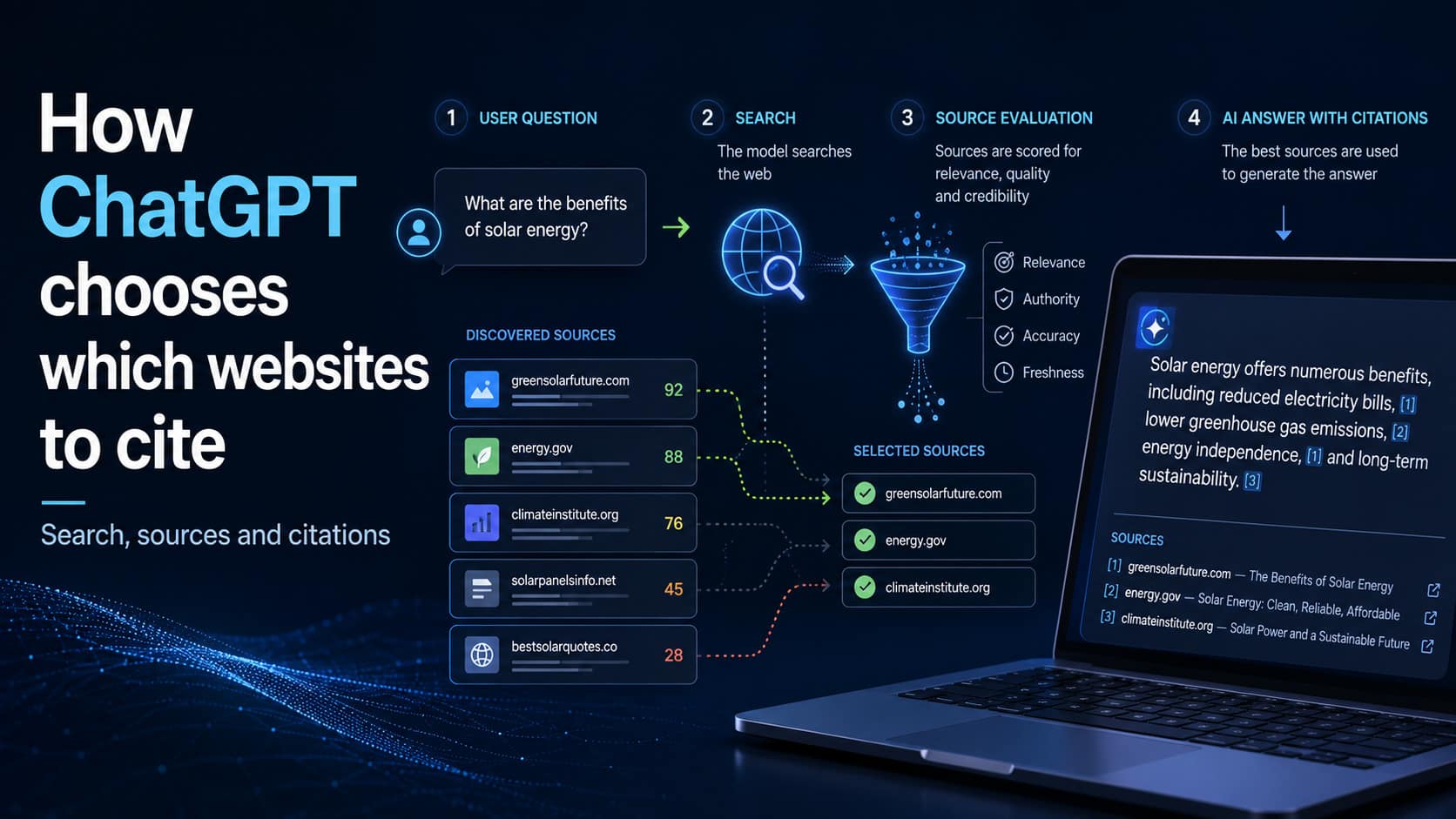
ChatGPT does not use a single public ranking where websites keep fixed positions. When a question would benefit from current or additional information from the web, ChatGPT Search may rewrite it as one or more targeted queries, retrieve results from third-party search providers and partner content, and build an answer that links to selected pages.
OpenAI says search results are ranked using multiple factors intended to surface relevant, reliable information, but it does not publish the full ranking model, exact weights, or a formula that determines which URL will be cited. No one can reliably promise a citation for a specific result. What you can do is confirm that the site is eligible for Search, that one clear page is the best match for the topic, and that the content gives a direct, current, and verifiable answer.
The key is to separate four processes that are often treated as if they were the same:
These are different stages. A crawler may be able to access a page without that page being selected for a particular query. ChatGPT may mention a brand without linking to it. A link in the Sources panel also does not mean that the page supports every sentence in the response.
Based on OpenAI’s current documentation, the process can be summarized this way:
In other words, ChatGPT may not search the exact words the user typed. A page written around one rigid phrase may fail to match a more specific query generated during the search process.
No. Citations are tied to responses that use Search, and not every conversation triggers a web search.
ChatGPT may search automatically when current web information would improve the answer, and a user can also select Search manually. If Search was not used, the absence of a citation does not show that the website has a technical problem.
When Search is used, the answer may include:
OpenAI notes that the Sources panel may include cited sources and other relevant links. When evaluating visibility, check whether a specific URL is attached to a claim, not simply whether the domain appears somewhere in the panel.
Discovery means that a page can enter the search process. OpenAI uses OAI-SearchBot for the automatic crawling that supports ChatGPT’s search features.
If a site blocks this crawler, OpenAI says its pages will not appear in ChatGPT Search answers, although the domain may still appear as a navigational link in some situations.
After Search is triggered, the system works with generated queries and retrieved results. Official OpenAI materials confirm the use of third-party search providers and partner content, but they do not publish the exact formula used to rank every candidate source.
No official source establishes that one universal factor, such as word count, Schema.org markup, the number of FAQ entries, or a Google ranking, determines selection on its own.
A citation is the visible connection between a source and the generated answer. A URL may be considered during search without appearing as a citation. Conversely, the Sources panel may show a relevant link that is not attached to a specific sentence.
This distinction matters when you measure visibility. A missing citation is not proof that the system failed to discover the page.
| User agent | Primary role | Does it determine participation in ChatGPT Search? |
|---|---|---|
OAI-SearchBot | Automatic crawling for ChatGPT search features | Yes. This is the crawler used to manage opt-out from Search and automatic crawling. |
GPTBot | Crawling content that may be used to train generative AI foundation models | No. Allowing it is not a requirement for participation in ChatGPT Search. |
ChatGPT-User | Visiting a page following a specific action or request by a user | No. OpenAI states that it is not used to determine whether content may appear in Search. |
The settings for OAI-SearchBot and GPTBot are independent. A website may allow the Search crawler while blocking the use of its content for training through GPTBot.
An example robots.txt configuration for such a policy is:
User-agent: OAI-SearchBot
Allow: /

User-agent: GPTBot
Disallow: /
This is only an example. The site’s actual robots.txt file must be reviewed alongside its other directives, firewall and CDN rules, and the IP ranges published by OpenAI.
OpenAI also says its search systems may need about 24 hours to adjust after a robots.txt change.
For a site to be eligible to appear in ChatGPT Search through automatic crawling, it must allow OAI-SearchBot and accept requests from OpenAI’s published searchbot IP ranges.
Robots.txt is only the first check. The crawler may be allowed there and still be blocked by:
ChatGPT Search relies on information it can access on the web and link back to. If the useful answer exists only behind a login, inside a closed interface, or in an element that cannot be extracted reliably, the page is less useful as a source.
OpenAI’s documentation shows that ChatGPT Search may rewrite a question as one or more targeted queries. The page therefore needs to solve the user’s actual problem, not repeat a single keyword phrase.
If a user asks, “Which SEO agency offers ChatGPT optimization in Bulgaria?”, the system may search around providers, location, and service. If the question is “How do I allow the ChatGPT crawler in robots.txt?”, the query and the most appropriate source page will be different.
The recommendations below are not an official OpenAI list of ranking factors. They are practical guidance based on how search, retrieval, and claim-level citations work.
When several pages on the same site give overlapping but slightly different answers, there may be no obvious primary source for the topic.
A useful model is:
The page should quickly show:
Generic claims such as “high-quality content is important” do not provide a specific, verifiable answer that can be meaningfully cited.
When official documentation does not disclose a mechanism, this should be stated clearly.
Suitable wording includes:
This helps readers separate verifiable facts from professional judgment.
For queries about services, companies, specialists, or products, the main information should not conflict across different pages:
Consistency does not guarantee a citation, but it reduces the chance that the system will encounter conflicting claims about the business.
A claim that appears only on a company’s own site is self-published. Editorial coverage, official registries, professional profiles, primary data, and credible independent sources can make that claim easier to verify.
This is not a reason to mass-create profiles or buy unrelated links. An external source should genuinely confirm the information and help the reader.
GPTBot is associated with crawling content that may be used to train OpenAI’s generative AI foundation models. It is not the control for ChatGPT Search eligibility. That role belongs to OAI-SearchBot.
OpenAI’s current crawler documentation covers OAI-SearchBot, GPTBot, ChatGPT-User, robots.txt, and published IP ranges. It does not require an llms.txt file for participation in ChatGPT Search.
An llms.txt file cannot replace accessible content, a clear primary URL, and an allowed Search crawler.
OpenAI has not published a rule stating that any schema type guarantees a citation. Structured data should accurately describe the visible page, but it is not a pass for automatic inclusion.
ChatGPT Search may rewrite a question as different, more specific queries. Ranking first for one tracked phrase does not prove that the same URL will be selected for every conversational version of that question.
Adding words does not fix a missing or unclear answer. An FAQ section helps only when the questions are real, are not answered better in the main content, and do not duplicate another primary page.
One appearance shows that the page was used at one moment and in one context. It does not prove consistent visibility across related queries.
Before diagnosing the site, confirm that the response contains inline citations or a Sources button. If ChatGPT did not use web search, the absence of your domain is not evidence of a technical problem.
Determine:
OAI-SearchBot;Disallow rule;For every test query, determine which page should be cited.
If you cannot identify one URL with confidence, the problem is probably the site’s content architecture, not ChatGPT alone. Do not create a new article for every wording variation. Improve or clarify the existing primary page first.
A reader should be able to understand the main answer without piecing it together from several pages.
Check whether the URL contains:
For every important claim, ask:
A page that mixes facts with unlabeled assumptions is harder to verify and less useful, whether or not it receives a citation.
The primary URL should receive links from relevant parent and related pages. Anchor text should describe the topic clearly instead of sending competing signals to several URLs about the same problem.
An informational guide, service page, product category, and company profile each serve a different purpose.
For “How does OAI-SearchBot work?”, a technical guide is likely to be the right source. For “agency for ChatGPT optimization,” the system may look for a service page or a page that helps users choose a provider. One URL should not try to satisfy both purposes completely.
OpenAI does not provide a report showing every question for which a domain was considered as a potential source. Practical monitoring therefore needs a consistent method.
Create a limited set of queries based on real business tasks:
For every test, record:
| Field | What to Record |
|---|---|
| Prompt | The exact wording without later editing |
| Date and context | Date, country, language, and whether the conversation contains previous context |
| Search | Whether web search was triggered |
| Cited domain | Which website was shown |
| Cited URL | The exact page, not only the domain |
| Supported claim | Which part of the answer is connected to the citation |
| Accuracy | Whether the source genuinely supports the statement |
| Repeatability | Whether the result appears in subsequent tests |
Do not change your strategy after one result. Compare groups of closely related queries and look for recurring issues:
OAI-SearchBot is blocked. The cause may be robots.txt, a firewall, CDN, or anti-bot system.GEO and AEO are industry terms for visibility in generated and direct answers. Their definitions, overlap, and differences from SEO are covered in our separate guide, What Are GEO and AEO?
This article has a narrower purpose: it explains ChatGPT Search, OpenAI’s crawlers, and visible citations. It is not a complete definition of GEO or AEO, and it is not the service page.
No. Official OpenAI materials explain when Search may run, how queries may be rewritten, the use of third-party search providers and partner content, crawler controls, and how citations appear. They do not publish a complete ranking model, signal weights, or a guaranteed URL-selection formula.
No. OAI-SearchBot is the crawler used for ChatGPT’s search features. GPTBot is associated with crawling content that may be used to train generative AI foundation models. The settings are independent.
OpenAI states that websites that deny access to OAI-SearchBot will not be displayed in ChatGPT Search answers, but they may still appear as navigational links. This should not be treated as a normal citation-visibility strategy.
Not necessarily. OpenAI’s Help Center says the panel may contain cited sources and other relevant links. Check whether the URL is attached to a specific claim.
OpenAI says its search systems may need about 24 hours to adjust to a robots.txt change. After that period, also review server logs, CDN rules, and firewall behavior.
No. You can improve technical eligibility, content structure, evidence, and alignment with the user’s need. The final source selected for a particular answer remains outside the control of the site or agency.
If your site is not appearing as a source, the cause may be technical, related to the content itself, or rooted in the site’s information architecture.
As part of AI search engine optimization, we review:
OAI-SearchBot and the applicable IP ranges;We do not promise guaranteed citations. Our goal is to remove verifiable barriers and build a site that offers clear, accessible, and reliable source pages for the questions your customers actually ask.
Sources checked on August 21, 2026.
Image source: ChatGPT